

Why Higher Ed Loves Survivor

Max Dawson’s connection to the groundbreaking reality TV series Survivor began long before he became an assistant professor at Northwestern University and taught a class about the show.
It started in 2000 when Dawson, a recent college graduate, was home visiting his mom during season one, Survivor: Borneo.
“She was obsessed with this show and said, ’You’ve got to check this out,’” Dawson recalled. “It was the final episode, and during the final tribal council, I turned to my mom and said, ‘Why is this guy Greg from my class at Brown on TV?’”
Though he was a soon-to-be Ph.D. student in radio, film and TV, Dawson had never been especially interested in reality series. But watching his former classmate Greg Buis—who he considered a quirky intellect—on air made him take a closer look.

Max Dawson
Amanda Edwards/Getty Images
Watching Survivor soon became not just a favorite weeknight activity but also part of his development as a scholar. When the show’s controversial 13th season, Cook Islands, divided the contestants into tribes based on race, for example, it became a case study for him and his colleagues to analyze—a microcosm of the relationship between race and the media.
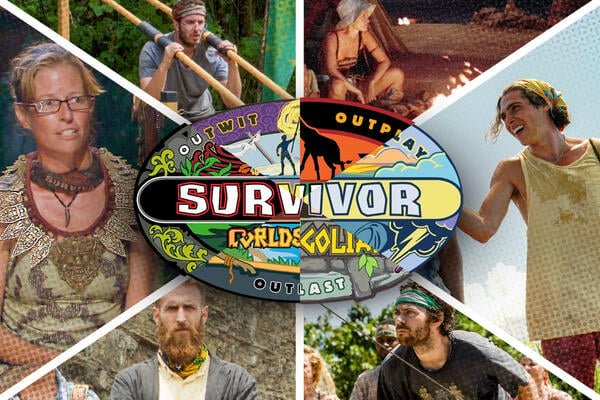
Eventually, those conversations inspired the curriculum for Dawson’s Survivor analysis course, The Tribe Has Spoken, named after the tag line Jeff Probst, the host, says every time a contestant is eliminated. Shortly afterward, word of the class reached the show’s producers, who eventually invited Dawson to play himself, first making him an alternate for Season 28, Survivor: Cagayan—Brawn vs. Brains vs. Beauty. Two seasons later, he became a contestant on Survivor: Worlds Apart, which separated tribes by class of work: white collar, blue collar and no collar.
Since the beginning, the show has resonated with academics, in part for its emphasis on characters who value strategy and drive, and in part because it operates as a sort of behavioral science lab.
“What creates the tie between Survivor and higher ed is the premise of the show—the idea of it being a social experiment,” Dawson said. “I do truly think that [Mark] Burnett, Probst and the producers of the show see the format as being this ideal lab through which to explore different social-cultural issues … It makes Survivor this thing that you can study, you can analyze.”
Academia as an Asset
In recent years, the overlap between higher education and Survivor’s weekly exploration of human behavior under duress has only grown. Since about season 26, when a self-deprecating, sweater vest–wearing law student went from being teased to a celebrated victor, contestants and fans alike have observed an increase in the number of brainiacs cast and the way they are portrayed. While academics were once playfully mocked, the show and its production team now appear to spotlight their wit, curiosity and introspection.
In addition to Dawson, who has since moved on to work in private research, the show has cast dozens of Ph.D. candidates, faculty members and campus administrators from across the country. Recent examples include Owen Knight, director of admission marketing at Tulane University from season 43, as well as Eva Erickson, a Ph.D. candidate in engineering at Brown University, and Shauhin Davari, an assistant professor of communication studies at Orange Coast College, from season 48.
The show has also cast many students enrolled in M.B.A., law and medical programs, in addition to now-scholars who left the corporate world after their season aired, including Kassandra McQuillen, from season 28, a former clean energy lawyer–turned–assistant professor at Texas Tech University, and Kelly Goldsmith, from season 3, a behavioral scientist and marketing professor at Vanderbilt University. And this isn’t just a trend within Survivor; other reality TV shows, including Love Is Blind, have also featured academics.
The current season—the show’s 50th, the finale of which will air tonight—features two university employees among the 24 returning players: Christian Hubicki, an associate professor at the Florida A&M University–Florida State University College of Engineering, and Rick Devens, director of communications at Middle Georgia State University. The two quickly became allies, often referring to themselves as Captain Kirk and Mr. Spock, and both noted that their experience in academia served as an advantage in the game.
“One thing that academia does is it forces you to reckon with the fact that there’s an entire frontier of knowledge that nobody knows and you really have to adapt in the academic environment, the different colleagues you work with, the competition for research funding. It’s not so different from being on the island,” Hubicki told Inside Higher Ed. “You have your own agenda, your own ideas, but you have to adapt to the people around you.”
Hubicki has also since used the show and growing popularity of brainiac characters to give back to STEM education, fundraising more than $30,000 for FIRST, a youth robotics nonprofit that helps students pursue their passions.

Christian Hubicki interacts with STEM students at a recent event held by the nonprofit FIRST.
Devens worked for years as a local broadcast journalist before shifting to higher ed. Now, as an administrator, he reaches every corner of his access-oriented campus in Macon, Ga. Like Hubicki, he calls that exposure an asset.

Rick Devens
Dominik Bindl/Getty Images
But the influence works in reverse, too, he said: The lessons Devens has learned on the show—where he is known as a “chaos agent,” operating at high speed and taking risks—benefit his work on campus.
“One thing I really discovered on the island is that even when things get tough and you don’t know what your next move is, if you take it on with a sense of joy, it really translates,” he said. “In higher ed you can use that … Most of the time, even though it can get stressful, you can sit back and think about the mission and just take in a lot of joy.”
Applying Lessons Learned
Devens is not the only academic who has applied the lessons learned on Survivor to campus life. Over the last decade, students, educators and even entrepreneurs have found creative ways to adapt the show’s social and rational sciences.
While sometimes that means student clubs running mock versions of the game, in other cases such gestures have become deeply tied to core learning outcomes.
For McQuillen at Texas Tech, that meant crossing over from her expertise in energy commerce to teach a sociology course, breaking down how the public perception of her no-nonsense, cutthroat character and other women like her has changed throughout the decade.
For Brian Mulholland, a longtime fan and an assistant teaching professor of math at Notre Dame University, it meant collaborating with Vanessa Chan-Devaere, an assistant teaching professor of psychology, to create a game theory and social cognitive neuroscience course called Outwit, Outplay, Outlast: The Dynamics of Survivor.

Students participate in a mock “Final Tribal” as a part of the class at Notre Dame.
Like Dawson’s class at Northwestern, the course does not instruct students on how to play the game. Rather, it uses the TV competition as a case study where theories from their respective fields—as well as ethics and theology—can be applied.
In his view, it’s all part of what more broadly unites higher education and the long-running TV show.
“Higher education is sometimes reduced to a credential that allows you to get a job. But I think the idea of a university is the pursuit of something higher. One of the main questions that university is supposed to ask is ‘What does it mean to be human?’ And Survivor mirrors that in some ways,” he said.
Mulholland has also brought former players into class to share how they’ve applied those insights to the real world. One of those guest speakers was Xander Hastings, second runner-up on Season 41. As a first-year behavioral economics student at the University of Chicago, Hastings knew the basics of game theory, psychology and decision-making when he played. For him, the learning experience was about narrative storytelling and how it influences the way individuals’ decisions are perceived.
Distraught by his loss, Hastings worried about how the public would view his performance. The show didn’t end up painting the scenario as a “hard fall from grace” the way he feared it might, he admitted, but he remained anxious. But an anthropology class he took, and the lessons it taught about subjective views of history, helped him work through it all.

Xander Hastings speaks with students about his experience on Survivor.
“I just loved recontextualizing all of history as being imperfect,” Hastings said. “I just found it to be really liberating. Throughout every facet of all of our lives, there will always be this dissonance between the way we see our life and events unfolding and the way that other people see it.”
Now, he’s using that awareness to develop an app tailored for prospective college students struggling to tell their story in the increasingly competitive college-application process. The soon-to-be-released product, called AdmitRaven, collects and synthesizes data and advice from hundreds of successful applicants to the nation’s most selective colleges, providing affordable application coaching for aspiring students.
“It was all born of my sister applying to college. I ended up helping her, and I think that everyone should have access to that,” he said. “Academia in and of itself is this interesting kind of game. It’s a lot more competitive than people realize.”
At the same time, that application process—just like Survivor—requires intense self-reflection.
“It’s part of what I think is so beautiful about the college-application process, and the Survivor casting process,” he said. “It’s a really rare opportunity that you get to reflect in that way. What other times in life do you get to stand on the shore of who I am and look out over the sea of who I could become, and communicate with someone about the essence of you?”
You may be interested

Common food item you should 'never' throw in your household bin, according to waste expert
new admin - Aug 17, 2026He has explained the reason and what to do instead Source link
The Heated Discourse About Civil Discourse
new admin - Aug 17, 2026[ad_1] Proponents of what’s often called civil discourse education are pushing to expand this teaching—and mandate it—across entire campuses. Earlier…
RFK Jr.’s quiet hunt for autism culprits stalls as Trump orders baseless changes to childhood shots
new admin - Aug 17, 2026President Trump has ordered a reduction in childhood vaccines — publicly faulting the shots for an increase in autism cases…