



IECA Leaders Discuss College Consulting in the AI Era

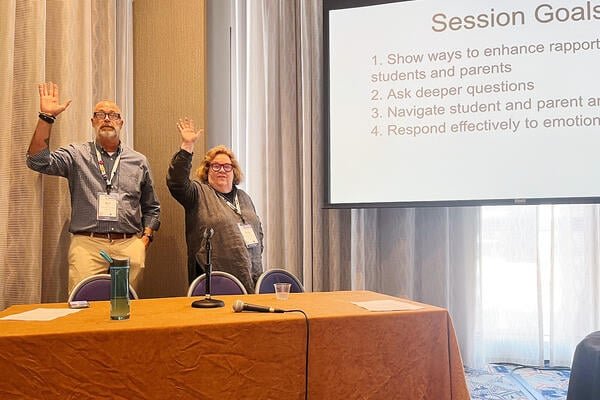
BALTIMORE—In the ever-changing world of admissions, what is the best way to support a student applying to college?
That’s the question hundreds of independent college counselors came together to ask during the Independent Educational Consultants Association’s 50th annual conference at the Hilton Baltimore Inner Harbor this week. The work of these counselors—or IECs, as they’re known in the industry—looks very different now than it did when the association formed in 1976, as institutions and students acclimate to the high cost of attendance, the rise of AI and an increasingly anxious student body. At the same time, the college consulting field is growing, Stephanie Simpson, who started as IECA’s CEO last December, told Inside Higher Ed. And it’s becoming more accessible and affordable to a wider range of students.
Simpson and Lisa Carlton, the association’s incoming president, who started her career as an IEC almost 20 years ago working with neurodivergent students, sat down with Inside Higher Ed at the Hilton to discuss what the work of IECs looks like today.
Q: How have you seen AI change the work of IECs over the past few years, from the IEC angle, the student angle and the institution angle?
Simpson: We just did a survey of our membership, and it came out just so loudly that it’s not only what IECs are most nervous about—how to ethically integrate into their own practices—but then also, how to support students in using it. We know that it far exceeds the next thing that they’re most worried about.
Carlton: I think that IECs, obviously, are using it in their businesses, because they’re all small business owners. With their students, I think people are still gently tapping their feet into it, I would say. For example, we had roundtables this morning, and this woman was explaining how she crafts prompts to help kids research colleges using AI. She’s being really careful about the prompt that she’s giving them, so that you know they’re not just getting the whole internet. There are certain populations [using it], in terms of essays—neurodiverse kids, it can help [them] ideate, potentially.
So, I think we’re moving from AI as this big horrible thing to now, sort of circling back to what Stephanie said: “How do we ethically use AI, knowing that kids are going to use it?” I would say that colleges are being pretty quiet about how they’re using it.
Q: What are you hearing about how students are using AI in the college search process, and are IECs concerned that students are going to be looking to AI more for where they want to go to school and maybe getting bad information?
Carlton: We have to kind of look at social media first—they’re looking at TikTok, they’re looking at YouTube, they’re looking at Facebook already, and they have been for years. We already had that going on. I think AI can be—it’s a consolidator, right? So, helping kids simplify the process, inviting it into the counseling conversation, is super helpful. And just like I would say, if a student showed me something on TikTok—“Well, what feels right to you about that? Would you be open to me sharing maybe some additional information that I know about this?” So I think it’s a jumping-off point, which can maybe help the kids, just like all these other things, help the students navigate what is a challenging process for them. Researching college is really hard for kids; they struggle with it. So, if something can make it a little easier for them, great.
Simpson: I think this is a real moment of value-add for IECs, because they are part of that relationship. The reviews [IECs get] aren’t “You got me into this school.” It’s “You made me feel good about the process, and you helped me learn about myself along the way.” I don’t think AI has replaced that.
Q: I’ve heard from some folks about trying to look at new ways to evaluate students in the admissions process, whether that’s a video essay or different ed-tech companies that are doing portfolios. How do you feel about some of these changes or attempts to progress the college admissions process?
Simpson: Well, first, I have a neurodivergent 15-year-old, and the idea of him doing a video essay terrifies me. So I do think we have to be aware of the limitations in terms of how that serves all students, but I’ll let Lisa talk to the trends.
Carlton: Well, I think—what are we trying to do with the essay? What’s a college trying to do with an essay? One is they’re trying to see if a student can write, right? But the other thing they’re really trying to do is get to know the human side of the student. Well, you can also do that in a video, so I think the videos, just like writing: Some kids are great at the videos, and some kids just freeze at the video. So, I think I’m kind of neutral on it. It’s another way to tell about yourself. There’s certain kids where I’m like, “I want you to do a video,” because I know they’re going to be so good—we’re going to win them on the video, right?
I think portfolios can be good. I do worry about access in some of these things, because not all students have a portfolio—they may be babysitting at home after school or working a job. So, I just think the process needs to stay equitable, and sometimes things like portfolios can lean a little bit more towards students who’ve had a lot of opportunity.
Q: There’s a perception that IECs are for very privileged students and only accessible to wealthy students, but it’s so interesting and exciting that, Lisa, you’re coming from a background of helping students with learning disabilities. Can you talk a little bit about how one, you’re tackling that perception of IECs, and also how your background influences how you’re going about that?
Carlton: Well, I think that most people who go into this work are not going into it to get rich; they go into it because they want to help students. Most of them work on their own, they’re carrying a small caseload. What other purchase that is now going to be close to, if you go to a private college, $400,000, would you not get a little help with? I think most of us work with a wide range of families, and I think that’s really important, that we are accessible, too. I’m really proud of the industry and the way that I think our members try to price it fairly.
Many people in this organization are working with kids who either have mental health challenges, learning challenges, who need a little extra help to make this launch successfully. And remember, the cost of an unsuccessful launch is very expensive. One of the things I often do is I’ll say, “I wonder if your student’s ready”—trying to save a family that money, like, “maybe we should do this before we do that.” So, I think having a professional set of eyes on it can hopefully help the family have a more successful outcome, which ultimately has a return on investment.
Simpson: Our industry data indicates that the majority of IEC clients are middle class and increasingly so, and a lot more [IECs are] offering hourly rates that are affordable to our families.
Q: We’ve talked a little bit about how the profession has changed and how the admissions process has changed. Is there anything you can share about how the students themselves have changed over the course of your career?
Carlton: One thousand percent. How long have we got? I would say that post-COVID, their families became more like a bigger part of their decision-making world, and their anxiety went way up. So, we have to now really take into account the mental health of a student, and it is not unusual to call a family and say, “I think we need to put this on pause for a minute,” or, “How can we lower the temperature?” Also [we do] more parent coaching: “No, you should only be talking about college no more than once a week,” you know? Like, helping them set some boundaries and rules, so that they can actually be happy and healthy at home.
And then social media. I can talk until my face is blue and they tell me what was on TikTok, you know what I’m saying? “But the TikTok person said …” My personal strategy is I don’t want to slam them down and go, “TikTok’s stupid.” I’m like, “Oh, tell me what you found out.”
I just think this has become so competitive that they just sort of gear up for it in a way that just kind of breaks my heart, and that wasn’t like that when I started.
You may be interested

Supermarket offers 75p 'fridge reset' in flash 24-hour deal – eggs and milk for 30p
new admin - Aug 17, 2026Shoppers have just hours to benefit from the promotion. Source link

How LGBTQ+ Leaders Are Navigating the Political Moment
new admin - Aug 17, 2026[ad_1] When the group LGBTQ Leaders in Higher Education started taking shape in the 2000s, it consisted of a handful…

'Best war film ever made' streaming now on Netflix
new admin - Aug 17, 2026One 2014 film, that's been called the 'best' war film ever, is now on Netflix Source link