


Dual-Enrollment Students Need More Support

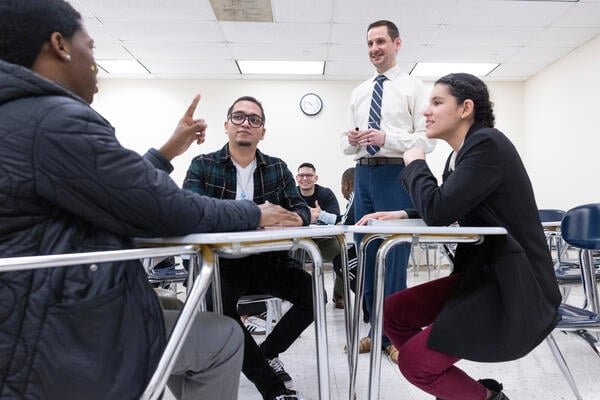
Dual enrollment—the practice of allowing high school students to also earn college credit—has become an increasingly common strategy for improving college and career pathways. But many students take courses that are not connected to a clear academic or workforce trajectory, and they often lack access to the advising needed to help guide their next steps.
To better understand those challenges, a qualitative study from Helios Education Foundation and Florida State University’s Center for Postsecondary Success examined how Florida students with advanced credits from dual enrollment and other accelerated pathways—such as Advanced Placement and International Baccalaureate—experience college once they arrive on campus.
The analysis included interviews with 89 students and six administrators from Florida Agricultural and Mechanical University, Florida State University, Florida International University and the University of South Florida during the summer 2024, fall 2024 and spring 2025 semesters.
The study found that most students felt academically prepared for college, with some saying their college coursework felt easier than classes they had taken in high school. And it showed that accelerated pathways helped reduce college costs and shorten the time to a degree. But the findings also pointed to a need for stronger alignment, advising and institutional support to help students fully benefit from the college experience.
Toby Park-Gaghan, professor and associate dean for academic affairs at Florida State, said existing outcomes data captures only part of how accelerated students experience the transition to college.
“It’s not enough to just dump these students onto a four-year campus and expect them to be successful because they have been already,” Park-Gaghan said. “We had some students tell us that by the time they got to college-level coursework, it felt super easy because they were already used to accelerated coursework. Other students said, ‘Wow, the pace was a whole lot more than I expected.’”
Key findings: During the 2024–25 academic year, 72.5 percent of Florida high school graduates participated in at least one accelerated pathway, up from 63.2 percent four years earlier—an increase of nearly 30,000 students statewide, according to the analysis.
About 30 percent participated specifically in dual enrollment, underscoring that students entering college with advanced credits are no longer the exception, but increasingly common among the population arriving on Florida campuses.
Paul Perrault, senior vice president of community impact and learning at Helios Education Foundation, said colleges need more targeted advising and transition support as accelerated pathways continue to expand.
“College students, the makeup of them, is changing across the board,” Perrault said. “That kind of focus—those three high-level supports of structured advising models, graduation planning initiatives and transition-focused supports—are really going to help target the support that those students need when they come to the university.”
The study results reinforce that need. They show that advisers were often unprepared to support students, particularly those who arrived academically advanced but developmentally still early in their college careers. Researchers also found that compressed timelines could come at a cost, leaving students with less time for internships and other experiences that help shape career pathways.
“They needed more intentional advising, transitional support and clear academic planning, even though these students are really good at schoolwork,” Perrault said. “How they navigate that system is the thing that really started to emerge when we looked at the data.”
Park-Gaghan pointed to Florida State’s Degree in Three and More in Four initiatives, which offer structured pathways, specialized advising, priority registration and career and graduate school preparation.
“They’re a very different population, and they may need more support around soft skills and questions like, ‘What do you want to do next?’” Park-Gaghan said.
Why this matters: The study found that many accelerated students successfully developed social networks through clubs, informal interactions and living on campus. But some faced challenges related to pressure from accelerated academic timelines.
“A lot of the pressure sometimes comes from parents who have both put the pressure on their students, and students have internalized it from either a financial or a time standpoint,” Park-Gaghan said.
“I do think there’s an internalized pressure that some of these students feel from various sources that their goal is to get out in two years,” he added. “There’s nothing wrong with that if that’s what they want to do, but some students identified that as a challenge when trying to balance developmental experiences while also finishing so quickly.”
Perrault said institutions nationwide will increasingly face similar questions as accelerated pathways continue to grow.
“That’s the trade-off universities and colleges are going to have to think about,” Perrault said. “These are questions we have to answer as more and more students take these courses—not just in Florida, but in Arizona, California and Michigan. Institutions are going to run into the same questions on how we can make sure we better serve these students.”
Get more content like this directly to your inbox. Subscribe here.
You may be interested

Common food item you should 'never' throw in your household bin, according to waste expert
new admin - Aug 17, 2026He has explained the reason and what to do instead Source link

The Heated Discourse About Civil Discourse
new admin - Aug 17, 2026[ad_1] Proponents of what’s often called civil discourse education are pushing to expand this teaching—and mandate it—across entire campuses. Earlier…

RFK Jr.’s quiet hunt for autism culprits stalls as Trump orders baseless changes to childhood shots
new admin - Aug 17, 2026President Trump has ordered a reduction in childhood vaccines — publicly faulting the shots for an increase in autism cases…