


What One Year of “The Public Scholar” Taught Me

A year ago, I started this column on the premise that the public wants what scholars know and scholars want to share it, but a gap exists between the two. So I asked op-ed editors, literary agents, book editors and scholars who’ve done this work well about how to close that divide. I thought I’d collect a grab bag of tips, and I did. But I also found that breaking through takes two things, and a lot of advice offers only one.
One half of breaking through concerns practicalities. This is a solvable information problem, as many gatekeepers publish clear pitch guidelines about what an op-ed or book proposal must accomplish. Some promising public scholarship sits unwritten because academics forget to look up how to open the gate.
The other half is less concrete. Historian Heather Cox Richardson, author of the Letters From an American newsletter, suggested that scholars need to remember how to teach an audience that has no obligation to keep listening. The idea resonated for me, as I still test my drafts by summoning my decade of teaching, especially those students who did not tolerate poor exposition or boredom. One former student, Michael, never hesitated to blurt out, “Professor, you’re not making any sense!” Another, Jennifer, who was more reticent, showed on her face how much or little she understood. They wanted to understand and feel wonder, like another student, Suman, who could not conceal his delight the day he worked through a rigorous proof that 1 + 1 = 2. So, before submitting my drafts today, I ask, Would Michael have spoken up? Would Jennifer have looked confused? Would Suman have grinned? Then, I revise accordingly.
A scholar who does not summon their teaching instinct when writing for the public risks producing a technically correct story that few readers finish. One who does not understand the submission process will not hear back from editors. Over a year, this column has argued that those who want to write for the public need both at once. Here’s a recap, organized by what you might need.
Before You Write
We sometimes tell ourselves that someone more credentialed or more eloquent should go first. “Don’t Wait for Permission to Write for the Public” helps set that doubt aside.
And because the work needs fuel, “32 Residencies to Fuel Your Writing Dreams” points to places, many of them free, where scholars can find the time that writing for the public demands.
On Craft, by the Gatekeepers
Two pieces take apart the op-ed itself: “What Makes a Great Op-Ed? A Los Angeles Times Editor Explains” unpacks how opinion editor Philip Gray makes decisions, and “How Op-Eds Play the Long Game of Persuasion” explains how opinion pieces change minds, even in a polarized landscape.
In “What Makes a Great Book Proposal? A Literary Agent Explains,” agent Kayla Lightener lays out what a proposal must accomplish, and “3 University Press Editors, 6 Publishing Questions” gathers candid answers from three editors making decisions about which books reach readers: Daniel Taber-Hewett at Oxford University Press, Diana Gillooly at Princeton University Press and Andrew Kinney at UNC Press.
In “Why I Signed With the Literary Agent Who Didn’t Want My Book,” I discuss my experience working with my agent, Marissa Koors at Curious Minds, who challenged my vision for my manuscript.
On Teaching Instinct, From Public Scholars Themselves
Historian David Perry, in “Don’t Let Trolls Keep You Off the Op-Ed Page,” shares how “drafting an op-ed can feel a lot like teaching an 8:30 a.m. Monday class.” Perry argues that op-eds offer more control than classroom teaching, where a student may share or misrepresent your lessons.
In “How One Scholar Is Fighting for Democracy On and Off Campus,” political scientist Jonathan Becker models civic engagement for his students: “If we take ourselves seriously as educators, and if the link between education and democracy is meaningful, then it is incumbent upon us to act.” Becker has since published an op-ed in The New York Times: “What Does the Trump Administration Have Against the 26th Amendment?”
Scholars across disciplines—economics, literature, law, science and more—model how to direct their teaching skills toward public spaces in “Trump Seeks to Silence Critics. These Scholars Are Pushing Back.” In doing so, they offer nuance on consequential topics in fraught times.
Many of these scholars report that writing for the public rekindles what initially drew them their disciplines.
A Final Word From a Popular Public Scholar
In “Heather Cox Richardson Hears the Public Scholar Music,” the well-known history professor, who reaches more than three million newsletter subscribers, told me that “the conceit of the entire project is that we, as human beings in the world in 2026, are all part of a conversation trying to ascertain what’s happening around us.” That is as good a description of public scholarship as I’ve found.
If you’re somewhere in the two-part process—seeing public scholarship as teaching and learning how to break through—I’d like to hear about it. To stay in the conversation, sign up for the Public Scholar newsletter, sent on the first Monday of each month. You’ll get word of each new article in the column, plus behind-the-scenes writing tips and news of other academics finding their voices in public spaces. Your expertise is hard-won. What might happen if you shared it more widely?
Sign up for the Public Scholar newsletter, sent once each month, for news of upcoming stories and more public scholarship insights.
You may be interested
New York AG Slams St. John’s Suit
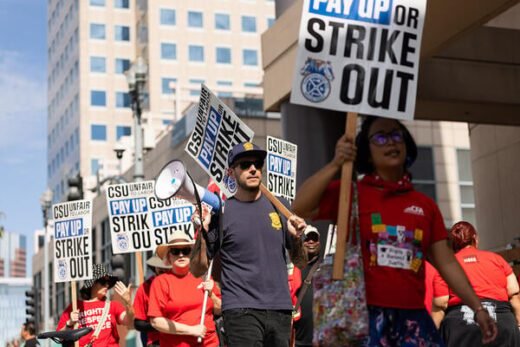
new admin - Sep 02, 2026[ad_1] CSU Teamsters rallied over the summer for contractually promised raises. Arwen Clemans/Los Angeles Times/Getty Images Skilled workers’ unions in…

America’s data center future is Loudoun County’s past
new admin - Sep 02, 2026InIn 2007, the US was on the cusp of an economic recession, and Buddy Rizer was tasked with finding Loudoun…
9/1: The Takeout with Major Garrett
new admin - Sep 02, 20269/1: The Takeout with Major Garrett - CBS News Watch CBS News Lindsay Clancy jury unable to reach unanimous decision…