

New York AG Slams St. John’s Suit

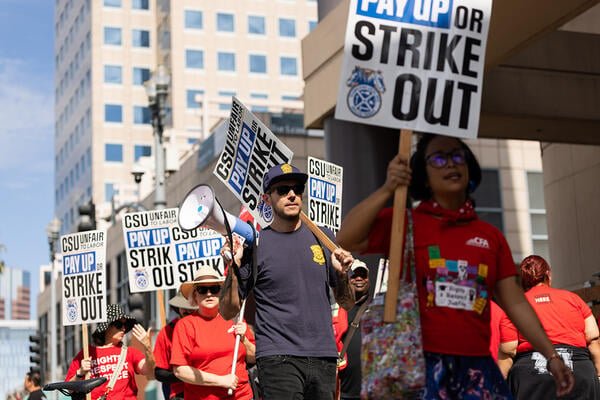
CSU Teamsters rallied over the summer for contractually promised raises.
Arwen Clemans/Los Angeles Times/Getty Images
Skilled workers’ unions in the California State University system spent the summer reminding administrators that they won’t go down without a fight. Teamsters’ unions at Cal State Long Beach and Cal State LA held rallies in August as part of statewide demonstrations during student move-in, convocation and welcome-week events.

Photo illustration by Justin Morrison/Inside Higher Ed
The unions continue to demand the system fund contractually promised raises that they say should have been granted in July 2025. Of all CSU employees, only campus presidents and senior executives received raises in 2025, according to CSU Teamsters, which represents 27,000 workers.
“At Cal State LA, Teamsters rallied and picketed with a coalition of unions to demand CSU pay workers the raises it promised them,” a union spokesperson wrote in a news release. “Meanwhile, members at Cal State Long Beach brought their demands to President Blanchard’s convocation address, disrupting the event with chants of ‘What do we want? A fair contract! When do we want it? Now!’”
As students return to campus and the academic year roars to life, faculty unions are pushing to wrap up ongoing bargaining efforts or turn up the heat on contract fights they left last spring. In this edition of Inside Higher Ed’s Labor Watch, several institutions enter mediation over contract renewals, Hofstra University’s faculty union narrowly averts a strike and Auburn University faculty plan to protest an upcoming Board of Trustees meeting.
WHO YOU GONNA CALL? THE MEDIATOR: Seven months into bargaining for their next contract, the University of Illinois Chicago’s faculty union asked university management for mediation, to which management agreed, UIC United Faculty announced in a news release. The union’s previous contract expired Aug. 15 and the two parties remain “far apart” on most issues, including faculty compensation, non-tenure-track job security and transparency in policy and decision-making related to AI, according to the union.
“We have taken steps intended as gestures of good will and investment in the bargaining process,” Charitianne Williams, co-chair of the bargaining committee, said in the release. “All this was ignored, and management has actively taken steps to prolong this process. From our perspective, no progress has been made this cycle.”
At the University of Oregon, it was university representatives who sought state mediation after bargaining for about six months. The graduate employees’ union accuses management of “repeatedly utiliz[ing] stall tactics—by coming to several sessions with nothing prepared—and propos[ing] status quo language to prevent any significant movement toward a new contract,” according to a union news release.
University management’s most recent salary proposal did not include raises over the next five years, and university officials haven’t responded to proposals related to protection of noncitizen graduate employees, workplace safety and academic freedom, the union said.
On the university’s bargaining updates website, officials called mediation a “normal phase of the bargaining process” and noted it’s “common for parties to reach agreement during mediation.” The first session with the state mediator will be Sept. 16.
STRIKE AVERTED: After professors threatened to walk off the job on the first day of classes, Hofstra University and its faculty union reached an agreement to extend the existing contract through Sept. 4, News 12 Long Island reported. As a result, faculty members nixed the planned Sept. 1 strike. The union expects to finalize details of the new contract before the new deadline.
“We have made meaningful progress on several major issues, and we believe continuing negotiations this week provides the best path toward reaching a fair agreement,” Anthony Basile, president of the Hofstra chapter of the American Association of University Professors, told News 12. “Our faculty members have demonstrated tremendous solidarity throughout this process, and our focus remains on securing a contract that supports our faculty, our students and the continued strength of Hofstra University.”
DEFENDING SHARED GOVERNANCE: Auburn University’s wall-to-wall labor union plans to hold a “visibility event” outside the Sept. 11 Board of Trustees meeting. In June, the board gave itself complete control over the curriculum at Auburn and dissolved its Faculty Senate, fulfilling requirements for public institutions in the recently passed Alabama House Bill 580 (though Auburn is exempt from the law). At the time, faculty members said the changes signaled the end of shared governance at the public university.
The event will “communicate how the recent changes made by the Board of Trustees to our university negatively affect our students and the future of the institution. Stripped of a representative body, faculty have not had the means to express widespread concern,” the United Campus Workers of Alabama Auburn chapter wrote in a news release. “On the morning of the Board of Trustees’ meeting, we will stand for shared governance and the value of faculty expertise. Mandated courses? Disbanded University Senate? A fearful campus? Together we will pose the question: IS THIS AUBURN?”
NY AG to SJU: BACK OFF: The New York attorney general has asked a federal court to dismiss the lawsuit brought by St. John’s University against the attorney general’s office, arguing the court must stay out of the case while it’s still pending before the New York Public Employment Relations Board.
St. John’s withdrew recognition of its two 56-year-old faculty unions in February; at the time, President Brian Shanley argued, “The university does not have the flexibility required to fulfill its Catholic-centered mission while its core academic decisions are entangled in a collective bargaining relationship.” The unions subsequently filed unfair labor practice charges against the university, and the university responded by suing the employment relations board and asking the court to block the board from processing the charges.
The attorney general’s office filed its response to the lawsuit earlier this month. In it, the office argues that precedent dictates the federal court must stay out of ongoing Employment Relations Board proceedings and that the university’s fear of harm is hypothetical.
“The university attempts to get the best of both worlds: holding itself out as a global, dynamic, and prestigious educational institution in order to attract top academic talent and further economic growth, while simultaneously portraying itself to this court as an insular institution of intensive theological practice,” the attorney general’s office wrote in the motion to dismiss. “But the university cannot have it both ways.”
You may be interested

America’s data center future is Loudoun County’s past
new admin - Sep 02, 2026InIn 2007, the US was on the cusp of an economic recession, and Buddy Rizer was tasked with finding Loudoun…

What One Year of “The Public Scholar” Taught Me
new admin - Sep 02, 2026[ad_1] A year ago, I started this column on the premise that the public wants what scholars know and scholars…

9/1: The Takeout with Major Garrett
new admin - Sep 02, 20269/1: The Takeout with Major Garrett - CBS News Watch CBS News Lindsay Clancy jury unable to reach unanimous decision…