

Taiwan welcomes idea of Trump talking to its president, which would be a major break in protocol

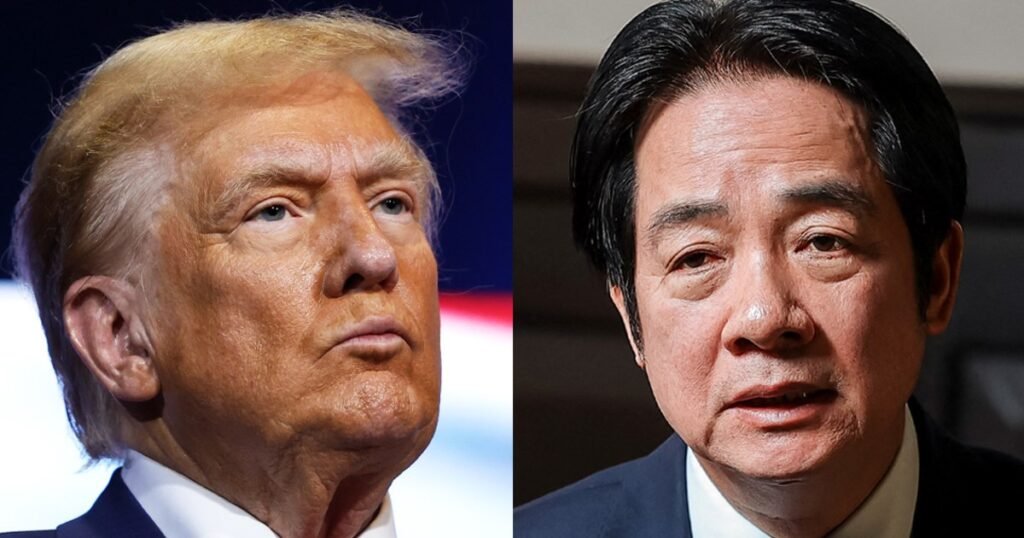
HONG KONG — Taiwan President Lai Ching-te would be “happy” to speak with President Donald Trump, the Beijing-claimed island’s foreign ministry said Thursday, after Trump suggested the two leaders might talk in what would be a major break in U.S. presidential protocol and likely antagonize China.
Subscribe to read this story ad-free
Get unlimited access to ad-free articles and exclusive content.

It is not clear whether there are any concrete plans for a call between Trump and Lai, but Trump has said twice in the past week that he would like to have one.
“I’ll speak to him. I speak to everybody,” he told reporters Wednesday.
Trump made the comments after a two-day state visit last week to China, where Taiwan was a central topic of discussion between Trump and Chinese leader Xi Jinping.
00:59
Trump says he and Xi talked “a lot” about Taiwan
00:0000:00
No U.S. president has spoken directly with the president of Taiwan since the U.S. and China established diplomatic relations in 1979. Like most countries, the United States has no formal relations with Taiwan, a self-ruling democracy about 100 miles from China, but it is the island’s most important international backer and arms supplier.
China, which has not ruled out the use of force against Taiwan, opposes U.S. arms sales to the island. Xi warned Trump at their summit last week that U.S.-China disagreements over Taiwan could lead to “clashes and even conflicts” if the issue is not handled carefully.
Though Trump says U.S. policy on Taiwan is not changing, he has alarmed Taiwan supporters in recent days by saying he is undecided on a pending $14 billion U.S. arms sale to the island, which he called a “very good negotiating chip” with China. U.S. policy has long prohibited discussing Taiwan arms sales with Beijing.
China has also been pressing the U.S. to change its stance on Taiwan’s sovereignty from “not supporting” independence to outright “opposing” it. Though Trump has not used this language, he said after the summit that he wanted both China and Taiwan to “cool down” and that he was “not looking to have somebody go independent.”
Lai thus now faces pressure from both China, which calls him a “separatist” and “troublemaker,” and the U.S.

During a speech Wednesday on the second anniversary of his inauguration, Lai said that Taiwan’s future can be decided only by its 23 million people, not by “external forces.” He said Taiwan was open to negotiations with China but not if they “package unification as peace.”
At a news conference afterward, he said that if given the opportunity, he would tell Trump that it is China, not Taiwan, that is undermining peace and stability in the region. He also said U.S. arms sales should continue as a “necessary means to maintain peace and stability across the Taiwan Strait.”
Lai added that his government was “committed to maintaining the status quo” and that “no country has the right to annex Taiwan.”
Taiwan has been under growing military pressure from China, which sends warplanes and naval vessels toward the island almost daily. On Thursday, the Taiwan Ministry of National Defense said it had detected seven Chinese warplanes, seven Chinese naval vessels and one “official ship” operating around Taiwan in the previous 24 hours.
In a statement on Thursday, the Taiwan foreign ministry reiterated Lai’s comments, adding that he “is also happy to discuss these matters with President Trump.”
Asked about a potential Trump-Lai call on Thursday, the Chinese foreign ministry said Beijing opposes any official exchanges between the U.S. and Taiwan and urged the U.S. to handle the Taiwan issue with “utmost prudence.”

This would not be Trump’s first conversation with a Taiwanese leader. In 2016, after he won the U.S. presidential election but before he took office, he spoke on the phone with Tsai Ing-wen, the island’s president at the time, shocking officials in both the U.S. and China.
While Taiwan has long sought such conversations as a sign of the normalization of ties with the U.S., “this is not that kind of talk,” said Lev Nachman, a professor of political science at National Taiwan University in Taipei.
Nachman said that Trump appeared to have taken on Xi’s framing of Taiwan and its leadership since leaving Beijing, talking about Taiwan as “a problem that needs to be solved.”
As a result, Lai would be speaking with Trump in a “position of weakness,” he said, having to “try to convince Donald Trump to still sell weapons of defensive character to Taiwan.”
With Trump potentially viewing Taiwan as an obstacle to getting the deal he wants with China, the likelihood of a call with Lai ending badly for Taiwan “is relatively high,” Nachman said.
Nachman said the call was unlikely to happen, however, especially when Trump is striving to maintain stability in relations with Beijing ahead of a U.S. visit by Xi in the fall.
“I can’t imagine they would be particularly thrilled about him speaking to Lai,” he said.
You may be interested

Scientists propose model to protect Earth from solar storms
new admin - Jul 22, 2026If a massive solar storm capable of wiping out power grids across the U.S. was headed toward Earth, could there…
U.S. launches strikes on Iran for 11th consecutive night
new admin - Jul 22, 2026The U.S. launched an 11th consecutive night of strikes against Iran on Tuesday. CBS News' Weijia Jiang reports on Defense…

What false positive cyclospora test means for outbreak, according to former FDA medical officer
new admin - Jul 22, 2026The FDA is still hunting for the source of the cyclosporiasis outbreak after earlier test results proved to be a…