

New Handbook on Writing as a Public Scholar

Over my years of writing in this space and others, proper academics would ask me for advice about how to move beyond their specialty audiences and into the broader realm of writing for the public.
I would be as helpful as I knew how, but mostly my advice boiled down to “Just write stuff and then write more stuff until someone affirmatively tells you to keep writing stuff.” It worked for me, but it is not a great program in terms of actionable advice.
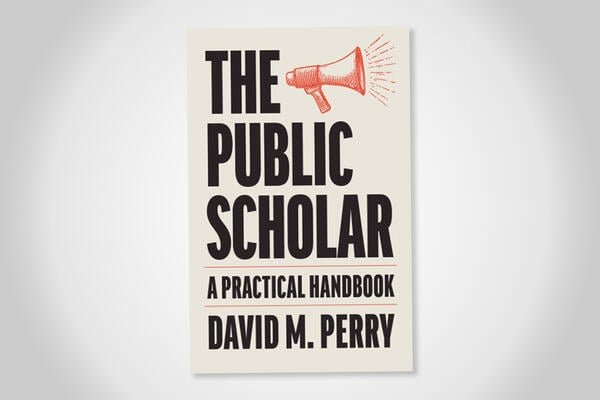
Fortunately, I now have a place to send people: David Perry’s The Public Scholar: A Practical Handbook, a book filled with the wisdom of experience and useful advice for making the transition from academic to general audiences with your writing.
I wanted to talk to David about not just the book, but the journey to writing and publishing the book, a journey that maps what it takes to become a public scholar.
David M. Perry is the associate director of undergraduate studies in history at the University of Minnesota–Twin Cities. He is the author of Sacred Plunder: Venice and the Aftermath of the Fourth Crusade and a co-author of The Bright Ages: A New History of Medieval Europe and Oathbreakers: The War of Brothers That Shattered an Empire and Made Medieval Europe.
JW: I’ve long believed that it’s important for people with academic expertise to write for the public—and I’m not talking about places like IHE or The Chronicle, but human beings in the world. I don’t know that I would say it’s necessarily a responsibility, but it is at least an opportunity available to just about anyone. What’s your pitch for being an academic who writes for the public?
DP: I do think it’s fundamentally a social good for experts to find whatever ways they can into public discourse, but I also think that argument has been made repeatedly and made by smarter and more successful and more institutionally powerful folks than I am, so I want to set that aside (in my book, it’s set aside to the last two or three pages. Spoiler alert, I guess!).
Here are two reasons: First, there are these moments when our expertise connects to the news, either explicitly or implicitly, but people are getting it wrong, missing context, misunderstanding evidence, etc. In those moments, it’s extremely possible, often satisfying and sometimes genuinely important for us to try and bring our expertise to the broadest possible audiences.
Second: Grad school teaches us to narrow (usually appropriately) our idea of who we are and what we do. But we remain whole people. We tell our students that the training we provide isn’t about the content, but habits of mind to enable lifelong learning. It’s true! And public writing is a space where we can put that into practice, working outside our narrowly construed disciplinary and subject-area boundaries. For me, that was having a son with Down syndrome, getting in pretty deep on Medicaid and education policy, and wanting to explain to people why it matters. But I’ve worked with academics who wanted to write about family history, travel, art, teaching—really anything.
Q: This is structured as a “handbook,” which is a guide or set of instructions, but it’s also a bit of a mini biography about you becoming a public writer. This is the story of your experience. I’m wondering how you look at this process, big picture, now having written the book and having a chance to reflect on all of it.
A: Taking pleasure in writing is something that came to me very late. I’m dyslexic. All my report cards and permanent records and the like say some iteration of “bright but lazy.” I’ve told all the stories in the book many times, but to write them down, organize them, try to really think through processes and systems, ultimately made me feel really lucky. I’m hoping that the book will show what a path for others could look like.
Q: As I say in the intro, I sometimes get people asking me for advice about breaking into public writing, but because I started as a public writer who moved into writing about education and policy, I don’t always appreciate the barriers they’re facing in terms of experience, skills, psychologically, etc. … What are the things that you see getting in the way of people fulfilling these nascent desires?
A: Two things—
The focus on the speed of a news cycle often freaks people out, and it’s true that writing quickly can be vital. But if there’s something you care about, something that you think is important, you can write about that any time and just hold until the news comes around again. It will.
Second, and this is more technical, experts often pitch themselves to mass media as experts ready to present commentary. That’s fine in a pitch to a journalist reporting on a topic, but essays are sold through arguments. It’s not enough to just say, “This is interesting” or “I know a lot about …” And of course that’s something familiar to any of us who teach undergraduate writing and try to help students understand the role of the thesis.
Third, people get scared of the constraints, but I see constraints as a gift to a writer. They take certain choices off the table, clarifying the choices that remain. Maybe this is me as a dyslexic writer talking, but I love working within the constraints of limited word choice, accessible vocabulary, only room for a few points of evidence, the need to lure readers into your piece with compelling opening prose, etc.
Q: I think that institutions will benefit if more of their faculty are writing publicly, but this kind of writing is not necessarily valued inside institutions. I remember filling out a faculty activity report one year where my weekly column at the Chicago Tribune carried the same institutional weight as a single short story published in a literary journal. (Not that either mattered—I was contingent faculty.) What are some things that institutions should do if they want to incentivize their faculty to write publicly?
A: One answer is—count it! There are a lot of good models to find meaningful ways to count public-facing work, and while they vary by discipline, institutions should begin an intentional process (sorry, I might sound like a higher ed consultant here) to craft standards that reflect their values. But then they have to live by them. For me, I like to see sustained public engagement (like your column) as a major component of a scholarly portfolio, with models explicitly spelled out in tenure and promotion standards. Instead, we mostly get vague statements about public-facing work being important, sometimes siloed into service, but not really counted. Until there are cases where the public work is load-bearing, at least to some extent, we’re stuck.
But the emphasis on counting assumes a faculty labor market that doesn’t really exist in most fields and, with the gutting of American STEM, is collapsing in new ones. So my arguments are more pragmatic—have communications teams that know how to both share work and protect authors from blowback, resist bad-faith attacks from outside (bad-faith attacks from inside are a different problem), and generally push to shift norms so public work is understood as core to our mission, especially at public universities.
Q: I think we both share a core belief that writers should get paid for their writing. You have advice on this in the book, but what should academics moving into writing publicly expect and be willing to ask for/demand for their writing?
A: One of my theories is that academics don’t talk enough about money, about making a living, paying bills. I did a lot of writing early on because I needed a little more income to cover two kids in childcare. Writing is work. Work should be compensated. A typical short public essay pays $100–$400, and that’s been stable for a decade (while inflation has, you know, not been stable).
The good news is that most outlets are much more transparent, and, when a piece is accepted, the editor tells you their rate. Some folks in the op-ed space argue for negotiation, but for me that’s something that happens down the road rather than on the first sale; for me, the rate is usually the rate. But if you aren’t offered a fee, that’s also the moment you should ask. I write an occasional free piece, and it’s fine if others do, too, but you should always ask.
Frankly, I think this is also true for academic journal articles, too.
Q: To close, I wonder if it might be a good idea to talk about the similarities and differences in the nature of rejection between public writing and academia. It’s not like academia isn’t without rejection, but I wonder if there’s a difference between the stakes or occasions for risking rejection in these different contexts. What’s your advice?
A: Get used to it! I often say that anyone who has made it anywhere in academia has to learn to handle rejection, but yes, it happens at a speed and scale with short-form public writing that’s totally different (as opposed to trade books, feature writing, etc.). This isn’t bad news. A fast no can be as useful as a yes, because it allows you to quickly seek other venues. An editor who turns down your pitches repeatedly is likely not doing anything personal, and I’ve certainly had editors encourage me to keep pitching even if they’ve declined everything for months. Also, a couple rejections on a piece is often a sign that it’s not a good piece, not quite right for the moment, not structured in a way that’s persuasive.
Basically, as opposed to academic writing, where one might work for months or years without clear signals about reception, public writing exists in a framework with constant, sometimes conflicting, signals about what’s working and what’s not. Over time, I think I became pretty good at reading the signals and figuring out if I needed to change what I was doing or somehow change the context in which I was doing it.
You may be interested
Resident Evil movie trailer wins over fans with nods to classic games | Gaming | Entertainment
new admin - Jul 24, 2026Resident Evil fans have been let down plenty of times in the past by films based on the horror franchise.…

Boox is taking on Xteink with its own tiny e-reader
new admin - Jul 24, 2026Boox’s new Tile lineup will take on Xteink’s popular e-readers that are small enough to stick on the back of…

Easy Ways to Create a Luxurious Wedding for Less
new admin - Jul 24, 2026[ad_1] IE 11 is not supported. For an optimal experience visit our site on another browser.Now PlayingHow to Cut Wedding…