

Loyola, UC Workers to Strike While Harvard Fights Continue

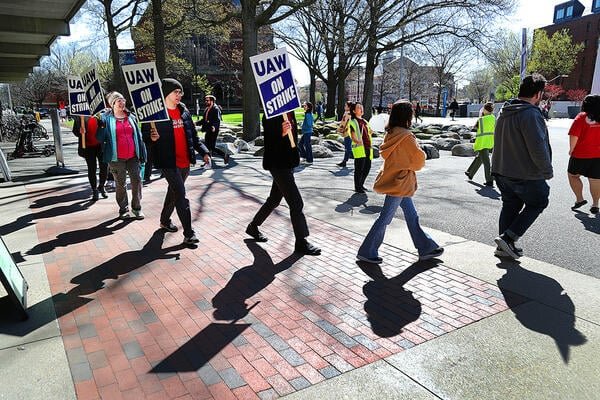
It’s May Day and faculty, staff and graduate student workers across the sector are turning out in support of their unions. Here’s just a taste of what higher ed unions have planned for International Workers’ Day:
- Non-tenure-track faculty with Tulane Workers United will hold a press conference to provide an update on contract negotiations before joining striking nurses and immigration activists on a march to New Orleans city hall.

Photo illustration by Justin Morrison/Inside Higher Ed
- St. John’s University’s two faculty unions will rally today to “push back on the anti-worker actions of the administration,” according to a news release. The event is part of an ongoing fight to regain the recognition that St. John’s president Brian Shanley withdrew in February. The union has filed an unfair labor practice charge with the New York State Public Employment Relations Board.
- The Portland State University American Association of University Professors will rally today, 11 days after voting no confidence in PSU president Ann Cudd. The vote delivered a “clear judgment on the administration’s direction as Portland State moves deeper into layoffs, program eliminations, and institutional contraction,” the union wrote in a news release.
The rallies, marches and festivities cap off another busy month for labor news: Harvard University graduate students kicked off a strike, the University of Illinois Springfield United Faculty ended theirs and the Maryland Legislature advanced a bill that would expand collective bargaining rights at state institutions. Read on for more in this edition of Labor Watch, Inside Higher Ed’s monthly roundup of labor news in higher education.
STRIKE ALERT: Faculty Forward LUC Union, which represents non-tenure-track faculty at Loyola University Chicago, is on strike as of May 1, the second-to-last day of finals week at the Jesuit university. The union has been bargaining with university officials for a year and a half and is asking for minimum 5 percent raises for all members, paid parental leave for part-time faculty and consideration of a course release in cases of “extraordinary amounts of service.” At the most recent bargaining session on Tuesday, university officials “refused to engage with” the union’s proposals, according to a bargaining update posted on the union’s website.
In statement, a university spokesperson said that officials remain “fully committed to bargaining in good faith to reach a fair and sustainable agreement that supports our faculty, our students, and the long-term strength of the University, while also maintaining the longstanding principle of parity across faculty and staff.”
The union that represents more than 42,000 University of California service and patient care technical workers voted to strike beginning May 14 after filing two unfair labor practice charges against the UC system. The charges allege that the University of California asserted “unlawful imposition of healthcare increases and other unlawful terms,” and that officials refused to bargain over housing benefits. In a statement, system officials wrote they are “disappointed” about the decision to strike and remain “focused on reaching an agreement that delivers real, immediate benefits for employees and is sustainable over the long term.”
Meanwhile, Harvard graduate student workers entered the 11th day of their strike on Friday. The bargaining committee met with university officials earlier this week, but the administration’s proposals fell “far short of enabling graduate student workers to afford basic living expenses including rent, healthcare, childcare, and emergency costs,” a union spokesperson wrote in a bargaining update. The university offered a 1 percent wage increase for fiscal year 2027; the union is asking for annual raises of at least 5 percent.
The strike will continue until “the university agrees to a contract that provides graduate student workers with the wages, benefits, and protections they need to live and work sustainably,” the spokesperson wrote. The next scheduled bargaining session is May 14, two days before final exams end.
AND A STRIKE SUSPENDED: On April 20, the University of Illinois Springfield United Faculty, which represents tenured and tenure-track faculty, suspended its strike after 11 days. The union said it reached a tentative agreement with the university but did not frame it as a victory.
“Our bargaining team made the difficult decision to suspend this strike because we do not want our students to lose further instructional time as they head into final exams and graduation,” Dathan Powell, an art, music and theater professor and president of the union, said in a news release.
Union members voted to ratify the contract Wednesday. Details about what’s in the final agreement are still forthcoming.
ON ANOTHER HARVARD LABOR FRONT: Harvard Academic Workers, the union that represents non-tenure-track teachers and researchers, filed an unfair labor practice charge against the administration after officials increased the class size of two first-year writing courses. The union considers the move to be “unilateral changes in working conditions while bargaining” and says it’s the result of an ongoing hiring freeze, hard term limits on academic appointments and “austerity budgeting.”
University spokespeople did not respond to a request for comment on the charge.
NORTHEAST UNIONS UNITE: More than 120 faculty and staff unions at campuses in the nine Northeast states have signed on to the Amherst Compact, a higher education bargaining platform developed by the Northeast Regional Bargaining Conference and backed by the United University Professions that is intended to “guide coordinated collective bargaining.” Signatories commit to bargaining around eight “core areas,” including fair compensation, paid leave rights and protections, and academic freedom.
“We believe it is time for a regional bargaining strategy to leverage the power of workers across job categories and institutions to raise the standards of work, learning, research, care, and the integrity of educational programs in our higher ed and academic medical systems,” the compact reads.
In interviews with The Chronicle of Higher Education, legal experts that have represented colleges in collective bargaining expressed skepticism that the compact will make much of a difference for its signatories. Brian Selchick, a partner at Cullen and Dykman, pointed out that priorities for such a diverse set of workers may not always align. Joseph Ambash, a partner with Fisher Phillips, said that the compact’s core areas are “all the things that the unions are bargaining about anyway.”
MORE FOR MARYLAND: A Maryland bill that would expand bargaining rights to non-tenure-track faculty at Maryland’s four-year public institutions passed the Legislature last month and is awaiting approval from Gov. Wes Moore. It follows a law in 2021 that expanded bargaining rights to community college faculty in the state.
“For years, I have heard from faculty who have been showing up for their students while barely keeping their heads above water and without a seat at the table,” Kenya Campbell, president of the American Federation of Teachers Maryland, said in a news release. “We have seen the transformative impact of collective bargaining for community college faculty who have won historic union contracts, and we know we will see that same transformation for these thousands of university faculty in the state.”
MIT GRAD STUDENTS BEGIN CONTRACT FIGHT: Graduate student workers with United Electrical Workers Local 256 at the Massachusetts Institute of Technology held a rally on April 24 to kick off bargaining for a new contract. During the negotiations, the union will ask for wage increases, funding security and expanded protections for international workers.
“Higher education is under attack, with billions of dollars of funding being cut for vital research. These attacks shouldn’t fall on the back of the graduate workers who keep this institution running,” Ben Velez, a third-year biology Ph.D. student and bargaining committee member, said in a news release. “We need MIT to step up and meet the industry standard by providing funding guarantees for the entire duration of our graduate programs so that we can complete our research and teaching missions without interruption.”
IN MEMORIAM: William Herbert, the longtime executive director of the National Center for the Study of Collective Bargaining in Higher Education and the Professions at Hunter College, died unexpectedly of natural causes last week at his home in Delmar, N.Y. He was 70. Throughout his career, Herbert’s research focused on faculty and graduate assistant unionization and collective bargaining, and labor history, law and policy.
“I was one among many who marveled at Bill for the truly boundless energy with which he applied himself to advancing the cause of workers not just in higher education and the professions, but in all sectors,” Nancy Cantor, president of Hunter College, said in a statement. “I will always treasure having had the unique opportunity to strategize with him on issues that his center would address, on positioning it for success at Hunter, and on leveraging its platform to make a difference nationally.”
You may be interested

Cyclospora triggers a trust crisis for Taco Bell, Taylor Farms
new admin - Jul 24, 2026[ad_1] Health and Human Services Secretary Robert F. Kennedy Jr. said this week that the cyclospora outbreak is “under control.”…
NCAA D1 Board Has No plans To Change Age-Based Eligibility Rule
new admin - Jul 24, 2026[ad_1] NEWYou can now listen to Fox News articles! The NCAA Division I Board of Directors doubled down Thursday on…

Pentagon website “anomalies” that removed names of 4 killed in Iran war remain
new admin - Jul 24, 2026The Pentagon website that informs the public about the dead and wounded in different military conflicts removed four deaths from…