


Grad Students Wonder if Academia Is Worth Saving (opinion)

Earlier this year, atmospheric science Ph.D. student Lily Zhang published a letter explaining why she was leaving academia. She hadn’t failed. She hadn’t burned out. She had simply looked clearly at the system surrounding her work—the misogyny, the exploitation, the demand for total sacrifice with no guarantee of return—and decided it wasn’t worth it. As current and recent Ph.D. students ourselves, we recognize her story not as an exception but as emblematic of what it means to be a graduate student in 2026.
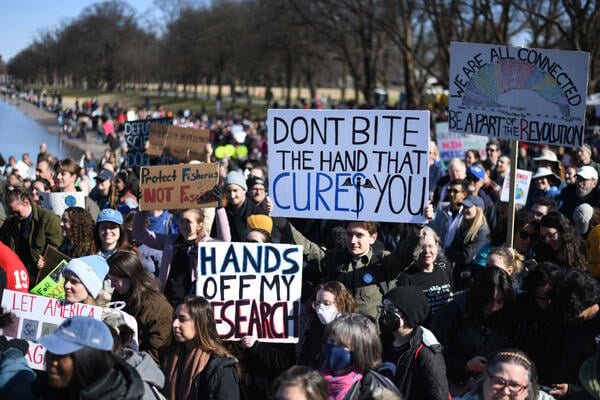
The current moment in American science is genuinely alarming. The Trump administration has doggedly attacked our nation’s top universities. The National Science Foundation’s board was disbanded this April. Federal research funding is contracting, with fewer grants awarded and widespread uncertainty about what comes next. Universities are cutting or pausing Ph.D. admissions. Postdoctoral job losses have surged nearly threefold. More than 10,000 STEM Ph.D.–trained scientists left federal roles in a single year. Those who remain are being told to develop a “plan B.” The message from Washington is blunt and repeated: Research is expendable.
But here is what that framing misses: The funding crisis isn’t breaking graduate students’ faith in academia. Graduate students had already been losing that faith for years, and the current crisis makes the problem impossible to keep ignoring.
Long before the first grant was frozen, graduate students were noticing a quieter set of contradictions. They were told that teaching matters while watching excellent teachers struggle for recognition. They were encouraged to engage with the public while learning that public scholarship rarely counts toward career advancement. They were told that mentorship is central to academic culture while watching faculty who pour themselves into students get passed over for colleagues with longer publication lists. They entered science hoping to improve society and discovered that the system rewards productivity more reliably than it rewards care.
As early-career academics ourselves, we’ve seen these patterns play out across academic disciplines. One of us—Lauren—wrote her own disciplinary farewell years ago: a breakup letter with astronomy. She had excelled in the field and was building a promising career. Yet she left because she could no longer swallow working in a field that made the work she wanted to do impossible—a system that refused “to acknowledge the terrestrial effects of celestial research.” Drawing on her training in African American studies, she pivoted into interdisciplinary social science, and today Lauren is at the Berkeley School of Information studying technology experts who work in advocacy and mission-driven nonprofit spaces. Still a scientist, but centering people and social problems.
The other, JP, stayed the course. He completed a Ph.D. in computational biology, mentored students, built public-facing science programs and entered the job market just as the research infrastructure began to unravel in 2025. He now holds two things at once: genuine belief in the power of scientific discovery, and serious doubts about whether the institutions responsible for supporting that discovery are willing to care for the people who sustain it.
Two different choices, but the same underlying question: Can a generation of scientists continue to devote their lives to institutions that no longer seem willing to invest in them?
What we see in ourselves and our peers is not a generation that lacks dedication or resilience. It is a generation that has looked at the contract academia offers—sacrifice now, security never, values optional—and begun asking whether it is worth signing. The current funding crisis has made that question urgent, but the question was already there.
To be sure, many scientists continue to do meaningful, ethical work inside imperfect institutions. And not every department is the same. But when talented, committed scientists leave academia not because they failed, but because they see its contradictions clearly, the problem is no longer individual. It is institutional.
The hardest question for faculty, administrators and department chairs is not what to do about Washington. It is what to do about the institutional culture already built and maintained. Promotion systems that treat mentorship as service and public scholarship as extracurricular. Evaluation structures that count citations and grant dollars but have no metric for the graduate students you helped retain. Department norms that ask junior scholars, and disproportionately scholars from historically marginalized groups, to carry the relational labor that holds communities together while counting none of it toward their advancement.
The federal government is telling researchers their work doesn’t matter. This is a crisis worth fighting against. But if the institutions that researchers turn to for solidarity are the same ones that have spent decades telling them their values don’t matter, that fight will be very hard to sustain.
Graduate students are not abandoning academia. They are asking whether the academy, as it is currently structured, deserves their trust. That is not a political question; it is an institutional one. And it is one that universities cannot afford to leave unanswered.
You may be interested

Dyson made a camera-equipped toothbrush that flosses for you
new admin - Sep 01, 2026Dyson is once again expanding its line of personal care products with a device that focuses on your teeth instead…

The market forces quietly adding thousands to patient bills
new admin - Sep 01, 2026After a failed round of IVF this year, Anne Hug's fertility doctor said she had a single polyp in her…
August Cuts to Start the Academic Year
new admin - Sep 01, 2026[ad_1] Minnesota State University, Mankato, is among the colleges and universities announcing job cuts in August. Jacob Boomsma/iStock/Getty Images With…