


Progress, Universities and “We Are as Gods”

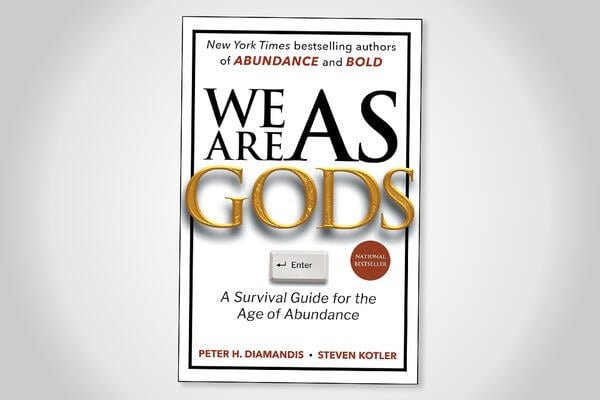
We Are as Gods: A Survival Guide for the Age of Abundance by Peter H. Diamandis and Steven Kotler
Published in April 2026
Throughout most of my academic career, the dominant theme has been progress. Webster’s defines progress (verb) as:
1: to move forward: proceed
2: to develop to a higher, better, or more advanced stage
This forward movement has little to do with how higher education has changed over the past 30 years. From inside a university, it is difficult to argue that things have gotten much better across most of our careers. Has college become more affordable? Have graduation rates meaningfully improved? Has student debt gotten lower? Has academic work become more stable and secure?
The answers to all these questions, and many more about higher education, are all no. So why has my higher ed career been defined by progress? Online education.
Due to both common and idiosyncratic career/family reasons (being a trailing partner three times), I was lucky enough to get into online learning all the way back in the 20th century. Over the years, I’ve been fortunate enough to have a front-row seat for every stage in the evolution of online education. From the birth of the original LMS companies (remember CourseInfo, ANGEL and WebCT?), the rise and fall of for-profit online universities, the diffusion of broadband, the exponential growth of the nonprofit hyperscalers (SNHU, WGU), the MOOC bubble, the rise and fall of OPMs, the enthusiasm and disappointment in microcredentials, and the takeover of the online master’s degree, I’ve watched it all unfold.
Despite some low moments (see OPMs), the online learning story is mostly one of progress. More online degrees. More online alternative credentials. More recognition of the quality of online learning. More integration of learning science into course design and teaching. More learning designers on our campuses.
It is with this framework of progress in my chosen profession of online learning that I come to We Are As Gods. I’ve been reading Diamandis and Kotler’s books since they published Abundance: The Future Is Better Than You Think in 2012 and The Future Is Faster Than You Think in 2020. (I seem to have missed their 2015 installment, Bold: How to Go Big, Create Wealth and Impact the World.)
We Are As Gods, a riff on Stewart Brand (whom I met on his houseboat during the first bubble), is the first part of a sentence that ends with “and might as well get good at it.” The argument that Diamandis and Kotler make is that, due to the convergence of recent advances in AI, networking, processing, sensors, robotics and nanotechnology, we are living through an exponential age of technological progress. For the authors, material scarcity will increasingly represent a societal choice.
What is different about We Are As Gods compared to the authors’ earlier books is that it carefully delineates the challenges and downsides of technological progress. Chapters of the book are devoted to the climate emergency, the social media–driven teen mental health crisis and the risk that AI will hollow out both learning and paid employment. While Diamandis and Kotler mostly treat these challenges as opportunities, they do point out that our mindsets and institutions will need to rapidly adapt if we want to share the benefits of scaled exponential technologies.
How to read a book about how everything is getting better when everything about higher ed seems to be getting worse? At least from our current vantage point, technological advances do not appear to be an effective antidote to fragile, diminishing funding (tuition and public dollars), demographic headwinds, deferred maintenance, and rising costs.
The levers that universities can pull to address financial shortfalls (increase enrollment, raise tuition, cut costs) are all either highly difficult or hugely painful. Nobody I know in university leadership roles thinks that, as a system, we will be able to innovate our way out of the structural challenges that postsecondary education now faces.
Am I being too pessimistic? If online education has not really helped higher ed from a macro standpoint, what set of methods, practices and technologies might? Can you make a case that the confluence of technological advances (AI and everything else) can bring about a new age of resilient universities and abundant learning/credentialing opportunities? Is it possible to make the leap between individual university stories of adaptation and success to sectorwide advances in institutional impact, resilience and durability?
For their next book (or someone’s next book), I’d like to see Diamandis and Kotler narrow their frame to a specific sector or industry. What happens when all the excitement about advances in AI, processing speed and robots comes up against the realities of financing, demographics and public policy?
How optimistic are you feeling about our higher ed future?
What are you reading?
You may be interested

Dyson made a camera-equipped toothbrush that flosses for you
new admin - Sep 01, 2026Dyson is once again expanding its line of personal care products with a device that focuses on your teeth instead…

The market forces quietly adding thousands to patient bills
new admin - Sep 01, 2026After a failed round of IVF this year, Anne Hug's fertility doctor said she had a single polyp in her…
August Cuts to Start the Academic Year
new admin - Sep 01, 2026[ad_1] Minnesota State University, Mankato, is among the colleges and universities announcing job cuts in August. Jacob Boomsma/iStock/Getty Images With…