



The Choice Between Paying for College and Basic Needs

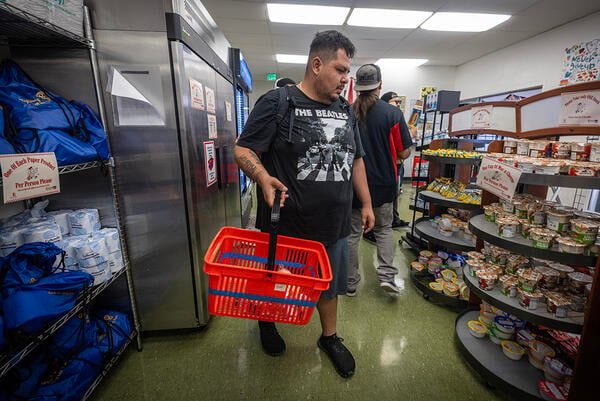
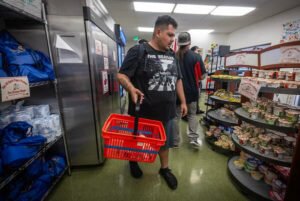
Many colleges offer free food pantries to help low-income students who might otherwise go without or have to choose between paying for food and for gas to get to school.
Barbara Davidson/For The Washington Post/Getty Images
As students return to college campuses for the fall semester, they are bringing backpacks and laptops and tales of summer jobs or internships. And many of them, whether they talk about it or not, are also arriving with serious financial stress and concerns about paying for their basic needs, including food, housing and transportation.
Some students are more likely than others to face such challenges.
New data shows that 78 percent of students at minority-serving institutions and 75 percent of students at historically Black colleges reported having to choose between paying for college and meeting their basic needs, compared to about 58 percent of college students over all, according to a recently released report from the education-technology company Ellucian. To make ends meet, 56 percent of all college students surveyed said they work full-time jobs, compared to 71 percent of HBCU students and 72 percent of students who attend MSIs.
Across all groups, 42 percent of the 2,000 students surveyed in the spring said financial stress affects their mental health “very much” or “quite a bit,” Ellucian data shows.
The data echoes previous findings from the Hope Center for Student Basic Needs, which shows that 59 percent of the college students surveyed experienced at least one kind of basic needs insecurity, compared to 75 percent of Black and Indigenous students.
Joe Sallustio, Ellucian’s vice president of industry engagement, said in the report that in order for students to thrive, colleges need to be aware of the realities they face. Ellucian lists full-time work, basic needs insecurity and mental health challenges among students’ primary obstacles.
The report says that students can have a hard time focusing on learning when they are worried about paying rent, buying groceries or working enough hours to get by.
Jorge Burmicky, a professor of higher education leadership and policy studies at Howard University who studies basic needs insecurity among HBCU students, said financial stress can take a toll on students’ mental health and their ability to remain focused on their education.
Drawing on his three years of research at six HBCUs across the country, Burmicky is designing a framework for how HBCU leaders can best address student basic needs insecurity. He said the guide will take into account that HBCUs typically serve larger percentages of first-generation and low-income students, as well as the rapidly changing nature of their challenges.
“Basic needs are very fluid. You could be housing secure today, but you could be food insecure tomorrow,” Burmicky said. That means college leaders have to be “constantly updating each other to make sure that we’re doing the best we can with students.”
Deborah A. Santiago, co-founder and CEO of the nonprofit Excelencia in Education, said that Latino students are “trying to balance the American dream of having it all, going to college and making money to try and get ahead.”
She said it can be difficult for students to admit when they’re struggling, because many are those “who succeeded despite the challenges in their community and their economic situation and to put that out there can, in some ways, really make them vulnerable.”
Colleges can do certain things to destigmatize financial stress, such as making food pantries and other resources available to all students, rather than asking students to “prove that you’re poor,” Santiago said.
Providing students with basic needs support can help improve academic outcomes by preventing them from getting into situations where they have to choose between paying for food or for the gas they need to get to class, Santiago said.
In some cases, such financial stress and basic needs insecurity can contribute to students stopping out of college, according to a new policy brief from the Community College Research Center at Columbia University’s Teachers College.
Serena C. Klempin, a senior research associate at the CCRC, said that colleges often fail to notice issues like homelessness and food insecurity because students aren’t comfortable admitting the challenges they face.
“In the United States there’s still kind of this mentality of being able to kind of pull yourself up by your bootstraps, and even if you’re struggling then you just need to get a job or work harder,” Klempin said. “These are individuals who are trying to get an education so they can work, but I think that perception is still out there.”
The Ellucian report suggests that colleges can better support struggling students by offering flexible scheduling and hybrid classes, as well as emergency funds, childcare and financial wellness initiatives.
You may be interested

High School Seniors Turn to AI for Support
new admin - Sep 08, 2026[ad_1] As concerns about college student mental health continue to grow, new data shows that the next generation of students…

Hurricane Lowell passing just west of Hawaii, bringing heavy rain, strong winds, punishing waves
new admin - Sep 08, 2026Hurricane Lowell was skirting western Hawaii very late Monday local time, bringing damaging winds, heavy rain and punishing waves, the…
Driveway rule in force across UK and 'drivers could be liable'
new admin - Sep 08, 2026Many motorists are thought to be unaware of the driveway rule Source link