

A New Direct Admissions Model in Michigan, Alabama

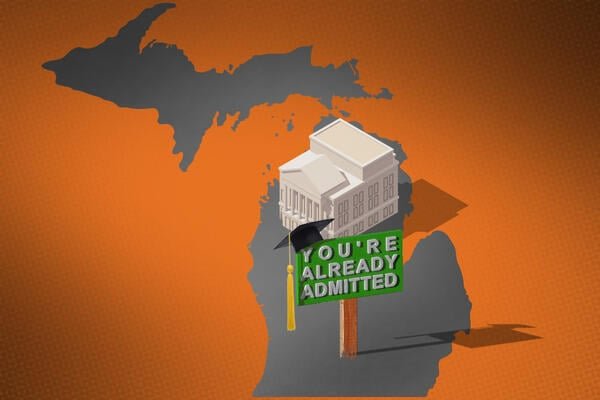
This fall, a group of private and public colleges in Michigan are joining the dozens of states where students can be admitted to college without sending in an application.
But Michigan’s approach differs from the traditional direct-admissions model, in part because it lacks the data infrastructure that most states rely on to send out offers of admission. The program in Michigan could be an example for other states with similar data constraints.
Instead of sending eligible students an offer of admission, institutions will have to wait until students make profiles that include information like their grade point average and intended major. After that step, they will receive offers of admission from institutions whose criteria they fit. Admissions offers will begin rolling in as early as mid-September. From there, students can opt to receive further communications from the universities and will have the opportunity to attend events like admitted students’ day.
The Michigan College Access Network, a college-access nonprofit, worked with the enrollment-management firm EAB to develop the program known as MI College Match. EAB launched a similar program last year in Alabama, where over 12,000 students received admissions and scholarship offers totaling over $5.1 billion. The Alabama program inspired MCAN’s leaders to reach out.
In a review of outcomes at five Alabama campuses, EAB found that about half of the directly admitted students who then expressed interest in those universities hadn’t previously been on the institutions’ lists of prospects. Michigan college leaders hope the platform will work the same magic in the Great Lakes State and connect them with students who may not have otherwise applied to their institution.
Shane Lewis, director of admissions at Oakland University, one of the participating campuses, said his institution chose to join because officials are hopeful that the program will attract students who may have opted out of college altogether, which he said is a growing problem in Michigan.
“In our mind, direct admission is going to remove any of the perceived barriers, so we can make the journey of the college-search process smoother,” he said. “It removes that rejection fear earlier in the process.”
Direct admissions has boomed in recent years, with at least 17 states and hundreds of individual colleges launching programs through which institutions admit students based on their grade point averages and other statistics, rather than an application.
The goal of the practice is multifold: On the student side, it eliminates the vast majority of the application process and shows students who might not be planning to attend college that institutions want them. On the institutional side, it’s a way to increase enrollment and get the attention of students who may not have otherwise considered the college.
Models vary significantly. Some public colleges in states like Idaho and California send out admissions offers to high school seniors without the students doing anything, based on data about their grades. Other institutions, particularly smaller private colleges, use third-party companies like Niche or Common App to find students to admit directly based on a profile the student has made on the site.
EAB’s model lands somewhere in between. Its platform, Match, which EAB acquired in 2022, functions similarly to Niche’s and Common App’s. But the firm’s programs in Michigan and Alabama only allow students to receive offers from a slate of colleges within their state rather than from across the country. That’s important, because almost seven in 10 U.S. undergraduates go to college within 50 miles of their home, according to research from the Institute for College Access & Success.
EAB has also partnered with state college-access organizations, nonprofits that work to increase college-going and completion, to launch the programs.
It felt like the right time for Michigan to have its own direct-admissions program, according to Ryan Fewins Bliss, executive director at MCAN; many colleges in the state were already participating in the Michigan Assured Admission Pact, an agreement that they would admit any Michigan high school graduate with at least a 3.0 GPA. The state had also spent the past several years strengthening its financial aid programs, making college more accessible than ever.
But students aren’t necessarily aware of these changes. Fewins Bliss said he hopes the direct offers from colleges help students understand what is possible for them.
“We’re hoping this will give students and families who may not think college is for them … an opportunity to get an offer or multiple offers, get financial aid they didn’t know existed, and change the conversation around the kitchen table about what is possible for them,” he said.
A Growing Model
This method of direct admission, in which a subset of a state’s private and public colleges come together on a single platform, appears to be gaining traction. Outside of EAB’s two programs, North Carolina and Tennessee have both launched similar collaborations in recent years.
But Taylor Odle, assistant professor of educational policy studies at the University of Wisconsin at Madison and a leading expert on direct admissions, said that requiring students to fill out a form or a profile before they can receive offers goes against the spirit of direct admission. (North Carolina does not require students to do so.)
“We are kind of feeling a little bit of friction against that whole guiding purpose of direct admissions: Simplify the process. In every single one of these cases—Common App, Match, et cetera, students have to do something extra that is only useful for direct admissions,” he said. “It’s fantastic to have more people in the game and to have more opportunities for students. But at the same time, as these processes get more complex, I worry about … whether or not we [are] just replacing the old application with these new portfolios and profiles.”
Fewins Bliss said a platform like EAB’s Match was the best option for his state because, unlike California, Idaho and North Carolina, Michigan does not have the centralized data infrastructure necessary to send out acceptances without students first filling out some kind of profile. But he feels confident that MCAN’s partnerships with over 300 K–12 schools will help ensure the profile isn’t too big a barrier. Those schools all already work with their students on other parts of the application process, like completing the Free Application for Federal Student Aid, and will incorporate MI College Match into that process.
Now, colleges in the state are gearing up to start matching with students. In interviews with four participating colleges, administrators said they’re eager to get in front of students who wouldn’t otherwise consider their institutions. They also said they’re excited to be able to offer admission early in the application cycle, so that students can spend less time fretting about application materials and more time deciding which institution would be the best fit.
“Really, what it’s doing is taking that transactional piece out of the way early so we can start building relationships with students, which is our strong suit, earlier in the process,” said Mandy Konkle, vice president of enrollment management at Albion College, a liberal arts college in the southern part of the state.
Karlyn Crowley, president of Kalamazoo College, another liberal arts institution, said she is especially excited for students to receive information about state financial aid and merit scholarships early on in the process. She hopes the information will help students understand that Kalamazoo isn’t out of reach just because it is a private institution.
“Families and students keep telling us they want to know about cost, they want to know about career outcomes, they want to know about return on investment,” she said. “It allows us to tell them earlier, ‘You actually have an affordable path here that you might not have realized.’”
You may be interested

Post-Pandemic, Online Ed Has “Staying Power”
new admin - Sep 08, 2026[ad_1] For-profit and public nonprofit colleges have the biggest share of online learners. Dejan Marjanovic/E+/Getty Images The surge in online…

Nepal observes day of mourning after devastating floods
new admin - Sep 08, 2026IE 11 is not supported. For an optimal experience visit our site on another browser.Now PlayingNepal observes day of mourning…

Passenger duct taped to seat after allegedly calling flight attendant racial slur
new admin - Sep 08, 2026Passenger duct taped to seat after allegedly calling flight attendant racial slur - CBS News Watch CBS News A passenger…