
Political Considerations Increasingly Shape College Decision

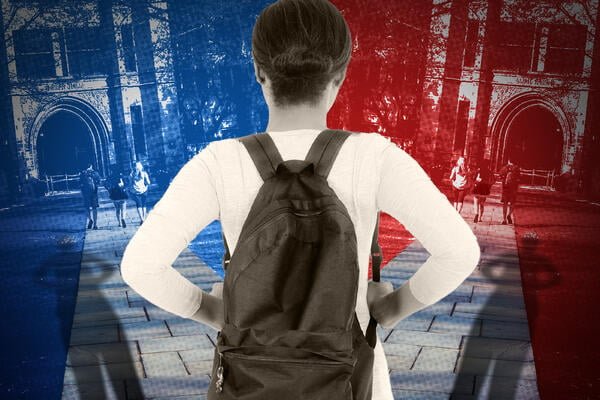
Nearly three-fourths of students say politics influences which colleges they’ll consider from the start.
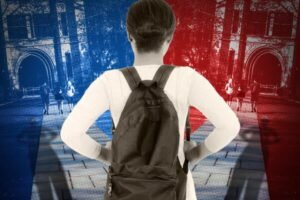
Photo illustration by Justin Morrison/Inside Higher Ed | f11photo and michaeljung/iStock/Getty Images
Political considerations play a growing role in students’ college-going decisions, according to a new student poll by the Art & Science Group. More than a third (34 percent) of respondents surveyed over the summer said they ruled out a school based solely on the politics of its state, up from 28 percent in 2024 and 24 percent in 2023. Another 12 percent said politics played some role in their higher ed thinking, even if it didn’t change where they ultimately applied or enrolled.
The poll’s new iteration was intended to show whether the 2024 results “were really bound to the runup to the presidential election and the high-volume things coming out of the political sphere,” said David Strauss, co-founder and principal at the Art & Science Group. The new findings indicate “it wasn’t a blip” connected to Donald Trump’s re-election: “It has gone from more than a quarter of students in 2024 to a third of students now in 2026, so that phenomenon is increasing in intensity.”
The findings underscore that “we’re segregating ourselves even more into our own bubble, and we’re doing it younger,” he said. “That worries me.”
The poll also zeroed in on when during the college application process politics impacted students’ choices, with findings similar to 2024. Nearly three-fourths (73 percent) said it shaped their thinking early on about institutions they might be interested in, 59 percent said politics influenced their decisions about where to apply, 25 percent said they considered it in comparing admissions offers and 13 percent said it helped them determine where to enroll.
“The most intensive role politics is playing is when students are deciding what schools to look into,” Strauss said. “In other words, the colleges may never even see these kids or have an opportunity to try to convince them of something. Those are big impediments for institutions.”
Students who ruled out colleges because of politics looked at both the institutions themselves and the states where they were located. Over 70 percent said they had evaluated specific colleges and universities, and nearly half cited states or regions.
The survey was administered twice during the 2025–26 admissions cycle: once to 1,347 U.S. high school seniors between February and March of 2026, around when they were deciding where to apply, and again to 1,547 graduates in the summer, after they knew where they were going. Across both rounds, 45 percent of respondents identified as white and 55 percent as BIPOC or AAPI, while 58 percent identified as female and 41 percent as male.
Though the breakdown of their political leanings wasn’t included in the report, Strauss told Inside Higher Ed that 20 percent of respondents identified as conservative or very conservative and 34 percent as liberal or very liberal. Another 38 percent described themselves as moderate and 8 percent said they weren’t sure where they stood.
According to the report, more than 15 percent of conservative-leaning students said they ruled out attending college in three states: California, Colorado and New York. Meanwhile, more than 15 percent of liberal-leaning students eliminated institutions in Alabama, Florida, Georgia, Louisiana, Mississippi, South Carolina and Texas.
Strauss said across the surveys, liberal-leaning students have tended to be “more discerning” in enumerating their reasons for rejecting certain institutions. “Larger portions of liberal-leaning students have talked about reproductive rights and LGBTQ rights, et cetera, and the conservative leaning kids will talk about ‘too Democratic’ or ‘too liberal,’” he said.
But he noted that colleges have some control in overcoming their state’s reputation.
“You can do your best to be the oasis in a state and make it known. So, if you’re a school in California, and a student thinks California is too liberal, you can try to be a place where there are different voices being heard,” he said. “The other thing you can do is have a reason to be a place that the student would want to be more than he or she doesn’t want to be in a state with those politics.”
You may be interested

Apple’s HomePod Mini 2 is available to preorder
new admin - Oct 13, 2026The speaker includes the S10 chip, which debuted in the Apple Watch Series 10, and it can power a host…
Kimberly Guilfoyle has been asked to resign as ambassador to Greece, White House says
new admin - Oct 13, 2026Washington — The White House told U.S. Ambassador to Greece Kimberly Guilfoyle to resign, days after an associate shared text…

DLSS 5 gets toned down for its Hogwarts Legacy debut next month
new admin - Oct 13, 2026When Nvidia originally showed off DLSS 5 earlier this year, the technology immediately got branded as gen AI for video…