


What Students Value Most About College

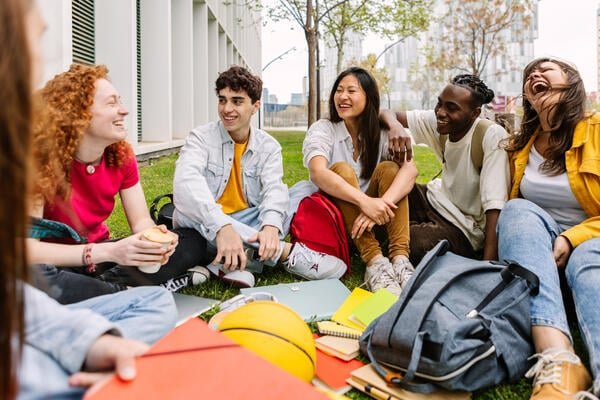
Students may assess the value of their college experience through a broader lens than financial returns and career preparation, according to a new report from Qualtrics and Buro Happold that finds personal growth, relationships and belonging are among the qualities students value most.
Based on a spring 2026 survey of 1,007 U.S. college students, researchers found that 74.2 percent of respondents reported receiving high or exceptional value from the purpose and personal growth they experienced in college, the highest among nine dimensions of the college experience. Economic return ranked lowest at 66.2 percent, even as concerns about college costs and career outcomes continue to dominate discussions about the value of higher education.
For Elliot Felix, a partner at Buro Happold and co-author of the report, the findings highlight the importance of understanding what students hope to gain from their college experience beyond the classroom.
“If you think about college, it’s a time for students to find their place, their people and their purpose,” Felix said. “Students are looking for value, and at the same time, they don’t want to measure it purely in terms of dollars and cents.”
Uneven student experiences: The researchers found a moderate positive correlation between students’ satisfaction with personal growth and their perceptions of the overall value of college. Within the purpose and personal growth category, students reported the highest satisfaction with trying new things at 80.1 percent, followed by being more mindful and present (77.6 percent), being challenged academically (75.3 percent), and gaining confidence (74.5 percent).
Satisfaction was comparatively lower for exploring career paths at 69.9 percent, learning to work in a team (69.3 percent) and solving real-world problems (68.3 percent). The report suggests that institutions could strengthen students’ perceptions of value by expanding career exploration, experiential learning and opportunities to develop practical skills.
Michael Darfler, an associate at Buro Happold and co-author of the report, said the findings highlight a distinction between the personal growth students experience during college and the financial returns they may not realize until after graduation.
“In the more immediate sense, what [students] are looking for is that tangible feeling of growth and of advancement,” Darfler said. “Those economic returns are ones that will come later in the process, and so it’s important for universities and colleges to think about, ‘What is our ROI?’”
Although 66 percent of all respondents reported receiving high or exceptional value from their college experience, perceptions varied considerably across student populations. Veterans and first-generation students reported some of the highest ratings, at 74.4 percent and 72.2 percent, respectively, while students with disabilities and transfer students reported the lowest, at 59.1 percent and 56.1 percent, respectively.
The report also identified different challenges across these populations. Among transfer students, networking and relationships received the lowest value rating at 57.5 percent, while commuter students rated advising and experience lowest at 61.5 percent. Students with disabilities reported the lowest value from community and culture (51.4 percent), while Pell Grant recipients rated economic return lowest at 60.3 percent.
Darfler said the disparities underscore how students’ circumstances can shape their opportunities to build relationships and engage with campus life, particularly for those balancing college with paid work or family responsibilities.
“For a traditional, first-time freshman, there is a lot of support and effort put into creating that sense of belonging and community,” Darfler said. “For a commuter student who’s maybe only there nights and weekends, coming in for class and then leaving again—not lingering because perhaps they’re working another job or they’re taking care of a parent—it just is more challenging for them to create that sense of community and belonging.”
Felix pointed to the challenges transfer students face navigating a new institution, which may help explain why they reported the lowest perceptions of overall college value among the populations surveyed.
“People talk about creating something that’s seamless, where they get rid of administrative hurdles and they get rid of friction, [but] transfer students by definition have a seam,” Felix said. “They’re like jumping on a moving train and getting oriented to new policies and procedures and systems and technology platforms.
“They often experience the runaround between offices to get an answer to a question,” he added. “It’s sort of a one-two punch between the belonging and the kind of reorientation to systems and policies and processes.”
Belonging and student voice: The report also identifies what researchers call the “year four cliff,” with fourth-year students reporting the lowest perceptions of value among the four class years surveyed.
While 70.3 percent of first-year students reported high or exceptional value from their college experience, that share fell to 65.6 percent among second-year students before recovering to 68.9 percent among third-year students. By the fourth year, perceived value dropped to 64.1 percent.
Felix said concerns about career prospects and return on investment may help explain the lower ratings among students approaching graduation, although the survey does not establish the cause. The report recommends strengthening career preparation, mentoring and other supports as students near graduation.
Beyond differences across class years, the researchers also examined how students’ sense of belonging relates to their perceptions of college value.
Among students reporting a high sense of belonging, 74 percent rated their overall college experience as highly or exceptionally valuable, compared with 43 percent of students reporting low belonging.
Katie Johnson, vice president of higher ed strategy at Qualtrics and co-author of the report, said institutions should view belonging as something students experience throughout their education, rather than simply through social connections or campus activities.
“It’s a student showing up and feeling like they have a place at that institution and like they have a voice,” Johnson said. “It’s something that needs to be integrated across the entire experience, and a lot of that comes back to giving students an opportunity to have agency on campus, to be a part of shaping the future of their institution and having a say in what their educational experience looks like.”
Darfler said institutions should begin fostering belonging during recruitment and continue building those connections through students’ academic careers and beyond graduation.
“When we think about creating a sense of belonging, it really is something that is a lifelong process that doesn’t just start and end,” Darfler said.
The value of AI: The report also examines how students perceive the value of generative AI in their college experience, finding that some of its applications are viewed more favorably than others.
Across 10 AI applications, students reported high or exceptional value at an average rate of 66 percent. Brainstorming and ideation received the highest rating at 71.2 percent, followed by summarizing academic research at 70.1 percent, translation (67.8 percent) and writing assistance (67.6 percent).
Students were less enthusiastic about outlining and drafting (66.5 percent reported high or exceptional value), source discovery (64.6 percent) and literature reviews (64 percent). The lowest-rated uses were turning to AI for help when stuck on a task (63.6 percent), coding (61.3 percent) and mental health advice (58.2 percent).
Researchers also found an association between students’ perceptions of AI’s value and their likelihood of recommending their institution. Among students who reported the greatest value from AI, 57.1 percent were classified as institutional promoters, compared with 25.8 percent of those who reported the least value.
Felix said the findings reflect a tension between AI’s potential to support students academically and concerns about how the technology could affect their personal development and future career opportunities.
“It’s sort of the classic example of two things that can be true at the same time,” Felix said. “Students can recognize the value of AI but can also see that it might reduce that value when it comes to their own development and career and the availability of jobs.
“Helping students discern when to use it, how to use it, why to use it … shows us that we need nuance, because it’s not an all or nothing,” he added.
Get more content like this directly to your inbox. Subscribe here.
You may be interested

Pacific hurricane region sets record for big, long-lasting storms, due to El Niño
new admin - Oct 13, 2026The drumbeat of monster hurricanes in the Pacific has broken a record for nasty, long-lasting storms east of the international…
Proposed Changes to Census Could Affect Native Students
new admin - Oct 13, 2026[ad_1] The Census Bureau proposed counting citizens based on their “usual residence” and limiting demographic questions related to race, ethnicity…

SpaceX launches cargo ship to space station in spectacular pre-dawn flight
new admin - Oct 13, 2026A SpaceX Falcon 9 rocket boosted an unpiloted Dragon cargo ship into orbit Tuesday, setting up a rendezvous with the…