



Let’s Not Blame Faculty for What They Haven’t Had to Know

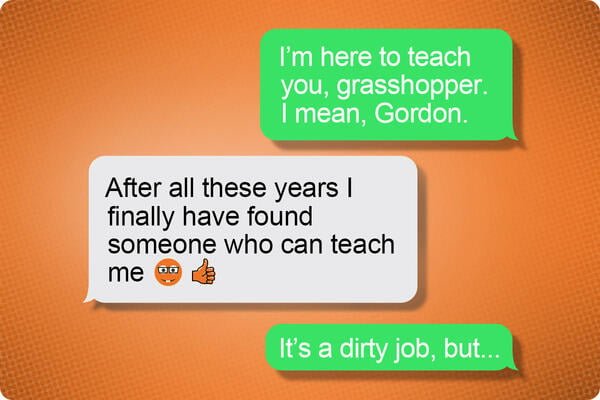
RST: Are you still mad at me, Gordon? On the phone the other day, you said it was the twins’ 14th birthday. You got all grandfather proud and texted me a photo of you holding both of them as newborns. I made barfing sounds and said they looked like mushrooms.
EGG: I am not mad, although I have taken you out of the will.
RST: Moving along, do you think the last two crazy years are a blip in U.S. history and things are going to be more sane now? I am embracing optimism on all fronts.
EGG: Embrace optimism. Our democracy is very strong and resilient and last week was the proof. The Dems will probably overplay their hand, but that is fine because the R’s have done that over the past two years. Maybe we can finally find ourselves perched in the middle of our electorate. That is my hope.
RST: Here’s something that caught me off guard at a recent conference: I was talking about how little attention faculty pay to the national landscape of higher ed and often don’t realize that their campus problems are actually pretty darned universal. Most faculty don’t read The Chronicle or Inside Higher Ed. An administrator stopped me and said, “That’s because we told them they didn’t have to. They focused on their students and their disciplines and their campuses because that’s how we reward them.”
EGG: Rachel, you are right. As I have been working on this project with you, I have discovered that I am not certain that I truly understand faculty. I have lived in rarefied air for most of my academic life, and I find the daily toil of a faculty member often a mystery. So, it is easy to get irritated with faculty because I expect them to know the issues of the day. Yet, as you just said, I spent much of my life telling them not to worry, just do your jobs and let me do mine. In another time and place that may have worked, but now, given the challenges facing universities of all stripes, I should have been communicating regularly about the challenges the whole sector was facing.
RST: Every president I know thinks they are communicating regularly with the faculty. Most say they are transparent. I’ve heard you tell current presidents that they have to be better at this, but how good were you?
EGG: Not good enough. I decided that we needed to go through a process of academic transformation at West Virginia due to a $45 million structural deficit. The reason to immediately address the problem was absolutely clear to me, but it was a bolt out of the blue to most of our faculty. In retrospect, I should have been preparing people for at least a year, because I knew what was happening at so many institutions and we were not immune. Bad news is hard to deliver, but it is better to keep faculty informed rather than hope for a miracle.
RST: And now you wear that no-confidence vote proudly, along with your Ted Lasso BELIEVE lapel pin.😊 But I don’t think this was just you. Presidents know this stuff is happening elsewhere but somehow believe it won’t land on them. Did you really not know, or did you not want to face the facts and make the hard decisions? How does a giant budget gap just appear?
EGG: I could feel it coming. Everything changed after COVID, and we were losing students at an unexpected rate. I felt we could grow our student body based on the classes that we had during my first few years. Although I was accused during our transformation for budgeting for 40,000 students as a reason for our deficit, we did not budget based on ghost numbers. I may be a risk taker, but I never budgeted on hope. With COVID, it was apparent that we were going to have a deficit.
RST: Were you surprised by the reaction of the faculty? Did you expect them to have been paying attention to what was going on elsewhere?
EGG: Actually, I was surprised. I naively thought that people would be reading the news that showed the financial precarity of institutions. The bond agencies started lowering ratings for universities and colleges, which scared the hell out of me. These agencies have a cadre of very smart people measuring trends, and they were signaling that the sector was in real trouble.
RST: Look. I’ve been reading The Chronicle since 1984 and writing for it since 1997, and until I started talking to presidents nearly four years ago, I had no idea how much I didn’t understand about higher ed, especially about budgeting. And yet, until recently, that hasn’t stopped me from blaming faculty colleagues for not knowing stuff I didn’t know until I had to learn.
EGG: It certainly did not stop me or members of my senior team from wondering on what planet people were living. It is easy for the faculty in times of stress to blame the administration. But what was actually startling to me was how fast the leaders of the university were critical of the faculty. In earlier times during my presidencies, I had not experienced so much animosity and finger-pointing from both sides.
RST: You, my friend, have been quite critical of faculty, which is one of our common themes. But the truth is, we need to be taught. I still don’t understand a lot of the higher ed news I read. There was a headline about “pocket rescissions” and I had to ask people what that meant. Reporters and others talk about “neg reg” and I’m like, Huh? And all the policies referred to by acronyms? I’m lost. It’s impossible to keep up with the news and we all cherry-pick the stuff that pertains to us, so we miss a lot of big-picture issues. As a faculty member, I would like a readable, informative (nutritious as well as delicious) summary of what’s going on that will have implications on my specific campus. And the fact is, that is nowhere to be found. Should it come from the office of the president?
EGG: Given the divisions which are occurring on campus, it needs to come from a credible source that all parties in the university believe is/are straight shooters and who also have the ability to make the information simple and readable.
RST: But it has to be specific, because, as I’ve been trying to teach you, each niche of the ecosystem has both similar and distinct issues. Remember what you learned at Hendrix College?
EGG: Truly, Rachel, although this is an important discussion, it is actually quite painful for me. I have learned to park issues that have bothered me and move on. Saying that, this notion of conflict between faculty and administration is such a debilitating reality within universities. If I could go back with the knowledge I have now, I would make different choices. Chief among them would be to bury fear and be very clear with every conversation and decision that there is a rationale based upon all of the information the university is providing. In other words, as part of shared governance, I would provide all of the appropriate information to the university family, and if they read and listened then they would clearly understand the status of the university and challenges facing the higher education sector. Failure to do this has caused me a lot of heartburn, and for many of my colleague presidents, it has caused them to be fired or resign.
RST: Yep. Here’s something else I’ve been thinking a lot about: When you look at who is talking about what higher ed needs to do and how it must change, it’s often outside observers. Someone recently pointed out that a big name in the industry gets a lot of money for going around talking about what has to happen and that person has never worked inside higher ed (and no, I’m not talking about IHE co-founder Doug Lederman). So we have pundits, former journalists and a whole industry of consultants who have never been responsible for a course, sat through a department meeting or prepared a tenure file talking about faculty. And we also have a bunch of old former presidents beating up on their peers still in the job and the faculty who beat up on them. Where are the sane, informed voices?
EGG: US! Truthfully, is that not what we are trying to do with the Odd Couple? We can provide informed opinions and observations about higher education from two people who have been deep in the trenches. And, yes, there are a lot of commentators flapping their lips about higher education who have never spent a day in the seat of a faculty or administrator. Yet they are expounding on the world of higher education as if they fully understand all of the nuances of the most complex organizations in this country. They often do more harm than good.
RST: Well, Gordon, no one is going to listen to us if you just complain about the faculty being whiny (yes, calling you out because you’ve said this a zillion times and often in all caps) and if you give a bunch of generic advice and rules for current presidents to follow. BTW, I’m still hearing about how you said that when you came in as president the first thing you did was fire the provost because you knew that person wanted your job. That might have been true in your specific context, but it sure as shooting isn’t universally the case.
EGG: I respect faculty, and certainly individually I have found so many friends over these five institutions. Saying that, in my conversations with university presidents, there is a common theme about faculty resistance to change. The net result is that there always is a lot of noise in the system.
RST: And some of the noise is coming from the pundit class. I’ve had to point out to Doug just how much he has missed about higher ed. The other day I complained to him about how hard it was to schedule a meeting with just a handful of concerned faculty members. Doug said, “Oh yeah. That was a funny bit in Vladimir!” He hadn’t known after all those years covering higher ed what things are like on the ground. And to his credit, Doug 2.0 is learning.
EGG: You are always trying to take credit for helping older guys who may have lost a little bit of their fastball.
RST: It’s a dirty job, but. What I’m grappling with now is how we expect people to understand the sector if there’s no general interest publication for faculty, except for whatever comes out of AAUP (I’m not a member, so I don’t know what they’re saying, though I can guess), and no substantive communications coming from their own administrations.
EGG: Look, the last thing I want to be is one of the arrogant people who believe that they are the only ones who understand the issues and therefore have the corner on all of the wisdom. But there is a reality about higher education which is that it is very complex, messy with so many variations from large and small, public and private, Mormon and Catholic. Take me, for example: What I am learning from you and this journey that we are pursuing is how much I do not know about higher education.
RST: Well, I am certain of nothing these days except for how much I don’t know or understand. (Which, by the way, when are you going to You Can See Everything so we can talk about it?)
You may be interested

Second Harvard Union Goes on Strike
new admin - Nov 11, 2026[ad_1] Harvard Academic Workers remain at odds with administrators over wages; childcare and family benefits; and discrimination, harassment and bullying…

After the Election, a Chance to Correct Our Course (opinion)
new admin - Nov 11, 2026[ad_1] When Texas A&M University’s spring semester began in January, a philosophy professor was told to remove passages from Plato’s…

Meghan Markle's father back in custody after allegedly cutting off his ankle monitor
new admin - Nov 11, 2026Meghan Markle's father, Thomas Markle, who is facing charges for possessing child sexual abuse material, is back in custody after…