



Higher Ed and the Tale of 2 News Feeds (opinion)

Americans have argued over the role of colleges almost as long as they have argued over the Republic itself. Thomas Jefferson founded the University of Virginia as a secular institution, which was in stark contrast to the religious ties defining nearly all other colleges at the time. During the Civil War, Abraham Lincoln signed the Morrill Act, redefining the nation’s commitment to higher education. After World War II, the GI Bill opened college doors to millions of veterans and helped build the modern American middle class while expanding the role of higher education in society. In every era, Americans have debated whom colleges should serve, what they should teach and what they owe the country.
Those debates continue today, at a time when public opinion about higher education appears to be shifting. Gallup, most notably, has documented a much-discussed decline in public confidence in higher education during the past decade, particularly among Republicans. Explanations usually focus on rising tuition, doubts about value, campus politics and ideological conflict. Those factors undoubtedly matter. Yet they ignore an important question that very much is part of the story: Where do Americans get the information from which they form their judgments about colleges and universities?
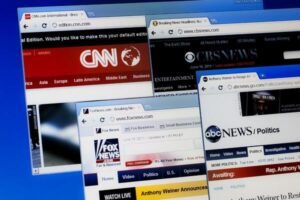
To help us answer this question, we turn to the Vanderbilt Television News Archive, which offers new and compelling evidence about that changing national conversation. Our analysis of data from the archive shows that Americans are receiving different stories about what is happening on our college campuses. Americans, in effect, have been watching the same institution, but through two different news feeds.
The archive began recording the evening news broadcasts of ABC, CBS and NBC in 1968. It began recording evening broadcasts for CNN in 1995 and Fox News Channel in 2004. To capture the changed information environment, we conducted an AI-assisted content analysis between 2004 and 2025. This analysis identified 517 unique segments devoted to higher education across the evening news shows from the five networks, then classified them by network and tone. Television is no longer the central source of political information, but its changing coverage speaks to the larger fragmentation of Americans’ information environment (as we’ll address in more detail below).
Let’s begin with one striking number. Between 2004 and 2025, Fox News aired 206 segments devoted to higher education—40 percent of the total coverage. ABC, CBS and NBC together aired 210. The three broadcast networks that once helped define a common national agenda devoted barely more attention to colleges and universities than a single cable channel.

Part of that difference reflects that broadcast evening news lasts 30 minutes, while cable news fills an hour. Yet even accounting for the length of the format, Fox still devoted twice as much attention to higher education as the other cable outlet with an hourlong evening news program, CNN (101 segments).
The tone of that attention sharpens our story. We used AI-assisted sentiment analysis to learn more about how the networks talked about higher education. We sought a simple and replicable approach, capturing favorable, neutral and unfavorable accounts of higher education. We assigned, for example, segments that described students’ struggles with tuition increases, deceptive recruiting tactics of for-profit universities or the turmoil caused by campus protests as negative. We classified as positive coverage of student and faculty achievements, and of colleges and universities adapting to better meet student needs, including by expanding enrollment and providing online access. We classified coverage that described, rather than assessed, such things as policy developments or changes in university leadership as neutral.
Our team also looked at each of the 517 segment transcripts to ensure proper classification. We are making our data and our method publicly available to ensure transparency.
In our analysis, nearly 54 percent of Fox’s coverage was classified as negative, while only about 11 percent was positive. CNN had the smallest proportion of negative coverage, about 27 percent, with more than half of its coverage being neutral. ABC, CBS and NBC were also considerably more likely than Fox to present higher education in neutral rather than negative terms.
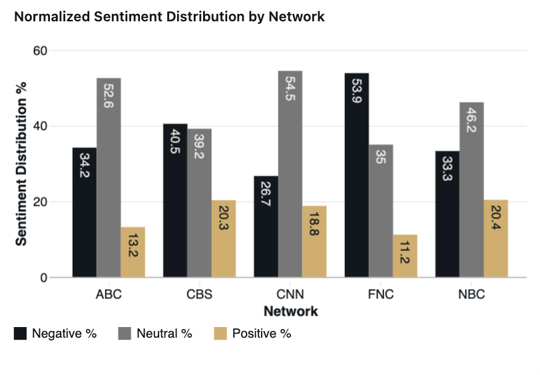
Source: Vanderbilt Television News Archive; AI-assisted analysis by Vanderbilt’s McGee Applied Research Center for Narrative Studies.
The bottom line: The most persistent voice in the conversation about higher education was also the most critical.
Now, we are not arguing that colleges deserve more favorable coverage from the press. Much of the criticism has been earned. Universities have too often struggled to answer the public’s most basic questions: Is a college education affordable? Is it worth what it costs? Are campuses intellectually open? Are institutions accountable for the promises they make? Failures on these fronts have surely contributed to declining confidence. But our results suggest that the story of higher education is also a story about the disappearance of a shared national narrative.
We know that viewers often choose news sources based on ideological grounds, which means they not only are more likely to learn things that reinforce attitudes they already hold, but they are far less likely to come across information that runs counter to their predispositions. We also know that both media coverage and public opinion respond to larger political conflicts. As a result, our findings reveal a bifurcated information environment that almost certainly helps sustain—and may deepen—that divide.
This reality presents university leaders with a difficult task. They should neither dismiss critical coverage as partisan hostility nor design reforms merely to win favorable headlines. Our data indicates that it is nearly impossible to get favorable coverage from all corners of the current media environment. And just dismissing criticism as partisan, and hence not legitimate, fails to acknowledge that the prevailing concerns have at least some merit. Higher education does need to address legitimate problems—cost, ideological conformity, weak accountability and uncertainty about educational value—because those failures matter. At the same time, they must recognize that even genuine reform will be interpreted through a media system that rewards conflict more readily than nuance and complexity.
Now, of course, some may point out that television news is no longer the principal place where Americans encounter political information. While true, that does not make these findings less relevant to the current debate in higher education. The stories aired on television news spread to other platforms, as they are clipped, reposted and discussed on social media feeds, reaching audiences far beyond those who watch the evening news.
If anything, today’s social media environment magnifies the pattern documented here. Americans no longer merely choose among networks offering different accounts of higher education; they increasingly inhabit personalized news feeds that reward attention, conflict and emotional reaction. The two news feeds are therefore less two distinct channels than two broad information systems, each containing countless outlets, personalities and algorithms that reinforce a different understanding of the same institutions. Our television findings offer a measurable window into that larger fragmentation—and may, in fact, understate its reach and intensity.
Universities cannot control the news, nor should they try. They can, however, become more candid about their shortcomings, clearer about their purposes and more rigorous in demonstrating their public value. They can engage audiences that have mainly heard the case against higher education. University leaders might be more willing to go on right-leaning podcasts or pen op-eds in outlets like The Wall Street Journal or The New York Post. Colleges and universities need to be more intentional about breaking into the two news feeds. And, of course, rebuilding public support will also require a renewed commitment to mission and the realization that no reforms will yield universal applause. This is far more than a public relations game.
Republican government, as Jefferson argued, depends on citizens capable of informed judgment. That conviction is even more important today. Americans should argue vigorously about what colleges cost, what they teach and whether they serve the public good. To ensure these arguments yield important change, however, we must realize that higher education, like all institutions, is operating in a fractured information environment. That means there are no quick fixes to increasing public confidence. And we should very much avoid playing to public opinion and instead focus on the basics that make higher education central to our democratic experiment.
You may be interested

From AI Use to Funding Cuts: How Provosts Navigate 2026
new admin - Sep 23, 2026[ad_1] As artificial intelligence continues to disrupt college campuses, chief academic officers are embracing AI tools. Roughly seven in 10…
Matt Gutman joins CBS News as chief correspondent
new admin - Sep 23, 2026Award-winning journalist Matt Gutman has been named CBS News chief correspondent, the network announced Tuesday. In addition to reporting for "CBS…

Commercialized Federal Research Has Generated Trillions
new admin - Sep 23, 2026[ad_1] As of 2025, universities own about 60 percent of the patents issued on inventions benefiting from federal funding. The government…