



Higher Ed Advocates Push Back on McMahon’s “Call to Action”

Two higher ed groups are calling for unity amid the Trump administration’s latest missive.
Photo illustration by Justin Morrison/Inside Higher Ed | Mahmud013/iStock/Getty Images | Jessica Rinaldi/The Boston Globe/Getty Images
Two higher ed coalitions are urging colleges and universities to stand together as they weigh how to respond to the administration’s latest push to reform institutions.
The free speech association PEN America and the Alliance for Higher Education, a new organization that aims to defend higher ed’s autonomy, said in a joint statement that the administration’s “Call to Action” threatens to fracture the sector and aims to compel institutions to make changes that the government can’t legally require.
“We encourage the sector to recognize this Call to Action for what it really is—a document designed to divide and weaken higher education—while also acknowledging the importance of meeting the needs of the nation’s people, security and economy through accountability for our sector and for the government,” the groups wrote in guidance about how to respond.
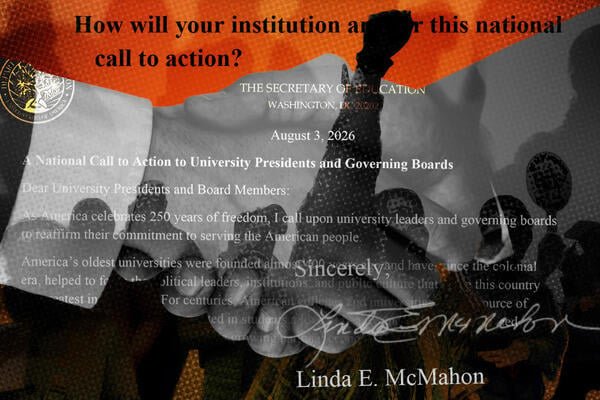
In a letter to university presidents and boards, Education Secretary Linda McMahon requested that institutions publicly commit to detailed plans for change. McMahon pitched the “Call to Action” as an essential step in rebuilding the public’s trust in higher ed and encouraged university leaders to “seize this occasion to drive essential reforms.” She wants colleges to respond to her questions by the end of this year; experts say how colleges answer her questions could carry consequences and will require nuance.
As colleges consider their responses to the letter, the Alliance and PEN encouraged administrators to detail how the Trump administration’s federal funding cuts have affected students and the role of diversity in democracy and how their institution supports both. Further, they want institutions to “reject the notion that academically rigorous research is somehow partisan” while committing to continue hiring faculty and enrolling students based on merit.
The secretary’s “Call to Action”—which addresses seven areas including institutions’ admissions policies, intellectual pluralism and college affordability—appears to stem from the administration’s controversial compact that it proposed last fall. Under that compact, universities allegedly would have received preferential treatment for funding if they agreed to a number of policy changes. After higher ed institutions rejected the offer, it didn’t go anywhere.
Although the letter didn’t detail any incentives or penalties associated with responding, Trump officials have said they are more likely to work with institutions that announce reforms.
The American Association of University Professors, a faculty union that has sharply criticized the Trump administration, said in an analysis of the letter that universities should seek explicit assurances that their responses or lack of response won’t affect their federal funding or other government actions such as investigations. “It is reasonable to ask whether the requested statements will later be used to construct a compliance regime,” wrote the AAUP.
PEN America and the Alliance acknowledged that McMahon’s letter is less combative and adopts a softer tone than last fall’s overture. But they argue that lessons learned in the fight over the compact should be applied again, as the letter threatens higher ed’s core values.
“As we learned from the fall 2025 Compact, collective rejection strengthened trust among students, faculty, staff and the public,” the two groups wrote. “It also crystallized the absolutes in our sector: institutional autonomy, students’ right to learn and thrive, and scholarly inquiry free from political coercion.”
The Alliance, PEN and others repeatedly note in their responses to the letter that universities are already grappling with many of the issues the secretary raised.
“The fundamental question is not whether higher education should improve,” said Ross Mugler, president of the Association of Governing Boards of Universities and Colleges, in a statement. “It is who decides what improvement requires, and that responsibility rests solely with governing boards and institutional leaders exercising independent judgment in the long-term interests of their institutions, students, and the public.”
Universities Plan for Responses
In the week since McMahon sent her missive, leaders have begun to chart a course for determining how to respond to the letter. Andrew Martin, chancellor at Washington University in St. Louis, said he’ll work with the provost and Faculty Senate to “establish a faculty-led process for reviewing the letter and developing WashU’s response.” That’s similar to University of Arizona President Suresh Garimella’s plan, which will include consulting key stakeholders. Others, like Ohio State University, aren’t saying whether they’ll respond, though an OSU spokesperson told Signal Ohio that the university is in a strong position to answer the questions.
While some institutions have pledged to engage faculty in how they will or won’t respond, the AAUP chapter at Vanderbilt University has excoriated the “Call to Action” as well as the university’s “Declaration of First Principles,” which outlines a series of commitments to support key tenets such as academic freedom, merit and excellence.
The Vanderbilt faculty members said in a statement Tuesday that faculty were not consulted on the declaration, which they see as a potential model for how universities could respond to McMahon’s “Call to Action.”
Vanderbilt’s chancellor was not among the higher ed leaders who reportedly consulted on the letter or talked with the White House about issues affecting the sector. But the AAUP chapter argued, “The striking concordance between that call and the VU Declaration means that whether or not Chancellor Daniel Diermeier was in the room, the Vanderbilt upper administration has offered an internal managerial toolkit with our university’s imprimatur to complement McMahon’s politicized demand for university compliance.
“And while the Declaration claims to be above political ideology, it was clearly written to be responsive to a political demand,” the chapter added in the statement. “We do not claim secret coordination (nor do we rule it out), but we find it impossible to treat these documents as unrelated.”
Vanderbilt did not respond to a request for comment by press time.
You may be interested

Of course the ChatGPT dog cancer vaccine spawned a startup
new admin - Aug 12, 2026That entrepreneur is Paul Conyngham, who says he is launching Gamgee to offer “personalised mRNA cancer vaccines for dogs.” But…

Colombia earthquake rescue volunteer reacts after pulling survivor from rubble
new admin - Aug 12, 2026Colombia earthquake rescue volunteer reacts after pulling survivor from rubble - CBS News Watch CBS News Rescue workers are racing…

UK's best 10 solar eclipse viewing locations for today
new admin - Aug 12, 2026Tonight's solar eclipse is due to begin from 6pm. Source link