




Food Recovery Fuels Student Success

Food insecurity has become a persistent challenge for community college students, forcing many to choose between buying groceries and covering other essential expenses. As colleges look for ways to remove those barriers to student success, a growing number are turning to food recovery programs that redirect surplus food to students in need.
One organization helping colleges expand those efforts is the Food Recovery Network (FRN), a national nonprofit that works with campuses to recover perishable food that would otherwise go to waste. Launched in 2024, its Community College Food Recovery Grant Program recently selected a third cohort of 24 community colleges across 15 states as grant recipients—up from five institutions in each of the program’s first two years.
The grants help colleges establish or expand food recovery programs by providing implementation guidance, financial support and technical assistance. Participating institutions partner with campus dining services and community organizations to recover from campus and local businesses surplus food that would otherwise be discarded, and distribute it to students experiencing food insecurity.
Regina Harmon, chief executive officer of the Food Recovery Network, said community colleges are uniquely positioned to address food insecurity because they serve many students facing financial challenges and are often located in communities where hunger is especially prevalent.
Third Cohort of FRN’s Community College Food Recovery Grant Program
- Baltimore City Community College, Md.
- Benjamin Franklin Cummings Institute of Technology, Mass.
- Central Lakes College, Minn.
- Central Texas College, Texas
- Community College of Aurora, Colo.
- Davidson-Davie Community College, N.C.
- Fullerton College, Calif.
- Gateway Community and Technical College, Ky.
- Hartnell College, Calif.
- LaGuardia Community College, N.Y.
- Los Angeles Mission College, Calif.
- Los Angeles Trade Technical College, Calif.
- Middlesex Community College, Mass.
- Montana Technological University Highlands College, Mont.
- Odessa College, Texas
- Owens State Community College, Ohio
- Pikes Peak State College, Colo.
- San Diego City College, Calif.
- Santa Fe Community College, N.M.
- South Puget Sound Community College, Wash.
- South Seattle College, Wash.
- Southeastern Illinois College, Ill.
- Southwest Tennessee Community College Foundation, Tenn.
- Tacoma Community College, Wash.
“Hunger is in every single ZIP code—it really is—but some communities have more resources to help support those who are experiencing hunger,” Harmon said. “What we saw is that the communities that are experiencing hunger and food insecurity at higher rates are actually in closer proximity to community colleges than they are to four-year colleges.”
Supporting community colleges allows the organization to expand food recovery efforts where the need is greatest while helping campuses build sustainable programs that can continue serving students over time, she said.
“When we work alongside community colleges, we are able to feed more people faster by supporting an increase in food recovery in those communities, or to help them strategize and bolster food recovery that they might have established already to ensure that it doesn’t go away,” Harmon said.
Feeding student success: Since the initiative launched, the program’s first two cohorts have recovered more than 478,000 pounds of food, providing nearly 400,000 meals. More than 100 volunteers have contributed over 2,700 hours to support those efforts, Harmon said.
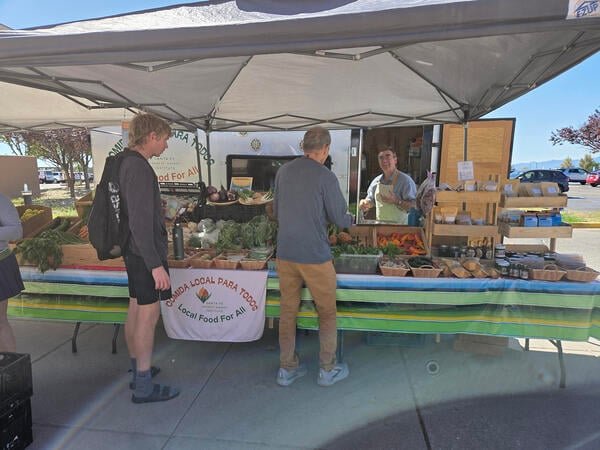
Among the participating institutions is Santa Fe Community College, where the Campus Cupboard provides free groceries, hygiene products and baby supplies to students and other members of the campus community.
LaNysha Foss, director of the Student Wellness Center at Santa Fe Community College, said the college joined Food Recovery Network’s initiative to expand its efforts to provide students with access to fresh, healthy food. The college has partnered with local farmers’ markets to recover high-quality produce that would otherwise go unsold, often purchasing items at below-market rates.
“We got involved with the [Food Recovery Network] by focusing on produce because the demand was that students were saying high-sodium canned foods were not the best way to feed their families,” Foss said.
The college has also recovered nearly 300 pounds of produce grown in its on-campus greenhouse for students in need, and is exploring ways to expand its partnerships with roughly 70 farmers across northern New Mexico.
“If you’re a student at Santa Fe Community College, you can get a week’s worth of groceries every week,” Foss said. “The fact that we have produce really makes [our pantry] come to life.”

Elvis Mmuo, a Santa Fe Community College nursing student, displays freshly washed produce delivered by the Santa Fe Farmers Market Institute for the college’s Campus Cupboard.
Santa Fe Community College
Foss said access to reliable, nutritious food can have a direct impact on students’ ability to attend class, concentrate on coursework and persist toward completing their credential.
“The nonacademic concerns that students face are the foundation of their academic success,” Foss said. “It’s not bifurcated. We find that the students who get access sooner and get the food that they need, that helps save them money.”

Locally grown surplus produce from the Santa Fe Farmers’ Market Institute.
Santa Fe Community College
The bigger picture: Harmon said addressing food insecurity is about more than meeting an immediate need—it can help remove financial barriers that might otherwise prevent students from completing their education.
“Having access to food on a college campus can sometimes be what will get that student to the finish line of getting their degree or their certificate,” Harmon said. “When the decisions that people have to make consistently—food, rent, gas money, all of these things—when they can have their food accounted for, that means that they can use their money for other items, books and gas to get to class.”
Foss said colleges should view basic-needs support as a core component of student success rather than a service that exists alongside academics.
“It’s the most foundational component, and it’s not just about the individual students; it’s about their entire family as well,” Foss said. “Food inflation is outpacing regular inflation, so when we meet the need for their access to food—and not just any food, but quality food—then we see that it really helps them succeed in all areas of life.”
You may be interested

Marine veteran amputee recalls dragging wheelchair during ultramarathon: “My chair isn’t me”
new admin - Aug 27, 2026A Marine veteran who lost his legs to an IED blast while being deployed in Afghanistan in 2012 found a…

Of course Samsung made a 1,100Hz gaming monitor
new admin - Aug 27, 2026Samsung announced its upcoming lineup of Odyssey gaming monitors today at Gamescom, and says that several will feature “world-first innovations”…

Boden's 'stylish' knitted sale jacket is 'the perfect summer into autumn piece'
new admin - Aug 27, 2026The Phoebe Collared Knitted Jacket is 'selling like hot cakes', according to Boden Source link