


Trump Attack on Higher Ed “More Serious Than McCarthy Era”

Almost immediately after President Donald Trump took office for the second time, his administration brought down the hammer on universities, freezing hundreds of millions of dollars in federal research grants while launching probes into diversity, equity and inclusion efforts and seeking to eliminate what it considers the liberal bias of American colleges.
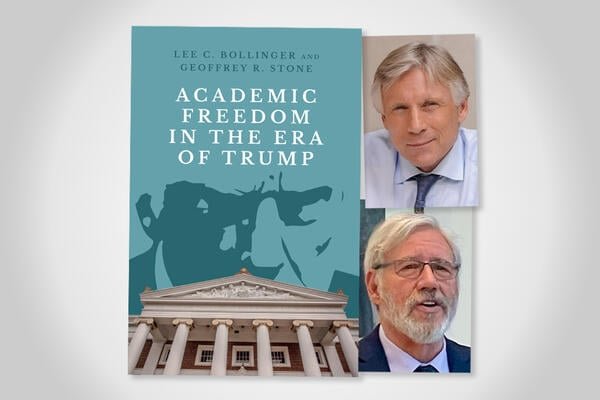
For former Columbia University President Lee Bollinger and University of Chicago law professor Geoffrey Stone, the Trump administration poses a “historic threat” to academic freedom—a principle that they argue is legally ill-defined and therefore vulnerable.
Bollinger and Stone tapped into their vast network of First Amendment experts and asked each to contribute a chapter to their new volume examining academic freedom through a legal, historical and philosophical lens. “We know most of the influential scholars in the realm,” Bollinger said. “It was not difficult to come up with a list.”
The resulting book, Academic Freedom in the Era of Trump (Oxford University Press), contains 20 chapters from 21 experts, including Columbia law professor Olatunde Johnson and Yale law professor Robert Post. Chapter titles range from “The End of the Cold War University” to “Little Fascists Everywhere: The National Socialist Playbook of Trump’s War on Universities.”
The two editors spoke to Inside Higher Ed over Zoom about what the first year of Trump’s second term has revealed about the federal government’s obsession with controlling universities, why it might continue and how it can be stopped.
The interview has been edited for length and clarity.
Q: When did you start thinking about putting together a volume like this?
Stone: It was not long after the beginning of the [second] Trump administration, when policies were put in place that disadvantaged a number of universities—including Penn and Columbia, for example. It became obvious that the Trump administration was using its authority—particularly its power over money—to impose upon universities [changes] that the administration wanted to inflict upon higher education. At that point, it became pretty clear that a book along these lines would be important.
Bollinger: Across higher education broadly, it was perceived as the most significant assault on the universities’ autonomy in decades. From my point of view, [it is] even more serious than the McCarthy era, because McCarthy was one senator. This is the president of the United States and the entire administration. So, it’s really a historic threat.
I would add—we didn’t seem to be doing very well in resisting. It was very scattered. The responses were fragmented, and the [academic freedom] principles at stake are not as well developed as one might think. So, getting together people who have thought about these things for a lot—if not all—of their professional lives to reflect on this seemed like a really important thing to do.
Q: You write that the McCarthy era is the closest historical parallel to what’s happening today, but as you just said, McCarthy was just one senator. Where does that comparison hold up, and where else does it diverge from what we’re seeing now?
Bollinger: One has to look at what the Trump administration is really trying to do. There’s a stated concern with trying to stop antisemitism on some campuses, but the law—with respect to withholding funding—is very clear about the processes that the government has to follow in order to cut funding. They just blew past those. So right away, there was a sense that this wasn’t really about antisemitism. This was about something else.
If you look at their demands on universities, they have nothing to do with antisemitism. They have to do with DEI and making sure that universities don’t have policies that deal with race or ethnicity. They want data about admissions policies to put pressure on universities not to admit African Americans, Hispanics, Native Americans. They [insist] on reviews of certain academic departments, and that’s completely outside of what is normally thought about in [universities’] relationship with the government. They wanted to have power over hiring decisions, and they wanted to insist that certain kinds of academics—conservatives—will be hired. They have incredible power.
We’ve not seen anything like this in decades and decades, and honestly, I think we were not prepared for it.
Stone: Traditionally, the way universities have operated is that they are largely independent. They have First Amendment rights to decide for themselves how to teach, how to hire, what scholarship is appropriate, and the government cannot generally interfere with that directly. It could not pass a law, for example, saying that a private university can’t hire someone who teaches something about race or something about religion or something about gender. That would be a violation of the First Amendment. So, what the Trump administration has figured out it can do—unlawfully, in my view—is use funding instead to manipulate that.
Bollinger: The principles at stake—generally referred to as academic freedom—are not as elaborately developed as we would like them to be … The principle of academic freedom came out of a faculty movement in 1916. It’s very often referred to, but it’s not as developed as the modern world needs for a variety of reasons, and it’s not as ensconced in constitutional doctrine as it ought to be, given the threat that we’re facing. So, another reason for doing the book was to try to identify where the law needs to develop in order to protect against what’s happening.
Q: What did you find? What would it take to really enshrine that in the law?
Stone: Part of what’s necessary is for courts to say that it violates the First Amendment for the government to withhold funds from a university because it is trying to compel the university to engage in or refuse to engage in various types of expressive activities. If the government wanted to pass a law that said, “Universities cannot do these things,” that would almost surely violate the First Amendment. So, what the Trump administration has done instead is use the bullying of withholding funding, and universities are vulnerable in that respect.
Even if the withdrawal of funds is a violation of the First Amendment, it can take a long time to win those cases, and in the meantime, you have to deal without that funding. Universities have been effectively coerced.
Bollinger: We need litigation over time … so that there’s development of the constitutional law. We need to go back and review the laws that govern funding—Title VI in particular—to see whether there are new or additional constraints on the government that need to be enacted in order to continue with the funding program that’s been in place since World War II.
Sometimes academic freedom is referred to by faculty against their own university administration. That’s fine, but we’re really talking about something that is a university principle or value, and so we need to straighten that out in our minds. We also need to think about what happens when the government comes in and attacks. [For example], they’ve gone after university presidents. What should be the academic response to that internally? In some cases, that puts the board of trustees or the board of regents in power, and while they may be terrific people and doing great service, it’s not clear to me that [having the board in charge] continues the strength of academic values to the degree we need.
Q: The Trump administration’s showdown with Harvard became an example of what was going to happen over the next year. What did that confrontation reveal to you about the limits, or lack thereof, of the federal government’s leverage over private institutions?
Bollinger: They have total leverage. If they really want to destroy an institution, they can do it. Now, we don’t know how the courts will respond to this and what the claims will be exactly, but the government has just enormous power over universities. That’s what’s been revealed by this.
We should also say that this has not happened just with universities, but with almost every other sector of civil society. Law firms have been singled out for representing clients that the Trump administration didn’t like. They’ve gone after the press for speech that is clearly protected. They’ve gone after businesses. This is a broad-based attack that amounts to an authoritarian-style encroachment on civil institutions.
Stone: To illustrate the First Amendment aspects of this, suppose that the Trump administration were to say to universities, “We will cut all of your federal funding unless you agree never to allow anyone on your campus to criticize the Trump administration.” That would clearly violate the First Amendment, and nobody—except maybe Trump—would disagree with that. The same principles are at stake when the Trump administration says, “You cannot teach certain things, or you must teach certain things, or we will cut all your funding.”
There’s no right to the funding in the abstract. The government is allowed to decide whether to give money or not to institutions, but they should do that based upon legitimate considerations of the value of the research that the institutions are engaged in, not to use the funding as a way to manipulate the ideologies of the universities.
One of the things that the Trump administration has focused on is the claim that many institutions of higher education are significantly biased in their ideologies—that they’re not as neutral as they would like to pretend to be. This claim has some merit to it, in the sense that if you compare the views of faculty, particularly in the social sciences, to the general public in the United States, they tend to be more liberal … Is there a distortion, and should that be taken seriously? That should not be answered by the federal government. The government should not try to figure out what people in the history department or the English department believe—that should be something for the university itself to decide.
Q: What do other countries’ experiences with government pressure on universities suggest about how this might play out over the next decade or so?
Bollinger: The two that are very prominent and frequently referred to are Turkey and Hungary, and in both cases, [President Recep Tayyip] Erdoğan and [former Prime Minister Viktor] Orbán went through periods where they basically did the same things. They removed administrative and academic leaders. They imposed controls over what could be said and taught. And even though there was resistance from the universities, the government power was sufficient—not to remove academic life completely, but to keep it from thriving. They were successful for many years. Orbán has been defeated in office, and Erdoğan is perhaps at the end of his time. But we’re talking two decades [of power], so it’s a very long, long period of time.
We’re in the early stages of this, hence the book … We don’t know whether the administration will be consumed by foreign wars and foreign issues and affairs and forget about the academy and other parts of civil society, or whether they will double down on this. And we don’t know what the next administration will be.
There is this view out there that universities deserve what they’re getting because they have departed from their mission of being neutral and they’ve become political ideologues. That’s a very common criticism. There’s always some truth to that, as Geof indicated, but if you spend any time in universities, that is not the reality of what it’s like. Even if you have very liberal views, I think faculty regard it as a professional obligation in the classroom and elsewhere in their professional lives to be balanced and open to ideas. There’s been this concerted campaign by the right to take examples of intolerance—disinviting speakers or shouting down speakers, all of which is terrible—and to use them to stereotype universities.
It’s very common for people to say universities have lost their way. They’re ambivalent about it. But they still want their children to go there. They still believe that [American] higher education is the best in the world. But the right has been successful in capturing at least part of the narrative about universities, all of which means that even with the end of Trump’s term, that may continue. There will be other politicians who will want to jump on that theme.
You may be interested
3 Key Changes in Trump’s New Accreditation Rule
new admin - Aug 26, 2026[ad_1] The Trump administration’s sweeping plan to reshape how accreditors oversee colleges and universities was released for public comment last…
Bill Gates is deeply worried about AI, and he’s no longer staying quiet
new admin - Aug 26, 2026Bill Gates has been reflecting a lot on AI lately, and the process has triggered a stark awakening. Once a…
The Secret Lies in the Gut
new admin - Aug 26, 2026Laurie Cox spends her day investigating the role of the gut microbiota in neurologic diseases like Alzheimer's and Parkinson's. This…