



New Student Visas Dropped 23% in 2025

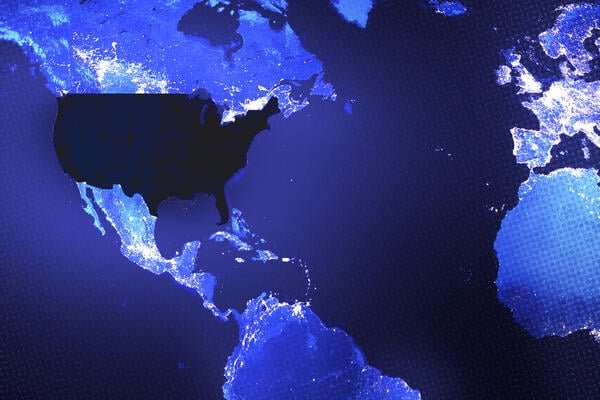
One expert attributed the declines both to constraints in the visa system, but also a lack of trust in the U.S. higher education system among international students.
Photo illustration by Justin Morrison/Inside Higher Ed | NASA
Twenty-three percent fewer student visas were issued in 2025 compared to the previous year, according to newly released Department of State figures. Some countries, like Iran, Myanmar and Venezuela, saw declines over 70 percent from year to year. India, the second-largest supplier of international students to the U.S. in 2024, also experienced a precipitous 56.6 percent drop.
An Inside Higher Ed analysis of the data shows that visa issuances were essentially in line with the previous year for the first several months of 2025 but dropped in May—the same month President Donald Trump paused all student visa interviews to implement new social media screenings for those applicants. The number of student visas issued remained below 2024 levels for the remainder of the year.
The largest decrease was among F-1 visa holders, who are in the U.S. seeking a degree and who are at the center of concerns about how the Trump administration’s international student policies will impact enrollments; those visas declined by 33.4 percent, versus 9.9 percent for J-1 and 6.7 percent for M-1 visas. (J-1 visas are for students and scholars in certain exchange programs, including the Fulbright program, while M-1 visas are for students in nondegree or vocational training.)
It’s unclear when the department released the new data; the last round of new visa-issuance data came out in March, when the department released figures showing that 35.6 percent fewer student visas were issued in summer 2025 compared to summer 2024. Although summer is a key time for incoming international students to secure their visas, the new data shows that those declines persisted into the fall, even as some incoming students hoped to defer their admissions to the spring because they couldn’t get their visas in time.
The year-over-year decline in student visa issuances was slightly less severe in the fall, at 28.4 percent. But one expert said she doesn’t see that as a sign of recovery.
“In 2025, visa-processing disruptions and new screening requirements clearly constrained the pipeline, but uncertainty itself can become a demand problem: Students who perceive the U.S. as an unpredictable destination may decide not to apply or may choose another country,” Rajika Bhandari, principal of Rajika Bhandari Advisors, an international education research and strategy firm, and co-founder of SouthAsia-IEN, a network connecting higher education professionals across South Asia, wrote in an email to Inside Higher Ed. “Prospective students are pivoting to nontraditional European destinations or other countries closer to home.”
Indeed, numerous factors likely contributed to these declines. The pause on interviews in May led to ongoing backlogs for visa interviews and processing, experts have said, with students struggling to get their visas in time for the start of the semester. F-1 visa refusals also surged in 2025, according to an analysis of State Department data by Shorelight, an international education firm.
At the same time, studying in the U.S. has become less appealing to some students amid the Trump administration’s larger crackdown on immigration. The Common App recently reported declines in applications from international students to study in the U.S. for the 2026–27 academic year. New regulations limiting how long students may study in the U.S. and ongoing concerns that the Trump administration plans to close off pipelines for students to work in the country after they graduate are making the U.S. a less appealing place to earn a degree, some experts say.
Advocates warn that drops in international student enrollment will not only be detrimental to U.S. institutions that rely on them to meet enrollment and revenue goals, but also to the country as a whole. International students are invaluable drivers of much of the U.S.’s research and innovation; they also funnel billions into the U.S. economy. NAFSA, an association for international education professionals, predicted that a drop in international students in the 2026–27 academic year will result in $3.4 billion in losses to the U.S. economy.
Which Students Are Impacted
China and India, historically the two countries that send the most students to the U.S., both saw significant drops in visa issuances—28 percent and 56.6 percent, respectively. Chris Glass, a professor and director of the executive doctor of education in higher education program at Boston College, said he sees those decreases as something of a rightsizing; Chinese and Indian students have only come to represent such a massive portion of international students in the U.S. in the past few decades.
He also said that these decreases seem to align with the Trump administration’s goals to not only tackle illegal immigration but also tighten the reins on legal immigration; a significant portion of Indian immigrants come to the U.S. as F-1 students before beginning optional practical training and later entering the H-1B system.
“I think the international education community will respond to these numbers with grave concern,” he said. “The current administration will see this as progress toward a policy goal.”
India is one of the countries that saw the largest decline from 2024 to 2025. But it wasn’t the biggest drop—that was Iran, which saw a greater than 90 percent dip compared to 2024, when over 3,000 student visas were issued to Iranians. Several of the countries that saw the biggest dips in 2025, including Iran, were subject to either the partial or full travel ban the Trump administration put in place last year. But others, like Nepal, Ghana and Kyrgyzstan, weren’t subject to the ban.
Only 32 countries out of over 200 listed in the data saw year-over-year increases, and, in many cases, these increases represented a very small number of students; Palau, for instance, increased its student visas from five to six. But several European countries—especially in eastern Europe—saw significant increases. Serbia and Moldova grew by 21.6 percent and 17.2 percent, respectively.
Those figures line up with the Shorelight analysis of visa refusals, which found Europeans experienced the lowest visa denial rates and that those rates were holding essentially steady as refusals climbed for African and Asian applicants.
Bhandari said it’s impossible to use these numbers to guess at how the situation will continue developing into 2026 because of how much has changed for international students in the past year.
“The question is no longer simply one of capacity and whether the U.S. can process enough visas; rather, it is a question of whether the U.S. continues to be an attractive and predictable destination for international students,” she wrote. “International students vote with their feet—currently, they are choosing to walk away from the U.S.”
You may be interested

Enes Kanter Freedom banned from home games of WNBA’s Chicago Sky, owner says, calling him “potential threat”
new admin - Aug 26, 2026Chicago — The Chicago Sky have banned Enes Kanter Freedom from their home games after the former NBA center was…

Families with one earner told 'use £2,880 rule' to avoid pensions raid
new admin - Aug 26, 2026Current rules around tax and finance 'unfairly penalise' single income families, but expert at AJ Bell says there are some…
3 Key Changes in Trump’s New Accreditation Rule
new admin - Aug 26, 2026[ad_1] The Trump administration’s sweeping plan to reshape how accreditors oversee colleges and universities was released for public comment last…