

Colleges Adopted “Systemic Suppression” of Protesters


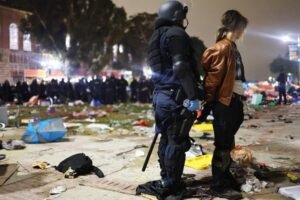
A California Highway Patrol officer arrests a protester on May 2, 2024, while clearing a pro-Palestinian encampment at the University of California, Los Angeles.
Government officials and university administrators took “heavy-handed” and “excessive” actions in response to campus protests after Oct. 7, 2023, actions that “disproportionately targeted” pro-Palestinian students and faculty members, creating a chilling effect that will stifle political expression for years to come, a new report says.
Produced by the American Civil Liberties Union and Amnesty International USA, the 287-page report documents what it calls the “systemic suppression” of anti-genocide speech at colleges and universities across the country. The “McCarthyite censorship” against individuals who exercised their right to free speech and criticized the Israeli government for the nation’s protracted war in Gaza continues to this day, the authors argue.
“Universities’ responses to campus-related Palestine advocacy and pro-Palestinian demonstrations have been more punitive in comparison with their historical responses to other comparable demonstrations over decades,” the report says. As a result, “These universities directly or indirectly have made it easier for the Trump administration to crack down on student activism, causing long-term damage to higher education.”
Based on a two-year investigation, the report covers events, policies and practices that have unfolded since the terror attacks of Oct. 7 at 80 public and private colleges and universities across 28 states and Washington, D.C. It draws on college records, statements from government agencies and officials, court records, case law, media reports, and survey responses from students who participated in protests at 41 colleges. (Ninety-six individuals completed the survey.)
To illustrate their arguments, the ACLU and Amnesty International zoomed in on six institutions: Columbia University; City College of New York; Tulane University; the University of California, Los Angeles; the University of Michigan; and the University of Texas at Austin. They also include in-depth case studies of a handful of international student protesters the Trump administration targeted with arrest, detention and/or deportation, including former Columbia University student Mahmoud Khalil and Tufts University Ph.D. student Rümeysa Öztürk.
Collectively, the findings show that “hundreds, if not thousands, of students at universities nationwide have faced campus disciplinary proceedings,” sometimes as severe as suspensions or expulsions—though it’s impossible to know the exact count, as many colleges have kept their disciplinary processes under wraps, the report notes. The targeting of pro-Palestinian students and faculty has led to “a steep decline in protests and a less visible protest movement on campuses across the country,” it concludes.
The report echoes the findings of a previous Inside Higher Ed analysis, which shows similar trends of stifled free speech, particularly in support of left-wing causes.
“These punishments can impose severe and lifelong consequences and profoundly disrupt students’ lives and academic careers,” the report authors write. “Instead of targeting students and faculty who are expressing their right to protest and association, higher education institutions have a responsibility to protect these rights. The First Amendment compels public universities and colleges to respect free speech rights and some have failed these obligations.”
The report states that more than 1,360 pro-Palestinian student demonstrations took place in the United States between Oct. 7, 2023, and May 3, 2024—97 percent of which remained peaceful. It details how many prompted forceful responses from campus police or local law enforcement summoned by university administrators, citing reporting showing that protesters were detained at more than 70 institutions; police arrested more than 3,200 people on campuses.
The punishment didn’t end there. Since the period covered in the report, colleges have continued to censor expression that criticizes Israel and to enforce campus codes of conduct against pro-Palestinian student activists. The nonprofit group Palestine Legal reported that in 2025, it received 663 requests for legal assistance in cases in which university administrations were investigating or had imposed sanctions for campus-related Palestine advocacy—up from 580 in 2024. In many cases, the report says, university enforcement of campus policy was “selective” and “far beyond what universities have historically imposed for similar acts of civil disobedience.”
The authors argue that much of the disciplinary action came as a result of pressure from the government and donors. They also criticize universities for adopting the “overly broad” definition of antisemitism outlined by the International Holocaust Remembrance Alliance, which includes “denying the Jewish people their right to self-determination” and “drawing comparisons of contemporary Israeli policy to that of the Nazis.” The report contends that such speech is protected by the First Amendment.
“Speech that is critical of Israel cannot, alone, constitute harassment,” the report says. “Campus policies incorporating the IHRA definition of antisemitism misconstrue antidiscrimination law to censor and stifle campus speech.” And while universities have often cited complying with Title VI of the Civil Rights Act—which bans discrimination based on race, color or national origin in federally funded programs—as a reason for dismantling pro-Palestinian protests, the reports’ authors say the IHRA definition goes “far beyond” what Title VI requires.
Between the spring and fall terms of 2024, the total number of protest actions dropped by more than 64 percent, the report notes, and protests have continued to decline since. Yet support for the people of Gaza has actually grown: According to a March 2025 Gallup poll, sympathy for Palestinians had reached a record high, while U.S. support for Israel had reached its lowest level in at least 25 years.
Among other recommendations, the report calls on university leaders to apply campus conduct codes and protest policies “fairly and neutrally to all students” and to “resist” pressures applied by the federal government.
That means upholding free speech protections for all students and scholars, regardless of nationality, ethnicity or race; ensuring that students have ample channels for expression on campus and that law enforcement is used only as a measure of last resort; and refraining from adopting policies that rely on overly broad and vague definitions.
“We urge universities and college administrators to resist the temptation to silence students or faculty members because powerful voices deem their views offensive. Instead, we urge them to defend the university’s core mission of encouraging debate, fostering free-flowing inquiry, and preparing the future leaders of our pluralistic society to tolerate even profound differences of opinion,” the report says.
You may be interested
How a Cornell Committee Wants the University to Change
new admin - Sep 23, 2026[ad_1] As higher education contends with seismic upheaval, the university cannot remain “exactly as it is today,” faculty at Cornell…
OpenAI nabs key Patreon execs ahead of upcoming announcement
new admin - Sep 23, 2026OpenAI has hired three former Patreon execs to anchor its product strategy for creators. After starting the creator subscription platform…

An ancient wall discovered beneath a Paris hotel could confirm the city’s origins: “Major breakthrough”
new admin - Sep 23, 2026An ancient wall discovered beneath Paris was described as a "major breakthrough" on Wednesday by France's culture ministry, with the…