

Heard at a Workforce Development Conference

Last week, Westmoreland hosted the Resilient Energy Technology and Infrastructure conference in collaboration with West Virginia University. It brought together educators, students and employers to talk about future directions. I was in listening mode.
The line that jumped out at me came from a speaker on an employer panel. Responding to a question about AI use, she offered that “there will be two kinds of employees: those who are willing to use AI and those who are not,” and suggested that the latter would be consigned to the lowest rungs. The other panelists nodded in agreement. They added that traditional skills will still matter, but that willingness to engage with AI to solve problems was emerging as a nonnegotiable.
When they discussed the oft-derided “soft skills,” they defined effective communication skills as being willing and able to point out problems to bosses tactfully but clearly. It was as much about temperament as skill. I’m not sure how to capture that in an outcomes assessment exercise. We can capture the “able,” but I’m not sure how to capture the “willing.”
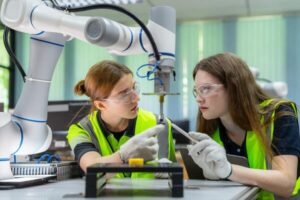
The two organizing themes of the conference were energy and advanced manufacturing, so it wasn’t surprising to hear repeated calls for electricians and engineers. The employers complained about the challenges of recruiting “qualified” candidates to the area—Western Pa., West Virginia and eastern Ohio—but I was struck by their definition of “qualified.” They wanted five to seven years of relevant experience, in addition to the right training and degrees. When an alert audience member asked about how new grads are supposed to break in, there was a pause, followed by half-hearted references to internships.
I’ve never heard of a five-year internship.
They mentioned other barriers to filling positions, such as a lack of childcare options and limited public transportation. One moderator mentioned drug testing, though the panel moved past that one quickly. But I couldn’t get past the chicken-and-egg problem of ruling out people who don’t already have multiple years of experience. (In response to a question about what colleges could do to help, one speaker asked for access to our alumni database, so her company could focus entirely on people who’ve been out there for a while.) If anyone is casting about for an explanation as to why people in their 20s are proving amenable to radical politics, this seems like a good place to start.
A separate panel addressed the generational stigma that still adheres to vocational education and community colleges. Parents who grew up in the ’80s and ’90s absorbed the message that blue-collar work was dying and that high-tech was the future. In their defense, that was the era of downsizing and offshoring, so the idea matched its time. As the boomer generation of skilled tradespeople retires, though, there often isn’t a comparably sized cohort behind them. I’m not sure that HR departments have quite caught up to that reality, based on their expectations of experience, so some of what looks like a shortage from an employer’s perspective is at least partly self-inflicted. Still, it’s true that many parents now base their advice to their kids on the world they remember from the ’90s and ’00s.
The solution that the small panel came up with had two parts: reach the kids as early as eighth grade, and include their parents while you’re at it. Parental disapproval can keep kids away from areas of interest. I couldn’t disagree.
A panel of current students was the highlight. When asked what they were looking for in employers, a few of them mentioned values aligned with their own. Nobody mentioned retirement plans. One went out of his way to defend his generation’s honor, saying that his generation wants to work, but that sometimes it gets shut out. Another student asked for employers to provide job-shadowing opportunities for students so they could get a sense of what the day-to-day reality of a job actually is. (To her credit, a later panelist agreed, noting that the cost of a shadowing day or week for the employer is basically zero.)
I came away from the day struck by what seemed like expectations gaps. The employers want experienced workers right out of the gate, which isn’t how experience works. The students want legible opportunities that allow them to grow into roles. Schools want to meet employers’ needs but define terms like “communication skills” differently.
That said, I liked the idea of addressing the “willing” part of “willing and able to point out problems.” It hearkens back to a classical idea of character education. Yes, students need to know the latest technology, and yes, employers need to be a bit more realistic. But as far as the task at hand for educators goes, we may need to get back to our roots. I’m on board.
You may be interested

Watch: Massie's full speech introducing impeachment articles against Hegseth
new admin - Nov 09, 2026GOP Rep. Thomas Massie on Monday introduced new articles of impeachment against Defense Secretary Pete Hegseth. These were his full…

Everything we know so far about the Nvidia spy scandal targeting CEO Jensen Huang
new admin - Nov 09, 2026The leather-jacketed CEO of Nvidia, Jensen Huang, has acknowledged an affair with Megaspeed exec Alice Huang, spurring an investigation by…

Trump Media revenue surges on high-speed Truth Social access
new admin - Nov 09, 2026[ad_1] Trump Media and Technology Group on Monday reported that revenue surged 205% in the third quarter, which it says…