



As Government Encroaches, Presidents Must “Lead the Sector”

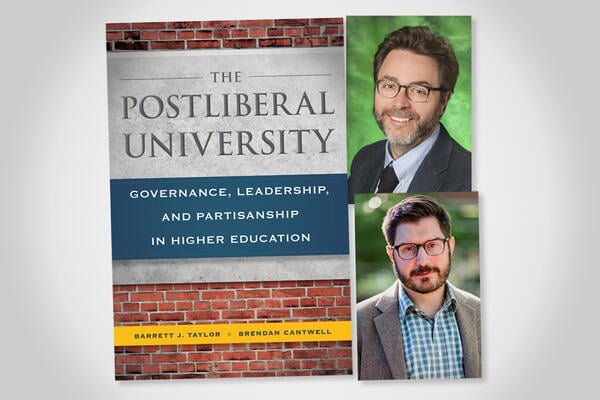
Higher education governance experts Brendan Cantwell and Barrett Taylor said their new book was tough to write. Over the past two years, they tried to keep up with the churn of higher education news, each headline more outrageous than the last—federal agencies slashed research funding, the Trump administration launched dozens of probes into university admissions practices and state governments got directly involved in curriculum and shared governance, to name a few noteworthy developments.
“There was a temptation to serve as a kind of news aggregator, but that’s not what we wanted to do,” said Taylor, a professor of higher education at the University of North Texas. “We’re professors. It’s our job to understand the broader underlying systems at work here.”
So instead of trying to analyze the news, they sought to “explain how we got to this point, and then offer a robust way to think about what will happen from here,” Taylor said.
The resulting book, The Postliberal University (Harvard Education Press, 2026), provides a framework for readers looking to understand the news they’re reading, said Cantwell, who teaches about higher education and education policy at Michigan State University. The book examines the partisan forces that have shaped higher education governance over the past several decades and offers university leaders concrete ideas about how to preserve the mission of higher ed and steer their institutions—and the sector as a whole—through this period of increasing government meddling.
Inside Higher Ed spoke with Cantwell and Taylor over Zoom about the book, the differences between neoliberal and postliberal governance, and how higher education leaders should meet the moment.
The interview has been edited for length and clarity.
Inside Higher Ed: Many higher ed news events over the past year have been called unprecedented, but as you were looking back, are there any precedents that you identified which other people missed?
Taylor: It’s true that things are unprecedented because things are moving really fast and escalating. We did identify, I think, quite a few precedents for ways in which states have systematically expanded their authority over higher education and constrained the capacity of the academic profession—people who work on campuses—to shape decision-making in higher education. That expansion of state authority into areas like curriculum and personnel helps to explain a lot about some of the newsier items coming out of the federal government over the last couple of years … Those state actions also helped to explain how governments—and a slice of the public—became suspicious about the ways higher education had operated, and [why state leaders] began to develop this new way of governing higher education.
Inside Higher Ed: What defines a neoliberal university versus a postliberal one?
Cantwell: We wrote a book in 2019, and we worked very hard to avoid the term “neoliberal,” in part because that term had been used so loosely in our field and others to describe everything we don’t like. Well, we actually embraced it in this book because we saw it as an opportunity to delineate the goals of higher education and the general understanding of how those goals should be pursued. So the neoliberal university—or neoliberal governance—is a higher education that is oriented towards private goods: getting people jobs, generating wealth, contributing to innovation and doing things efficiently. It’s a higher education that was pretty expansive and open and had the idea that more and more people should be involved.
Under these conditions, where the goal was to deliver on mostly economic outcomes, higher education was organized through competition. Competition, accountability and indirect government steering through things like performance funding were used to direct colleges and universities from a distance and orient them towards … private good outcomes. That way of thinking about higher education—while there’s lots of elements to it that are still active today—is really receding, and a new way of thinking about higher education and governing higher education is emerging.
Taylor: We use the concept of a “governance accord” to talk about the goal, as Brendan put it, and then the means of pursuing that goal [through] downstream policy and implementation. The easiest way to think about the shift from neoliberal to postliberal governance is as a move away from that private good goal toward what we call the partisan good. We define the partisan good in two senses. First, it is a broad understanding that higher education should be more subject to political control—that governing coalitions at the state level should have and exercise more authority over public universities. That’s largely a bipartisan project. It looks different in red states, blue states and purple states, but in a variety of states, governments are expanding their control and their authority over higher education in more direct ways than the indirect competition steering that characterizes neoliberalism.
The second sense of the partisan good [looks at specifics]—because there are two major political parties in the U.S. and they’re doing very different things. Republican-controlled states have generally been much more aggressive and intervened much further in matters like curriculum, shared governance, faculty working conditions and teaching and learning than have Democratic or divided governments. So, they’re doing very different things, but they’re all expanding authority over higher education.
If we think about performance-based funding or outcomes-based funding as a steering mechanism, implicit in that is a sense that higher education is not trustworthy to fulfill its objectives—that it needs to be held to account. If those don’t seem to be working, then maybe states take a more direct steering approach to accountability. Particularly, but not exclusively, in red states, I think that starts to happen.
Inside Higher Ed: In the book, you talk about a “neoliberal Trojan horse.” What does that mean, and what are some examples?
Taylor: We use the phrase “neoliberal Trojan horse” to refer to an initiative or an effort that is consistent with the postliberal goal of the partisan good, but that is cloaked or made legible in terms that would be familiar to neoliberal governments. If you are someone who has—as I have—been around higher education for a while, you’re steeped in neoliberal assumptions and ways of operating. When someone says, “We need to do this because it will make higher education more efficient,” or “because it will increase return on investment,” that is hard to contest, because a default assumption for several decades now under neoliberal governance has been that that’s the purpose of higher education … A neoliberal veneer over something that has a postliberal goal within it—that’s where we use the phrase “neoliberal Trojan horse.”
Cantwell: A couple of examples might be laws that have passed in several states that direct universities to conduct reviews and eliminate programs based on enrollment. [Laws] focusing on efficiency and making sure that it’s a good value for money spent on the program—I’m thinking of Iowa and Ohio, for example—are often paired with laws that take a more direct role in reshaping the curriculum through civic centers and changing the general education requirements. So you have this one law that is leading to the closure of programs that the state does not like using a means that seems more palatable, more legitimate. A neoliberal Trojan horse is often accompanied by other kinds of more direct controls; you welcome the horse in, and then the [direct controls] of the state jump out.
Inside Higher Ed: You conducted a survey for the book, which found that a lot of the public skepticism about the sector is centered on whether higher ed shares someone’s values, and not necessarily doubts about cost or efficiency. How does that finding change how universities should be making their case to the public?
Taylor: It’s a pretty succinct way to think about the change from neoliberal to postliberal governance. Under neoliberal governance—because it’s a private good model and the focus is on efficiently delivering those benefits—the most common response to public skepticism or critique has been to say, “We have a really high return on investment. Our graduates earn good wages. We’re doing what we can to make our education affordable.” All of those things demonstrate efficiency and suggest that private returns are, in fact, delivered. But that is very unlikely to assuage the doubts of someone who says, “I think this university does not share my values,” or “I think this part of the university operation does not share my values.”
If you can imagine a state official who expresses skepticism over the existence of a gender studies program, demonstrating that graduates of that program earn high wages is unlikely to persuade that person to keep the program open. That’s not the critique they were leveling. What they were saying is “I don’t think gender studies should be offered at the university.” And so, I think the fact that such a large share of respondents indicated that they didn’t perceive higher education as sharing their values is a pretty clear indicator that continuing to talk about efficient delivery of private benefits is using the rules of the previous governance accord to try and build trust, rather than the rules of the current one.
Cantwell: There are presidents who realize this value gap is a problem. I would point to Ron Daniels at Johns Hopkins as an example, but his response has been to say, “You know what? The public is right and we need to pivot to a more conservative university.” That is one way to respond. Another way to respond might be to say, “Hey, let’s build some internal consensus about what our values are inside the university, with the university as it is, and then work on communicating with community groups, with the general public, with members of the State Legislature about what it is that our values actually are and how we’re living them.” Not so much a defense, but clarifying what it is that the university does and why it does things that way to help bridge some of the gap between what people think the university is and why they think that is out of line with their values.
Inside Higher Ed: You urge presidents to lead higher education and not just their university. What does that look like in practice?
Taylor: Anytime there’s this kind of social disruption, there are going to be opportunities for some folks to take advantage of that and try to improve their own position—the position of their university, the position of their unit. Under neoliberal governance, that was very strongly encouraged. Your goal as a unit leader or a university leader or a system leader was to improve your competitive position relative to other units or universities or systems. We increasingly think the hostility that higher education faces—while individuals and institutions feel it oftentimes very acutely—really is directed at higher education itself as a social institution.
So, if a leader of a university looks at this disruption and says, “Here’s an opportunity for me to improve my university status by taking advantage of some of these new opportunities,” that might help a particular university to climb the rankings, and that might be good for that individual president or unit administrator’s career. But it is not good for higher education at a time when the entire sector is facing these intrusions from state government that make it harder to deliver on the benefits that we are supposed to deliver. And so we’re trying to encourage those folks to lead the sector rather than just their particular unit—to think about higher education itself as being under attack, and what they can do to support higher education rather broadly.
Cantwell: Higher education leaders could help to support the enterprise and help move us into a kind of new place, beyond where we are now, by starting to be quite honest about what they see as the direction of particular state governments and of the federal government.
For example, I see efforts to roll back the desegregation and inclusion initiatives that have taken place in this country since at least the mid-’60s as one of the possible goals of the second definition of the partisan good—where the Republican Party has an idea about the way society should look and who society should serve—and I think that higher education leaders might help to build some credibility if they were willing to lay out the stakes more clearly. This is about a return to a pre–civil rights era version of higher education, and what was that era like? It was smaller. Many fewer people participated in higher education. It was structured by race and gender. It involved many fewer connections with people from around the world, and those connections have led to a dynamic expansion of the science system in the United States and globally. You don’t have to explain it in an alarmist way. You don’t even have to explain it in an explicitly moral or political way, but lay it out as what is happening. Any serious analysis of some federal and state policies lead you to that conclusion.
You may be interested

Lawmakers return to Capitol Hill for lame-duck session, Democrats to hold leadership elections
new admin - Nov 09, 2026Congressional members are returning to Capitol Hill for the first time since Democrats' sweeping midterm wins. CBS News' Taurean Small…

October CPI report: Inflation likely slowed
new admin - Nov 09, 2026[ad_1] Americans are tired of inflation, as last week’s election results showed, but there may have been some relief last…

Trump says FBI to probe Nvidia’s Jensen Huang and Chinese spy
new admin - Nov 09, 2026[ad_1] President Donald Trump said that he had spoken to Nvidia CEO Jensen Huang earlier in the day Monday, after…