

Annual NACAC Conference Tackled AI, College Value

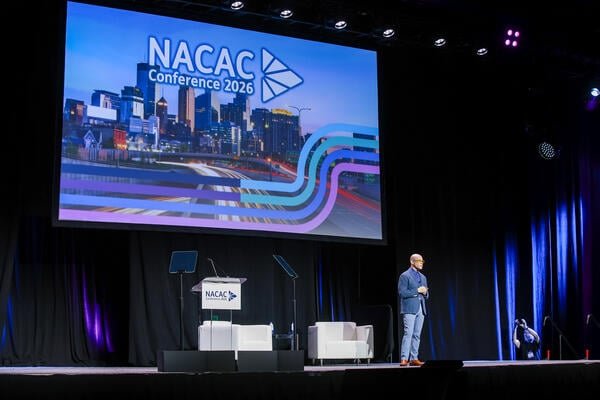
MINNEAPOLIS—It’s been a long year for higher ed. International enrollment has plummeted. Federal student loans have been capped. Funding cuts have stripped institutions of resources, degree pathways, research opportunities and employees. And through it all, admissions officers have had to do what they’ve always done: make their institution sound great to prospective students.
But at the annual National Association for College Admission Counseling conference in downtown Minneapolis last weekend, they got a reprieve. Multiple attendees told Inside Higher Ed that they found this year’s event uplifting: seeing old friends, hearing how colleagues are continuing to innovate despite political and institutional pressures, and feeling like NACAC has their back.
“One thing about our conference is that, for many of our members, [it] helps reignite them and energize them for the year ahead,” said Sean Robins, the association’s director of advocacy.
Inside Higher Ed was on hand to take it all in. Here are four key takeaways about where the admissions landscape stands and what to watch for in the year ahead.
1. The value of higher ed has become a bigger part of admissions messaging.
Questions about whether a college degree is “worth it” are nothing new. Still, admissions officers say they’re being hit with more queries than ever about whether a degree from their institution is worth the price tag.
In a session about challenges facing liberal arts colleges, Johnnie Johnson, vice president for enrollment management at Washington College, on the Eastern Shore of Maryland, said he is fielding more questions from parents about why they should choose his institution over another with a lower price tag. Joanna May, vice president of enrollment at Smith College, said that lately she has been focused on cataloging all the benefits that students get out of a Smith education, such as an alumnae network that stretches beyond Smith to the other women’s colleges in the Seven Sisters network.
That’s especially important for middle- and upper-class families who may not be getting substantial financial aid, she said. This past year, Smith launched an outreach campaign for admitted students who hadn’t received any financial aid, outlining some of the perks of studying at Smith, like a guaranteed research or internship experience and a professional development stipend.
“I try to shift the college away from purely price and talk about what you are going to get at a liberal arts college,” she said.
High school counselors, too, are feeling the shift to focus on ROI. At a session on extracurricular activities in the college application, Jeff Morrow, director of college counseling at Oaks Christian School in California, said he gets asked frequently now about whether parents should even send their kids to college.
“[They’re] questioning the notion, where before, I think students and families were not willing to question the value of college,” he said. “I think they’re asking more of those questions, which puts more pressure on.”
But Conner Stanfield, senior assistant director of admission at Grinnell College, told Inside Higher Ed that he wished more speakers at the conference had discussed how to talk with prospective students and families about the benefits of college outside of the job market and earnings.
“It’s not just that individuals who go to college make more money,” he said. “They also live longer, healthier lives. They’re more active in their communities. They vote more frequently, right? And we all know the importance of voting.”
2. Political talk was much more muted than last year.
In the year following President Donald Trump’s return to the White House, admissions leaders spent much of their energy preparing to manage a federal landscape they knew would be adversarial toward higher education. The topic was a strong theme at the 2025 NACAC conference, but this year, political presentations were sparser; only a handful of sessions delved into once-common topics like diversity in a post–affirmative action world.
Angel Pérez, NACAC’s CEO, said admissions staff members are more reticent now to talk about the current political landscape. Some planned panels were even canceled because the panelists’ institutions weren’t comfortable with employees discussing the administration publicly, he said.
“So many of our members used to speak to the media and were able to tell their own story of what’s really happening on a college campus, and now that’s increasingly harder,” Pérez said.
Among the political sessions that did go forward were a panel on testing policies in the context of the Supreme Court’s 2023 affirmative action ban, a workshop about race-conscious college counseling within high schools and an annual federal policy update presented by the association’s leadership.
Candice Mackey, a counselor at a public high school in Los Angeles, who presented the panel on race-conscious counseling, said she wanted her counselor colleagues to understand the role they can play in helping their students navigate the topic of race in the admissions process.
“We definitely heard good feedback afterwards,” she said. “At my core, I believe that we are in this profession because we do want to make a difference, and we want to do the right thing and support human beings.”
3. AI worries are evolving.
ChatGPT has been on the scene for almost four years now, and the admissions profession has been grappling with AI-written college essays for nearly as long. This year, though, attendees expressed less anxiety about applicants using chatbots to craft application materials than about how they’re using them to search for colleges.
Over the past year, multiple reports have highlighted the growing number of high schoolers using AI to narrow down their college search; some have said they get all their information about some institutions from the bots without ever navigating to those universities’ websites. As a result, institutions have focused on ensuring the information that pops up in AI chats is accurate—and that their institution is presented as an option at all.
During a panel on AI use across admissions roles, Ben Neely, chief academic innovation officer for the test-prep company Revolution Prep, shared data from a poll his company conducted of college students showing that 52 percent use AI to research colleges. (Similar research by EAB had comparable results, finding 46 percent used an AI tool in the search process.) Anecdotally, Neely shared that a friend of his son had recently used AI to search whether it was “OK to smoke weed at CU Boulder.”
“I think that students … feel like they don’t have to be as vulnerable [with AI] as humans,” he said. “This is a broad generalization, but today’s young people would rather go to a computer than an adult human in a lot of cases for some of the questions that they’ll have. And I think that AI is sort of feeding into that.”
Institutions are also increasingly wondering how AI can lighten their admissions workload, while being careful not to take the human touch out of the process. Alex Aguirre, a senior admissions counselor at Hamline University, a liberal arts college in neighboring St. Paul, said his office uses no AI tools, which is what prompted him to attend Neely’s session.
“Hearing out how some directors and other institutions are using AI as a part of their application process has been an interesting thought, as far as how we can be a little bit more efficient in our work,” he said.
4. More Americans want to attend college outside of the U.S.
Pérez told Inside Higher Ed that the conference received more proposals than ever focused on helping high schoolers and adult students apply to international colleges, with representatives from international universities across 35 countries in attendance. And high school counselors were interested in what they had to say: One session on common mistakes in U.K. college applications was filled to capacity.
“More students since last year have actually been considering studying outside of the United States,” said Pérez, noting that he’s heard from leaders at several Canadian universities that the U.S. is now their top source of foreign applications. “That’s very different than what it used to be. So obviously, it’s reflective of what’s happening with politics in America—just students thinking, ‘Perhaps I have other choices.’”
At a session about helping nontraditional students from the U.S. apply to international institutions, speakers from the U.K. and New Zealand affirmed that they had recruited American students looking to move due to the Trump administration. Kelsey Jackson, regional manager for the Americas at Victoria University of Wellington in New Zealand, said she’s worked with at least 20 families looking to study at her university for that reason.
But Alana Stuart, the regional manager for USA and Canada at the University of East Anglia, in England, said political pressures aren’t the only reason Americans are looking to complete their studies abroad. Some are “fed up” with elements of the American higher education system, including the cost and the general education model, which is less common in other countries. In the U.K., for example, students don’t take general education courses and graduate in three years; that can be attractive for students eager to get into the workforce, Stuart said.
“People are mad about what’s happening here,” Stuart said. “Education-wise and politically.”
The panelists also noted that Americans have become more aware in recent years that international degrees can be more accessible—and in some cases more affordable—than studying in the U.S. At the same time, they noted common barriers, such as more rigid admissions requirements, and recommended that interested students start their search by reaching out to a recruiter at least two years before they want to enroll.
You may be interested

Hackers turn up the heat in refrigerators at hundreds of supermarkets in France, sparking fires and food losses
new admin - Oct 12, 2026Major French supermarket chains on Monday said they were hit by a cyberattack that caused their refrigerators to shoot up…

Fontaines D.C. Tap Rosalía for Collaborative Single ‘Where Is Gone?’
new admin - Oct 12, 2026[ad_1] Fontaines D.C., teamed up with Rosalía for a new track, “Where Is Gone?” The song, produced by James Ford,…

IHEP Report Shows How Colleges Fare on 2 Earnings Tests
new admin - Oct 12, 2026[ad_1] New data shows how programs fare on two earnings-based value metrics. A new analysis from the Institute for Higher…