



Plans to Remove Blue-Light Emergency Phones Draw Criticism

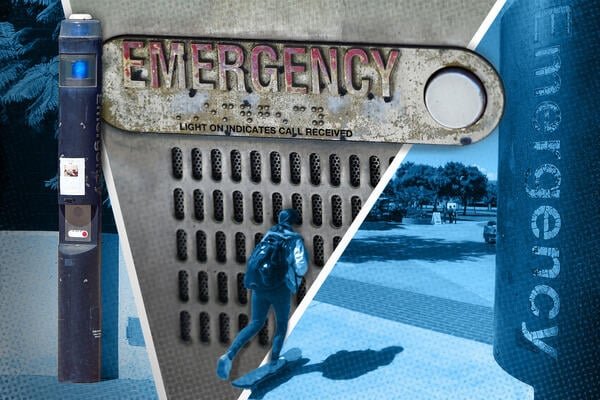
When Billyjoe Contreras was touring colleges with his daughter two years ago, he said they felt reassured by the big, blue emergency-phone light posts dotting the University of Connecticut’s campus.
“The tour guides took pride in the fact that at every blue light you could see the next blue light,” Contreras told Inside Higher Ed. “Young girls have to walk on campus late at night, and following the blue lights makes them feel secure … Those poles are the walls protecting our campus.”
But that sense of safety crumbled last month when UConn became the latest university to decommission many of its emergency phones. Although they became popular in the 1980s and ’90s to help address the threat of sexual assault and other crimes on campus, high maintenance costs, low use and the ubiquitous availability of cellphones have driven numerous institutions—including New Mexico State University, the University of Colorado at Boulder and the University of Nebraska—to shut them down over the past decade.
According to UConn, the phones have been activated only 166 times over the past five years, and all but two of those calls were tests or pranks. In addition, the phones cost $70,000 a year to maintain and currently need an estimated $6 million in upgrades.
“With the widespread adoption of cell phones in recent decades, the low volume of calls on the 1990s-era blue light phone kiosk system shows the community does not use or need it for its original purposes, and that it has become obsolete,” Stephanie Reitz, a university spokesperson, wrote in an email to Inside Higher Ed. “Supporting the largely dormant program and the costs associated with it is no longer practical or a good use of resources.”
That reasoning is cold comfort to Contreras, who said he’s especially troubled by the recent high-profile report of a rape at Cornell University, which allegedly took place at a fraternity house.
Although UConn said the blue-light phones will remain available in areas with poor cellphone reception, Contreras worries that elsewhere, people in emergency situations won’t be able to access their cellphone—assuming they have one and it’s charged—as quickly as pushing a button on a lamppost.
“No parent should have to go to bed at night and think that UConn took these lights away and our kids are now vulnerable to some perpetrator,” said Contreras, who earlier this month filed a legal complaint against the university in an attempt to prevent it from decommissioning the lights. “I don’t want one of our kids to be the face of a news story tomorrow morning.”
‘Relic’ of Stranger-Danger Era
Contreras isn’t the only person who wants the blue lights to remain on campus. As of Friday, more than 4,000 parents, students and other supporters had signed an online petition to keep UConn’s lights up.
“Even if these blue safety lights have only been used once or twice over the past few years, isn’t that reason enough to keep them?” one signatory wrote in a message of support. “Maybe they aren’t used more often because their very presence serves as a deterrent. Removing them and then waiting to see if they’re needed feels like a dangerous case of trial and error when we’re talking about the safety of our children.”
Others questioned how the university expects “young students to feel safe by removing blue lights,” and if UConn realizes “this is not the time to be removing safety measures on campus.” As the petition puts it, the lights are “more than just a safety feature—they symbolize security and peace of mind for students, staff, and visitors.”
In fact, their role in creating the perception of safety on campus—more than mitigating or preventing sexual assault and other crimes—is why they became so popular in the 1980s in the first place.
“A lot of campuses were concerned about darkness on campus and that pathways were not well lit. At the same time, there was rising awareness of campus sexual assault and the sense that there ought to be more opportunities for people to get help when they need it,” said Elizabeth Ellcessor, a media studies professor at the University of Virginia who has written about emergency technologies and blue lights in particular. “The blue-light phone came in as a solution to both problems at once.”
Technological advancements aside, nowadays they’re “a relic of an earlier understanding of what sexual assault looked like,” she added. “It’s very rarely a stranger-in-the-bushes situation.”
But that’s the type of threat the towering blue lights were predicated on.
Some of the most talked-about campus crime stories of the day included serial killer Ted Bundy’s homicidal rampage at a Florida State University sorority house in 1978 and the 1986 rape and murder of Jeanne Clery, a Lehigh University student who was attacked in her dorm room by another student she’d never met. (Her murder led to the enactment of the Clery Act in 1990, which requires colleges and universities to report campus crime data, support victims of violence and publicly outline the policies and procedures they have put into place to improve campus safety.)
Although those and other random, heinous attacks were uncommon, they fueled the stranger-danger hysteria of the 1980s and ‘90s, a national moral panic that overstated the threat of violent crimes committed by strangers.
The Real Threat
Data shows that most victims—including 85 to 90 percent of campus sexual assault victims—know their attackers. And the crimes often take place far from any blue lights.
“Blue-light phones are located outdoors in common walkways and pathways across campus, but that’s not where most sexual assault happens, particularly on a college campus,” said Ellcessor, adding that most sexual assaults occur in dorm rooms, frat houses or off-campus housing. “Blue-light phones are often talked about as something that can help someone respond in the moment, when a crime is happening. But that’s not super common in terms of how people address any number of crimes, including sexual assault.”
Although blue-light safety phones were never widely used to report crime on campus—even before cellphones—-universities that take them down still stand to make students and their parents feel less safe.
“One thing that blue-light phones were really good at was showing people that a college or university cared about safety because they were highly visible,” she said. “Even if colleges implement other systems that are more effective, those systems are invisible, right? If you tell the students to download a safety app on their phones, it doesn’t look like the campus is doing anything. You don’t have the same sort of physical, visual reminder that someone cares about safety.”
But the phalanx of campus safety mobile apps—such as LiveSafe, Rave Guardian and Campus Shield—that UConn and other universities are providing as modern-day alternatives to blue lights don’t do much to address sexual assault on campus, either, said Amy Hasinoff, a communication professor at CU Denver who studies technology and sexual violence.
“Most of these apps have a button to call 911 or alert trusted contacts. But if you’re intoxicated, that’s not going to happen. If you’re on a date and someone is subtly coercing you into sex that you don’t want, are you going to call 911? No,” she said. “Because those kinds of incidents don’t feel like an emergency. Typically, if it feels like an emergency, it’s a different dynamic. If it involves coercion, abuse of power or intoxication, it’s hard to imagine a scenario where the apps would be effective.”
To that end, she said, addressing campus sexual assault will require universities to shift their focus away from a victim’s immediate response and toward the realities about who is committing these crimes in the first place.
“We need interventions that address people who potentially, one day in the future, may cause this form of harm,” Hasinoff said. “Blue lights are great as symbols that colleges care about campus safety, but they perpetuate this idea that a stranger is the most likely perpetrator.”
You may be interested
Retirement Notices: A PSA
new admin - Oct 12, 2026[ad_1] In private industry, I’m told, the two-week notice before leaving a job has become almost quaint. Many employers take…

Akriila, Six Sex, Vita, and aLex vs aLex: Latin Club Queens
new admin - Oct 12, 2026[ad_1] Since the turn of the millennium, Latin America has become a hotbed of electronic dance music, warping countless homegrown…

Win a £250 Waitrose and John Lewis voucher perfect for Christmas shopping
new admin - Oct 12, 2026You could win one of four Waitrose/John Lewis Christmas vouchers, which would come in handy as the festive season approaches.…