



The Expanding Reach of Free Tuition

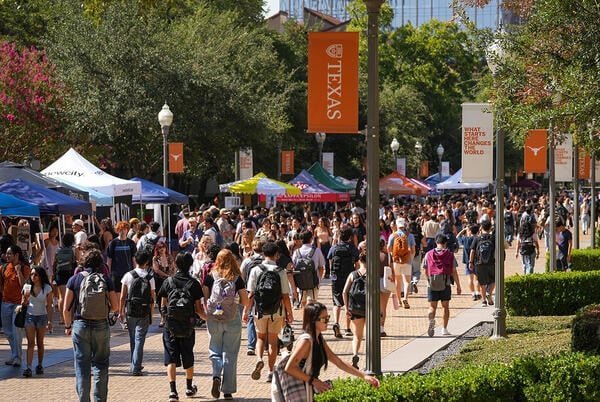
Guaranteed tuition programs typically cover tuition costs for eligible students, though housing, food, transportation and other college expenses remain significant financial challenges.
Jay Janner/The Austin American-Statesman/Getty Images
As institutions nationwide grapple with widespread concerns about the cost of higher education, guaranteed tuition programs have emerged as one way to make a degree more financially accessible. These initiatives typically cover tuition for students who meet certain eligibility requirements, often based on family income, though the amount of assistance and conditions vary by institution.
In Texas, for example, public universities have expanded eligibility for guaranteed tuition, extending financial assistance to a wider range of families. To get more residents to take advantage of the opportunity, the state is kicking off its second annual Free College Application Week today, waiving application fees at public colleges and universities in the hopes that more prospective students will apply.
Trellis Strategies, a Texas-based postsecondary research and consulting firm, recently released an updated directory identifying 34 of the state’s 45 public universities that offer at least one guaranteed tuition program. Family income eligibility thresholds range from $30,000 to $130,000, with the median income cap increasing from roughly $80,000 last year to $100,000. Of the 32 programs with income caps, 19 now serve families earning $100,000 or more.
Bryan Ashton, managing director at Trellis Strategies, said the expansion reflects mounting awareness that college affordability concerns extend beyond the lowest-income households, affecting families who may not qualify for federal Pell Grants but still struggle to cover educational expenses.
“There’s a growing recognition of that middle-class squeeze, especially students who may not be Pell Grant eligible, but might be in that area where income and budgeting is a month-to-month challenge,” Ashton said. “We’ve really seen the growth of these programs from being a Pell supplement to being a support for middle-class learners as well.”
The expanding promise: Guaranteed tuition programs are part of a broader landscape of college-affordability initiatives across the country, including college Promise programs, which seek to make a college education more accessible through financial assistance and, in some cases, additional student support services.
John Barnshaw, senior leader at College Promise, a national nonprofit focused on expanding access to postsecondary education, said 475 Promise programs have been introduced, spanning all 50 states and involving roughly 1,850 colleges and universities nationwide.
Thirty-eight states run their own programs. Texas is one of the 12 without a statewide Promise program, he said, though individual universities have expanded their guaranteed-tuition offerings. Barnshaw described the state’s growing number of programs with income eligibility caps of $100,000 or more as “good in terms of progress towards making it available to more people.”
“There’s a lot of demand to access higher education generally, [but] there’s a tension among people who are skeptical about its value,” Barnshaw said. “Part of what we’re seeing is policymakers stepping up and saying, ‘Well, if we can subsidize more of the cost of education or the cost of attendance, then we can actually go and help address some of the skepticism if more people can attend at a lower cost or no cost.’”
Barnshaw also pointed to the role these programs could play in addressing workforce needs, particularly in Texas, where the state has set a goal of having at least 60 percent of residents between 25 and 34 hold a postsecondary credential of value by 2030.
Despite the expansion of guaranteed tuition and Promise programs, covering tuition alone often does not eliminate the financial challenges students face in pursuing a degree. Housing, food, transportation and other expenses can account for a substantial share of the cost of attendance, raising questions about how much such initiatives can ultimately do to support student persistence and completion.
Ashton said the programs in Texas can help students better anticipate their college expenses and potentially free up other financial aid to cover costs beyond tuition.
“It allows for some predictability in cost when students are applying for college,” Ashton said. “While these programs really only support tuition—and we know that tuition is a subset of the overall cost of going to college—it allows flexibility for financial aid to be used for some of those other expenses that students have.”
Some universities in Texas are also adjusting program requirements and taking other steps to reach more students, Ashton said. Those changes include moving application deadlines to Jan. 15, increasing eligibility for transfer students and offering scaled partial tuition assistance at higher income levels, as seen at institutions such as the University of Houston, the University of Texas at Austin and Texas A&M University. Some programs extend assistance to families earning as much as $130,000 annually.
“Forty percent of costs for Texas public four-year institutions are tuition- and fee-based, which means that the majority of costs for students still exist,” Ashton said. “We need to continue to think about how we connect students to food and housing resources as they navigate their educational experiences.
“We also need to think about open educational resources and other ways to decrease the cost of learning materials that go with the various programs,” he added. “Sometimes these programs don’t cover things like course fees or other individual program fees.”
Making college attainable: Barnshaw said tuition-guarantee programs can benefit both students and states by expanding access to a college education while helping develop a more educated workforce.
“The states win because they’re often last-dollar programs, so for the amount of money that they contribute, they see appreciable gains in education and skilling in the workforce,” Barnshaw said. “And the student wins because they’re getting an education and the skills they need to be competitive.”
For students, Ashton said, expanding eligibility for tuition guarantees can make college feel more financially attainable, particularly for those who might otherwise be discouraged by the perceived cost of a degree.
“There’s an increase in willingness to apply based on the visibility of the tuition cost,” Ashton said. “That allows for students to see themselves being able to afford college.”
Get more content like this directly to your inbox. Subscribe here.
You may be interested

Saturday Sessions: Christone "Kingfish" Ingram performs "(Still) Nothin' But Your Love"
new admin - Oct 12, 2026Grammy Award-winning guitarist and singer-songwriter Christone "Kingfish" Ingram brings Mississippi blues tradition to his captivating live performances. Kingfish has played…

Pope Leo to undergo surgery Tuesday to remove a lung nodule
new admin - Oct 12, 2026Pope Leo XIV will be admitted to a hospital Tuesday morning to undergo surgery to remove a lung nodule discovered…

139 people dead, including 15 children, after migrant boat capsizes off Africa: “Overwhelmed with all the bodies”
new admin - Oct 12, 2026At least 139 people, including children, have died after a boat carrying more than 300 migrants capsized off the coast…