


Beyond Financial Aid for First-Gen Students

First-generation students make up 54 percent of all undergraduates in the U.S., but only 24 percent attain a bachelor’s degree within six years, compared with 59 percent of their continuing-generation peers, according to FirstGen Forward. The Kessler Scholars Collaborative has sought to close the degree-attainment gap through a comprehensive support model for first-gen students.
The collaborative was formed in 2020 to back programs at six inaugural institutions, including the University of Michigan, where the first Kessler Scholars Program was established in 2008. In 2022, 10 additional institutions were selected to join the collaborative as part of a partnership with the American Talent Initiative.
Supported by Bloomberg Philanthropies and the Wilpon Family Foundation, the program offers first-generation, limited-income students financial aid plus community, mentoring and individualized guidance. Nearly 1,200 students participated during the 2025–26 academic year, and the program expects to serve nearly 1,500 this fall, including 392 new scholars.
An external evaluation from Ithaka S+R looked at how Kessler Scholars are faring compared with other first-generation students at the same institutions. Among Kessler Scholars who entered the six inaugural institutions in fall 2020, 74 percent earned bachelor’s degrees within four years, compared with an average of 59 percent of all first-generation students at the same institutions. By the end of summer 2025, 84 percent of the Kessler cohort had earned a degree.
“One of the metrics that we’re looking closely at is not just do students on these campuses outperform the national first-gen metrics on persistence and completion—which are troublingly low—but because we’re working with campuses that are so diverse, are they also outperforming first-gen students on their campuses?” said Gail Gibson, executive director of the Kessler Scholars Program.
She added that the program also focuses on helping students access academic and professional opportunities that can prepare them for success after graduation.
Participants in the Kessler Scholars Collaborative
- Bates College, Maine
- Brown University, R.I.
- Centre College, Ky.
- Cornell University, N.Y.*
- Johns Hopkins University, Md.*
- Ohio State University, Ohio
- Queens College, CUNY, N.Y.*
- St. Francis College, N.Y.*
- Saint Mary’s College, Ind.
- Syracuse University, N.Y.*
- University of California, Riverside, Calif.
- University of Dayton, Ohio
- University of North Carolina at Chapel Hill, N.C.
- University of Pittsburgh, Pa.
- University of Michigan, Mich.*
- Washington University in St. Louis, Mo.
*Kessler Scholars Collaborative inaugural institutions
“Kessler helps unveil the ‘hidden curriculum’ of higher ed,” Gibson said. “The program thinks about the hidden curriculum of the workplace and how we prepare students for internships, research experiences and other opportunities that mean the success they found on campus can repeat after graduation.”
How Kessler works: Among graduating seniors surveyed at the six inaugural institutions, 81 percent participated in at least one of three high-impact experiences: an internship, undergraduate research or study abroad. Specifically, 59 percent had completed an internship, 49 percent had participated in faculty-mentored research and 40 percent had studied abroad.
“We’re trying to make the case that ‘Yes, you are talented and smart, and we want you in these institutions, but we don’t want you to crawl through and finish without the same sort of rich experiences that your peers have,’” Gibson said. “High-impact practices are a really strong example of that.”
The evaluation also found that 85 percent of survey respondents in 2024–25 said they felt they belonged within their Kessler community and 88 percent felt that they mattered to the program.
Nick Watson, program lead for college access and success at Bloomberg Philanthropies, said the community-building component is one of the most important elements of the collaborative.
“Being a first-gen and limited-income student and having someone who’s gone through the experience to then tell you ‘Actually you do belong’ and build connection—it’s part of the secret sauce here,” Watson said. “That seems like a no-brainer, but so many times institutions take it for granted that it’s happening organically or naturally.”
Kessler Scholars at the inaugural institutions had an average cumulative GPA of 3.40, compared with 3.12 among other first-generation students at the same institutions. Ithaka cautioned that its comparisons between Kessler Scholars and other first-generation students are descriptive and do not account for differences in students’ precollege characteristics or other factors that could influence selection into the program.
For Watson, one benefit of expanding the collaborative is the opportunity to examine how the model works across a range of institutions from an Ivy League university like Brown University to a smaller institution like Centre College.
“What can we learn when we pair varied institutions together about what makes this work?” Watson said. “What we’ve seen is you have to have institutions that are coming in from the same student-centered space.”

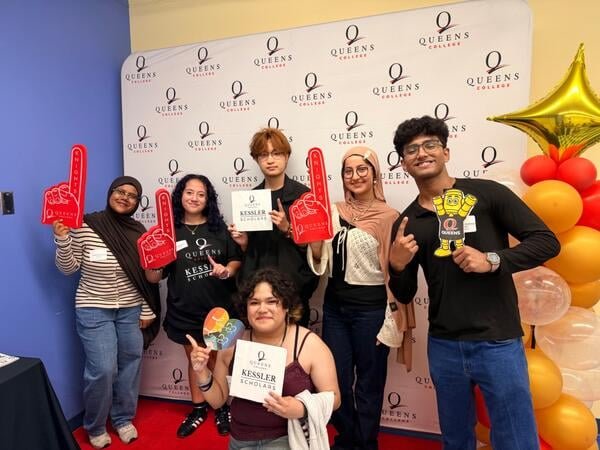
Kessler Scholars from Johns Hopkins University, St. Francis College, Queens College and the University of North Carolina at Chapel Hill attend a cross-site event in New York City.
Chrystle-Claire Greene/Queens College
Gibson said participating institutions are expected to provide a consistent set of core supports but have the flexibility to adapt the program to their own students and campus context. The University of North Carolina at Chapel Hill, for example, has used Kessler to focus on recruiting rural students from across the state, while Washington University in St. Louis has prioritized persistence among first-generation students majoring in STEM fields.
“There are core elements of the program model that we ask each institution to implement,” Gibson said. “Students should have a peer mentor, there should be a dedicated staff person, students should come together for rich and unique cohort-based activities. This is, after all, a community-driven intervention.”
“But local context should control, and without it, you’re not going to have the kind of learning, institutional buy-in and meaning if that weren’t true,” she added.

Kessler Scholars from 14 different institutions attended last year’s First Gen Summit hosted by Wellesley College.
Lessons for other institutions: The evaluation also identified areas for improvement. Some 55 percent of scholars met with program staff at least twice per semester, while 57 percent attended at least three Kessler events per semester. Sustaining engagement as students progress through college remains an ongoing challenge for the program, Ithaka noted.
Gibson said additional data expected in spring 2027 will offer a first look at outcomes across all 16 participating institutions.
For institutions outside the collaborative looking to strengthen support for first-generation students, Watson said the lesson isn’t necessarily to replicate Kessler in its entirety, but to start small and build from there.
“It doesn’t have to look the same at every place. But there are learnings for all types of institutions, depending on where you’re at, both from a bandwidth perspective and also a resource perspective,” Watson said.
Gibson said institutions can look to models like Kessler for strategies they can adapt to address the particular challenges facing first-generation students on their campuses.
“This question about ‘How do we get smarter and better at student success?’ is one that schools are wrestling with across higher ed right now,” Gibson said. “One reason we’ve emphasized evaluation—especially external evaluation—throughout is because we want this project to be able to offer guidance and learning across the sector.”
Get more content like this directly to your inbox. Subscribe here.
You may be interested
See Anthrax’s New ‘Cursum Perficio’ Video
new admin - Sep 17, 2026[ad_1] Rhythm section ace literally tries to break the chains that bind him in clip for title song on thrashers'…
AI is feared globally as the destroyer of jobs
new admin - Sep 17, 2026Pew Research has published a new global survey that sheds light on how people view AI, including its impact on…
How to Build Strong Career Connections
new admin - Sep 17, 2026[ad_1] IE 11 is not supported. For an optimal experience visit our site on another browser.Now PlayingWhy Networking is the…