

Leader in Push for DACA Reflects on Its Anniversary

Fourteen years ago this month, former president Barack Obama announced the Deferred Action for Childhood Arrivals program, a relief for immigrants brought to the U.S. as children, who are often referred to as Dreamers. The new policy allowed them to legally work in the country and protected them from deportation.
And with new career options ahead of them, many young people with DACA status pursued higher education, hoping for a pathway to permanent citizenship in the future.
But no new students have been able to obtain DACA status since 2021 amid a lengthy legal battle over the program. The U.S. Supreme Court has twice kept the program alive, though DACA has continued to face legal challenges.
Most recently, the U.S. Court of Appeals for the Fifth Circuit deemed the work-authorization aspect of DACA unlawful but upheld the legality of deferring deportation last year. It also limited its ruling to Texas, arguing other states didn’t prove they had standing. The appeals court kicked the case back to U.S. District Judge Andrew S. Hanen, who ruled against the program in 2021, to decide what’s next for DACA in the state. While litigation continues, the court has maintained the status quo for now, allowing current DACA recipients to continue renewing their status.
The Trump administration, meanwhile, has been slowly eroding DACA’s power. Instead of moving to end the program, as Trump did during his first term, administration officials have encouraged DACA recipients to self-deport and lagged on processing DACA renewals. The Department of Justice’s Board of Immigration Appeals said in April that DACA isn’t enough to prevent deportation, and the Department of Homeland Security has owned up to deporting dozens of residents with DACA status.
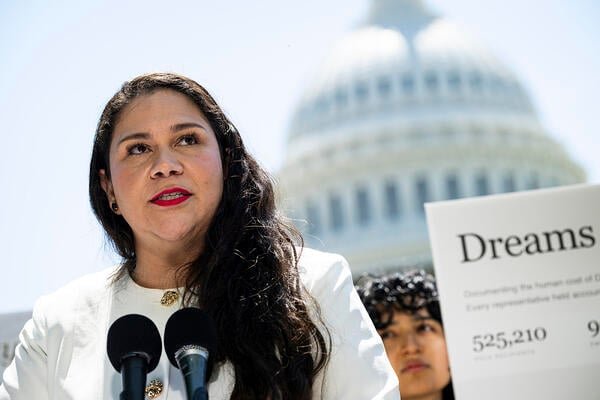
Inside Higher Ed spoke with Gaby Pacheco, one of the advocates who spearheaded DACA’s creation. Today, Pacheco is president and CEO of the TheDream.US, a scholarship provider for undocumented students. The conversation, reflecting on DACA’s June 15 anniversary and where the program stands now, has been edited for length and clarity.
Q: We just passed the anniversary of the announcement of the DACA program. Years later, what kind of impact has the program had on undocumented students and alumni?
A: It’s kind of unbelievable that it’s been 14 years. And at the same time, it does feel like yesterday when President Obama was making the announcement. I don’t think anyone imagined the magnitude of success that this program was going to have, the 800,000 people’s lives that it was going to change and how critical it’s been to the livelihood of all these Dreamers who continue to have DACA but also the transformational ability for this program to have allowed for people to go to school.
Today, 14 years later, we see the data, the statistics. We know that Dreamers are contributing billions of dollars into the economy, that the average age of a DACA recipient today is 32, that they own homes, they have been able to build families, they have children and they have careers.
We launched a couple of months ago the DreamsDelayed.com website, and it’s been really both heartwarming and heart-wrenching to see how Dreamers talk about being at a same job for 14 years, how they really depend on this program for their livelihood and how critical this program has been for the communities that they live in.
Q: As a former DACA recipient yourself, can you tell me a little bit about your own story with the program?
A: After June 15 happened, we had to quickly work on putting all the parameters [in place] and working with the USCIS Director Alejandro Mayorkas on what the form was going to look like, the questions they were going to ask. All of that got me really busy. And on Aug. 15, 2012, when the program actually was open and implemented, I turned all my energies to helping probably hundreds of thousands of young people across the country apply for DACA … I didn’t apply until probably late 2012, early 2013.
When I finally got my DACA, I was able to not only get work authorization and find a job that afforded me health insurance but also I was able to get a driver’s license. The first time I got to travel outside of the United States was on an educational trip with the Mexican Embassy to Mexico City. I got to go back and visit my grandmother in Ecuador before her passing in 2016. And in 2016, I actually was diagnosed with endometrial cancer. If it wasn’t for the fact that I had a job that had work authorization, I wouldn’t have been able to afford the incredible health-care support that I had during that time. It was also the year that I got to buy my first home. So, as a DACA recipient, it was literally night and day for me, and I know that that’s the case for so many people.
And this is why it’s extremely troubling today to know that even though the Trump administration, the courts, different states like Texas, have tried to end the program, we are seeing [the administration erode the program] through other ways, through slow-walking the process and internal things that they’re doing. It’s scary. Even though I’m no longer a DACA recipient, because I was able to, through a marriage petition, become a green-card holder and eventually a U.S. citizen, I still feel the pain of all the young people that are going to the DreamsDelayed website to share their stories, the DACA recipients that are part of TheDream.US and the many friends that I have who are either out of work or have been put on leave because their DACA has been delayed and their status hasn’t been renewed. Their anxiety is just so high, because they don’t know what they’re going to do if they lose their jobs.
Q: As you mentioned, the DACA program has survived multiple legal challenges at this point. But at the same time, it seems as if the policy isn’t affording people the protection it once did. Where does DACA stand right now?
A: Last year, the [the Fifth Circuit] gave its final judgment and sent it back to Judge Hanen. Judge Hanen has not ruled on anything. We’re waiting on when that’s going to happen.
At the same time, the Trump administration has every power to actually end the program if they wanted to, they just have to do it the right way. [During Trump’s first term] they tried to do that. It went to court. The Supreme Court actually ruled that they illegally tried to end the program, but they were within their rights to try to do it. They just had to follow procedure.
The bad thing that we’re seeing—and that we feel is unlawful—is that they are in essence ending the program; it’s death by a thousand cuts. They have ensured that DACA recipients who want to apply for advance parole and meet certain criteria can’t do it. They have sent everyone to do fingerprints again, even though they have fingerprinted them many, many times.
Since last year, if you look at the USCIS data, they made the wait time even longer. You have DACA recipients today that have been waiting since November, December for their DACA to be renewed.
There are also discrepancies in numbers. Earlier this year, we requested members of Congress ask USCIS and ICE how many DACA recipients were being detained. The Senate received one set of numbers, the House received another set of numbers and we don’t really know which one is true. All we can say is that we know there have been about 300 DACA recipients who have been detained and about 90 of them have been deported. Those who got a lot of media attention and had really good attorneys were able to return to the United States, but we don’t really know the extent.
The bigger picture here is that this administration is doing a lot of things that are making it so much more difficult for DACA recipients to actually benefit from both deferred deportation and work authorization. And the troubling part is that we don’t really know what is happening. Internal conversations and decisions are being made, and the general public just does not know what is happening.
Q: TheDream.US has a large community of undocumented scholarship recipients and alumni, some of whom have DACA. How have you seen their lives change under this administration?
A: We have a report that is called “The Authorization Gap,” and that report really focuses on the fact that one in five of our TheDream.US graduates are no longer DACA recipients and don’t have work authorization. It talks about the toll that today’s Dreamers are experiencing because of what is happening across the country around immigration. And particularly for those who have DACA, the mental instability of not knowing if their DACA is going to be renewed or not, what’s going to happen, if they’re going to be detained or not, it’s pretty high. DACA recipients are still doing pretty well as far as having full-time jobs and putting their work authorization, their careers, to use. But when we look at the mental health aspect, we’re seeing chronic uncertainty and just a lot of anxiety. It really is starting to take a mental health toll on the lives of these folks.
Q: At this point, many undocumented immigrants don’t have DACA, including most undocumented students. How does that affect today’s undocumented learners?
A: Today, I would say every 18-year-old in the United States who is a Dreamer does not have DACA and wouldn’t be eligible for DACA because they were just too young or not even born [when] they needed to be here in the United States, which was before June 2007. What’s happening with that population of folks, what I find really interesting, is that they want DACA. They’re not thinking about green cards, they’re not thinking about citizenship, they want the bare minimum. And they’re constantly saying, “Can I apply for DACA?”
The other thing is that if they’re graduating from college, it’s really difficult for them to put their talents and their degrees to use because they don’t have work authorization. So, many times, what we see is that they have to go the entrepreneurship route. Our alumni survey report shows that, of those who have work authorization right now, 84 percent are earning income full-time versus only 43 percent of those who are fully undocumented. Only 7 percent of our alumni with work authorization right now are looking for income opportunities versus 33 percent of the fully undocumented [alumni]. So, there’s a huge difference there. It’s also a huge difference in pay. If you have work authorization, you’re able to get paid a lot better. You’re able to have a better work schedule. If you’re fully undocumented, you are getting paid usually under minimum wage or minimum wage, and your schedule is whatever you can take, either graveyard shifts or weekends or night shifts. It’s the jobs and the opportunities that most people just do not want.
Q: In the past, when DACA faced challenges and setbacks, higher ed institutions have come out in support of it. As fewer students can take advantage of DACA, do you still see DACA as a higher ed issue? Why or why not?
A: The Dreamer movement comes out of the youth movement and the student movement of people trying to get access to higher education. The first Dreamer who inspired the Dream Act came to be known to Senator [Richard] Durbin because she wanted to go to a prestigious music conservatory, but because of her status, she was not allowed to. So, there would be no Dreamer movement if there wasn’t this desire for higher ed. The whole entire program really centers around young people who have grown up in our country and who have gone through the K–12 system. Over 99 percent of DACA recipients have graduated from high school. You have DACA recipients who have been able to go to college and not just do a bachelor’s degree; many of them today are doctors or nurses. They have master’s degrees and Ph.D.s. So, you cannot take out higher education and education in any of the discussions around DACA and Dreamers. It is at the heart of it.
Part of that, too, is all these higher education institutions, like the American Council on Education, the Presidents’ Alliance [on Higher Education and Immigration], all these different associations are both supporting and have always been supportive of the Dream Act. We just unveiled the updated RemembertheDreamers website, which is a collaboration between ACE, TheDream.US and other higher education associations. And the whole idea is to ensure that we inform what is happening with stories, with data, and that this is a place where people can take action and where professors and teachers and anybody in academia can lift their voice and ask Congress to do something about this population.
Q: Where do you see higher ed’s role in the fight for DACA right now? What does taking action look like?
A: What a lot of people don’t understand or see is just the power of higher education. There are many donors and people who are involved. The alumni of these institutions are either members of Congress today or work in these offices. A college president [has] a much closer, not just relationship, but ability to get in front of these leaders to request and ask for there to be change and some sort of movement on legislation. That’s why it’s really critical that higher education flexes their muscle and uses their power to have conversations with senators and uses their boards of trustees and their funders and their donors to advocate for this group of very important students to the college campuses’ student body.
You may be interested

Starmer resignation highlights Britain’s chaos after Brexit
new admin - Jun 23, 2026Academics have long since tracked the correlation between economic downturns and antipathy toward immigration. And so it was throughout Europe,…

Planned auction of Titanic artifacts including personal belongings faces U.S. government pushback
new admin - Jun 23, 2026A plan to auction more than 100 artifacts salvaged from the wreckage of the Titanic - including personal belongings, currency,…

These are the best smart home deals this Prime Day
new admin - Jun 23, 2026Every Prime Day is a good day to make your home smarter, as deals on connected gear proliferate not just…