



Addressing Food Insecurity Through Urban Agriculture

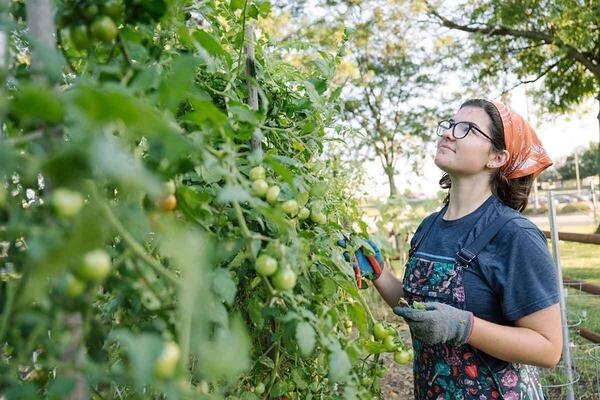
The student-run farm and composting initiative helps students and local community members facing food insecurity.
When Zac Kissell was searching for a summer job last March, he didn’t expect it would alter his career goals.
The rising third-year mechanical engineering technology student at the University of Dayton stumbled upon a posting to work at Flyer Farm, the university’s student-run urban agriculture initiative. More than a year later, Kissell said the experience has inspired him to explore careers that combine engineering and the environment, in the hopes of making systems more streamlined and sustainable.
“I can just look into making something that is going to be efficient for not only the environment but also society itself,” Kissell said.
Kissell is one member of a small team of students and staff who work at Flyer Farm, which sits on an unlikely plot of land adjacent to the university: six tennis courts previously owned by the Fortune 500 company NCR Corp. What started in 2017 with a few garden beds has grown into a full-scale urban farm with over 30 beds, an orchard, beehives and chickens.
Students handle the farm’s daily operations, including weeding, watering and harvesting, while another student-led team collects food scraps from residence halls and offices as part of the farm’s composting operation. The students grow vegetables, raise chickens for eggs and collect honey from the bees, which they sell at the university bookstore. Most of the produce is donated.
In full bloom: During 2024 and 2025 combined, Flyer Farm donated 12,000 pounds of produce to the university’s Food4Flyers pantry and to Miami Valley Meals, a Dayton nonprofit that prepares meals for community members experiencing food insecurity. Its composting operation diverted more than 100 tons of food waste in 2025, saving the university thousands of dollars in disposal costs, according to Meagan Pant, a university spokesperson.
The farm’s community focus grew out of research conducted by two University of Dayton professors between 2017 and 2022, which indicated that 36 percent of students experienced food insecurity during their time on campus.

Flyer Farm offers hands-on learning opportunities for students.
For Kissell, knowing the produce is giving back to community members who might not have enough to eat is especially meaningful.
“It’s really nice,” Kissell said. “I’m putting in all this time, and knowing that this is going to people that need food, it’s better than just knowing that it goes to waste or to a store, just for it to sit there on a shelf. This is going to a food bank that’s getting prepped for meals, and those meals are going out to people that truly need it and want it.”
In addition to helping local community members, the farm provides University of Dayton students with Federal Work-Study jobs and allows for hands-on learning.
Steven Kendig, the university’s executive director of energy utilization and environmental sustainability, who oversees Flyer Farm’s operations, said the farm began after students expressed interest in urban agriculture and composting and now provides experiential learning opportunities. Student employees come from a variety of academic disciplines and some have never had a job before, so the farm offers them hands-on agricultural experience, he said.
“The whole reason that we were doing this was to demonstrate how you could take a site like a tennis court and build an urban agriculture site that was productive,” Kendig said. “So if you could do it on a tennis court, you could do it on a corner lot, or anywhere, and that’s what we try to do.”
The farm also has a new collaboration with nearby Sinclair Community College’s English as a Second Language program: It plans to dedicate garden space to immigrant and refugee students to allow them to grow vegetables native to their home countries. Two student interns from the community college’s horticulture program are working at Flyer Farm for the summer.
In the weeds: Flyer Farm’s operations pay for themselves, and outside donors have contributed by buying equipment, chicken feed and trees.
The Hanley Sustainability Institute on the university’s campus provided initial funding for tools, Kendig said. The farm has also received grant funding through the Environmental Protection Agency, Montgomery County Solid Waste District and PepsiCo.
“Everything we do, we try to do as efficiently and low cost as possible, and with some donors, we get by,” Kendig said.
The composting initiative saves the University of Dayton’s dining services about $30,000 a year in disposal costs, while honey sales at the bookstore cover the cost of keeping the bees, Pant said.
The farm’s success has also drawn attention from other institutions. Officials from other universities, including Miami University and the University of Cincinnati, have visited Flyer Farm to study and replicate its model. Representatives from Columbus also brought residents to evaluate the farm’s environmental impact before endorsing a local version.
Get more content like this directly to your inbox. Subscribe here.
You may be interested

Lucas Herbert Breaks Course Record With 11-Under Round 1 At LIV Golf UK
new admin - Jul 23, 2026[ad_1] NEWYou can now listen to Fox News articles! Lucas Herbert and Bryson DeChambeau picked up right where they left…

This week on “Sunday Morning” (July 26)
new admin - Jul 23, 2026The Emmy Award-winning "CBS News Sunday Morning" is broadcast on CBS Sundays beginning at 9:00 a.m. ET. "Sunday Morning" also streams…

Amy Winehouse Remembered on 15th Anniversary of Singer’s Death
new admin - Jul 23, 2026[ad_1] "Her voice, her songwriting, her honesty and her unique spirit remain as powerful today as ever," estate wrote in…