


New Push to Fix Calculus Bottleneck

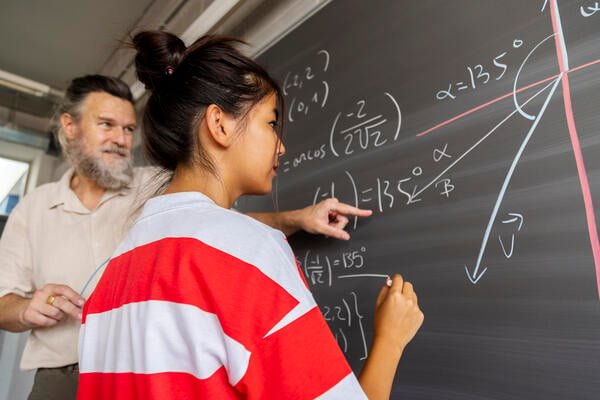
Calculus has long been one of the biggest hurdles for students pursuing a STEM degree, with success in Calculus I often determining whether they continue in their major—or switch to something else.
To reduce that barrier, the nonprofit Every Learner Everywhere recently launched the Courseware Lighthouse Implementation Program, an initiative that brings together 12 public colleges and universities to redesign how Calculus I and II are taught.
Rather than introducing a new technology tool into individual classrooms, the initiative works with entire mathematics departments to rethink course design, strengthen faculty collaboration and use student performance data to refine instruction over time. The program follows a six-phase framework that guides departments through planning, implementation and ongoing evaluation.
The goal is to create more engaging learning experiences, improve student success in gateway math courses and help more students persist in STEM majors.
Laura DaVinci, senior director of Every Learner Everywhere, said improving student outcomes in calculus requires more than adopting new technology; it requires rethinking how institutions support students and faculty throughout gateway math courses.
“It has to do a lot with the students’ perception that calculus is difficult,” DaVinci said. “When they go in with that anxiety and that, ‘Oh no, I know for a fact that only two-thirds of students ever pass calculus,’ it’s really daunting to go in wondering, ‘Am I going to be the student that fails?’”
“It’s really up to the instructors and the institutions and all the support systems that go with it to make sure students feel supported and successful in those courses,” she added.
Redesigning calculus courses: DaVinci said the program will launch this fall with eight institutions; the remaining four will join in the spring. About 1,800 students will participate during the fall semester, and that number is expected to more than double once all 12 institutions are involved.
Courseware Lighthouse Implementation Program Inaugural Cohort
- California State University, Fresno, Calif.
- California State University, Los Angeles, Calif.
- Dallas College, Tex.
- Georgia State University, Ga.
- Houston Community College, Tex.
- Miami Dade Community College, Fla.
- Queensborough Community College, N.Y.
- San Antonio College, Tex.
- University at Buffalo, N.Y.
- University of Nevada, Las Vegas, Nev.
- University of North Texas, Tex.
- University of Texas at Arlington, Tex.
To reach more students, DaVinci said, the initiative takes a departmentwide approach rather than relying on individual faculty members to drive change. Previous efforts centered around a single “champion faculty member,” she said, which can limit how many students ultimately benefit.
“So instead of going with the one-offs, instead of going with the pilot of the most interested faculty, we took the approach of departmentwide implementation,” DaVinci said. “The faculty get to be in a community of practice and … that also means they get to hear each other’s wins.”
The initiative also brings together organizations with expertise in institutional change, mathematics education and learning science to support colleges as they redesign gateway calculus courses.
The Gardner Institute will work with the participating institutions to build the governance structures and faculty support needed to sustain large-scale course redesign. Transforming Postsecondary Education in Mathematics, known as TPSE Math, will help ensure the changes align with the priorities of the mathematics community and keep faculty at the center of the redesign process. Meanwhile, WestEd, a nonprofit research group aimed at improving education, will evaluate student outcomes and help institutions use data to guide continuous improvements.
Participating colleges will also integrate Learnvia, an AI-enabled courseware platform developed by Carnegie Mellon University, which combines artificial intelligence with principles from cognitive and learning science to personalize student learning and provide instructors with data intended to improve teaching and student outcomes.
Cost was also a factor in selecting the courseware, DaVinci said, because traditional textbooks and online learning platforms can create additional financial barriers for students.
“Most institutions have either a pricey textbook or a courseware that comes with the textbook,” DaVinci said. “Our strategy has been that it’s completely free to the institution and to the student, so there is no cost whatsoever.”
Tracking student outcomes: As the program progresses, DaVinci said, it will track student grades and persistence from Calculus I to Calculus II to determine whether the redesign is improving outcomes. She said the three-semester implementation process will allow institutions to make adjustments based on early results and better understand the impact of the changes.
“They might start the first semester with the easy pieces that you can adapt to make sure that the students feel supported and they have the active learning and the engagement and everything else,” DaVinci said. “But as you’re going into the second and the third semester, [institutions] can do a lot more of the design and strategic thinking and incorporating the data as it’s coming in live from how the students are doing.”
DaVinci said the goal is to move away from traditional lecture-based instruction and toward a more engaging, student-centered calculus experience.
“It really matters how you’re designing the course, and I’m saying this because what we’re hoping to see is that students have a much more engaging experience in the classroom,” DaVinci said. “There may be active learning; there may be different group work. Instead of doing the traditional lecture and then doing homework and a quiz later, we’re looking at a completely revamped course design where the students can actually understand the concept before they come into class.”
Get more content like this directly to your inbox. Subscribe here.
You may be interested

Ford picks Apple Maps for its next EV platform and updated BlueCruise
new admin - Jul 23, 2026Ford plans to embed Apple Maps directly into its Universal Electric Vehicle Platform, which will start with a $30,000 midsize…
Malcolm-Jamal Warner's widow says her body "went through shock" when her husband died
new admin - Jul 23, 2026Tenisha Warner, the widow of "The Cosby Show" actor Malcolm-Jamal Warner, spoke exclusively to "CBS Mornings" co-host Gayle King about…

Not citric acid or spray – 1 cleaning tip makes shower head look ‘new’
new admin - Jul 23, 2026Cleaning your shower head doesn't have to be difficult (Image: Getty)Nobody likes to spend their evenings or weekends cleaning, but…