



Va. Increases Campus Gun Restrictions, Fla. Does Opposite

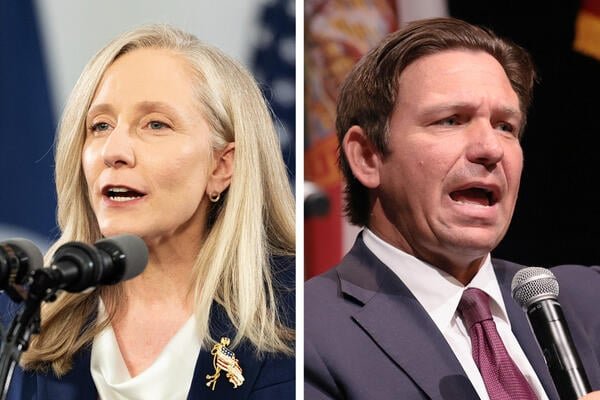
Virginia Gov. Abigail Spanberger, left, and Florida Gov. Ron DeSantis signed legislation this month taking diverging approaches to gun regulation on public campuses in their states.
Mike Kropf and Joe Raedle/Getty Images
Last week, Virginia’s Democratic governor held a ceremonial signing of a law that generally bans guns and explosives from public college and university buildings. The event was held at the University of Virginia, which saw a deadly campus shooting almost four years ago.
“In November 2022, three students here at the University of Virginia were shot and killed on Grounds—Devin Chandler. Lavel Davis Jr. D’Sean Perry,” Gov. Abigail Spanberger told attendees, according to a news release from her office. “This horrific tragedy devastated this community and our Commonwealth. Their families, friends, and football teammates deserve more than shared grief. They deserve action.”
Spanberger said that while some regulations already technically banned possession of firearms on Virginia campuses, the lack of a law made that prohibition harder to enforce. The law (House Bill 626/Senate Bill 272) still allows institutions to permit guns in buildings as part of curricula or “as part of any organization,” such as the Reserve Officers’ Training Corps, authorized by a university to carry weapons in a building.
UVA president Scott Beardsley said the university, including under former president Jim Ryan, had been pushing for the change for the past four legislative sessions. A UVA spokesperson told Inside Higher Ed that its policies have “long … prohibited anyone from possessing a weapon inside any University building and in certain regulated outdoor spaces.” However, without the law, “police were unable to open investigations or execute search warrants for reports of firearms in University buildings,” the university said.
Virginia’s Democratic-controlled General Assembly passed the legislation. Democratic Delegate Katrina Callsen, who introduced it, said it “felt like a common-sense next step to actually give police officers the tools that they need to enforce [campus gun bans] and to keep people safe.”
States Adding More Guns
In Florida, Republican political leaders took a different approach this year, apparently in response to a similar campus tragedy: They moved to allow more guns on campuses. On Friday, Gov. Ron DeSantis signed into law House Bill 757—which, among other things, permits public college and university employees to wield guns. Local media reported that the legislation was proposed in response to a mass shooting about a year ago at Florida State University, in which two dining workers died.
While HB 757 requires public colleges and universities to do things like conduct annual “security risk assessments,” adopt “active assailant response plans” and train all employees and students in “active assailant preparedness,” it also allows institution presidents to give faculty and other nonstudent employees permission to carry guns on campus if they go through a training program.
“We’ve made historic strides to implement school safety measures that are working to protect our schools,” DeSantis said in a news release. “Today, I was proud to build on these efforts by signing HB 757, which enhances campus security requirements and best practices at our colleges and universities.”
The Republicans who co-sponsored the law in the Florida House didn’t respond to requests for comment Monday.
And in Utah—where conservative activist Charlie Kirk was shot to death in September on the Utah Valley University campus—House Bill 84 now awaits Republican Gov. Spencer Cox’s signature or veto. It would allow people age 21 and up to carry concealed guns on public campuses without concealed-carry permits.
The diverging responses to campus mass shootings follow a national pattern. Everytown for Gun Safety, which says it’s the nation’s “largest gun violence prevention organization,” says 14 states require colleges and universities to allow concealed guns on campus. With the exception of Minnesota and Wisconsin, they’re all red states. (State gun laws differ in other ways, too, but Everytown’s tracker focuses on this issue.)
Sam Levy, Everytown’s director of policy advocacy, said that “whether it’s guns on campus or any other core gun safety issue, unfortunately, the partisan divide is the practical divide among the laws that we see get filed and advanced and signed into law. And that’s unfortunate. This is not a partisan issue—this is a public safety issue.”
Levy added that safeguards are important on college campuses. “The presence of more guns on college campuses—which are spaces with students, young people, with high degrees of stress, high levels of drug and alcohol use, other risk factors—actually creates more dangers and more risk of harm.”
Levy noted that, beyond higher ed–specific laws, Spanberger in Virginia has increased gun regulations, while Florida’s leaders have made continued attempts to roll back firearm restrictions.
“It’s a guns-everywhere mentality versus a common-sense set of safeguards,” he said.
You may be interested

Rich man wants to pay you £70,000 to drive his Bentley and go to parties
new admin - May 19, 2026The successful candidates will travel the world (Image: Mensent Photography via Getty Images)A wealthy entrepreneur is searching for two individuals…

Why Fuerza Regida Loves the Chevy 454 Pickup Truck
new admin - May 19, 2026[ad_1] T he first time I saw a 454 truck, I must have been about 10 years old. Back then,…

Brock Lesnar returns to WWE Raw one month after apparent retirement
new admin - May 19, 2026[ad_1] NEWYou can now listen to Fox News articles! Brock Lesnar made his shocking return to WWE on "Monday Night…