



Women’s Flag Football Gains Traction in the NCAA

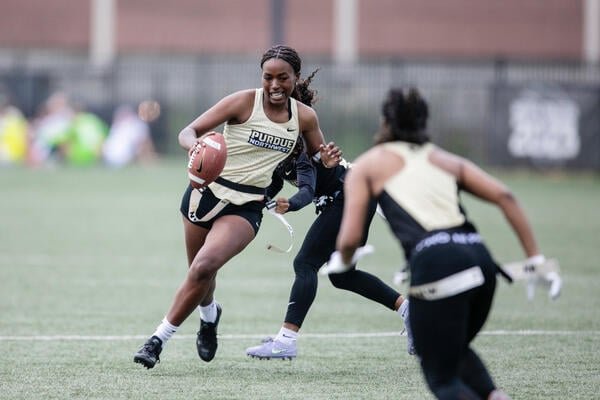
Nearly 400 colleges will compete at the club or varsity level next spring, making women’s flag football one of the fastest-growing collegiate sports. Athletic directors say it’s a useful recruitment tool, too.
Brown repeatedly emailed Sacramento State’s athletics director and university president, and finally got a response from president Luke Wood. He told her “‘to create the petition’ so he could see the interest,” she said. “And I just went right to work.”
Her petition garnered over 360 signatures. The effort paid off: Last month, Sacramento State announced it will launch a club women’s flag football team for this academic year. For 2027–28, officials plan to transition the program to an NCAA Division I sport.

Raia Brown played flag football in high school and petitioned Sacramento State to start a team.
The team will have plenty of competition. Women’s flag football is among the fastest growing collegiate sports; nearly 400 colleges will compete in women’s flag football next spring, more than 130 of them at the varsity level. In January, the NCAA added flag football to its list of emerging sports for women—programs designed to expand female students’ access to athletics.
The sport owes its rapid rise in part to the NFL’s support. The league and the New York Jets recently collaborated with the Eastern College Athletic Conference to create the largest collegiate women’s flag football league in the U.S., according to an NFL spokesperson. The Big 12 is also taking steps to become the first Power Four Football Bowl Subdivision Conference to sponsor women’s flag football through its partnership with the NFL, aiming to launch in 2028.
“When you have the NFL backing and underwriting flag football, that is significant,” said Karen Weaver, an adjunct assistant professor at the University of Pennsylvania’s Graduate School of Education. “I can’t think of another sport that we offer in college for women that has that kind of backing behind it.”
She noted that some sports, such as women’s rugby, have remained emerging for at least 10 years without achieving NCAA championship status, as flag football appears poised to do.
To gain such status, a sport must have a minimum of 40 schools sponsoring it at the varsity level and meet contest and participation requirements. The NCAA voted in May to formally recommend that Divisions I, II and III sponsor legislation to add flag football as an NCAA championship sport, and all three have since done so, NCAA associate director of external communications Gail Dent told Inside Higher Ed. They are set to vote on the proposals in January, and if the three divisions approve the legislation, flag football will become a championship sport. “If it gets approval in January, we hope to host the first NCAA flag football championship in the spring of 2028,” Dent wrote in a statement.
Enrollment Booster
For years, colleges have looked to athletics to increase enrollment, particularly as headcounts at many institutions have fallen due to the demographic cliff and declining public confidence in higher ed.
Purdue University Northwest in Northwest Indiana, for example, has exponentially grown its student-athlete population since Director of Athletics Rick Costello joined the institution nearly 15 years ago. He told Inside Higher Ed the school had about 100 student-athletes in 2012 and by fall 2025, the number had grown to over 400.
“On an annual basis, that has been significant for the university,” Costello said. “First, because our student athletes are incredible students, we’ve had 21 semesters in a row over a 3.0 [average] GPA. Our retention rates are incredibly strong; we’re over 86 percent. And just the vibe and the spirit that our student athletes bring to campus—it’s been fantastic. And all this with the backdrop of the enrollment struggles of smaller universities in the Midwest.”
Costello said it seemed “natural” for Purdue Northwest to add women’s flag football to its list of sports, particularly as it gains popularity in the Midwest. More than 100 high schools in Indiana now field teams, he said, and the college aims to recruit “great students” to compete.
“It’s allowed us to increase enrollment in the underrepresented gender within our athletics program here—that being women,” he said. “So we were able to add another sport with 18 female student athletes participating, and I expect that to grow to 25 this year.”
Though it’s unclear how much recruiting flag football players has directly translated to tuition revenue for colleges, small liberal arts institutions in particular are looking to the sport as a recruitment tool to help boost enrollment. Weaver said it makes sense for colleges to want to get in on the sport.
“It doesn’t cost that much to run, so why not try to attract another dozen or dozen and a half full-pay tuitions or partial pay?” Weaver said. “Or even just to drive your enrollment to be able to say, ‘Okay, now I can offer this.’ Plus, if you offer just for women, it sort of helps your Title IX numbers.”
Title IX prohibits sex-based discrimination in education programs and activities that receive federal financial assistance, so adding women’s sports like flag football can help colleges ensure equity and compliance with the law.

The Ursuline College Women’s Flag Football team poses for a team picture in the studio.
A Different Game
Women’s flag football provides athletes a safer, reimagined take on tackle football. It’s played in the spring instead of the fall. And while the exact rules and terms of play may differ slightly by league, contact is never allowed. Instead of tackling opponents, players aim to pull a flag off their belt.
A typical game is played 7-on-7, though teams could play with fewer depending on the size of the roster. Several college athletic directors told Inside Higher Ed their teams currently have about 15 players, but they plan to expand in the coming year.
For Noah Harris, the University of South Carolina Upstate’s inaugural head coach of women’s flag football, the sport has “very easily” allowed colleges to find players eager to learn the game.
“For so many years, most of them, they’ve been watching football with their dads and their brothers, and it’s like ‘When will we get our opportunity to play?’ Now they have an opportunity, albeit not tackle, but they have an opportunity to play in the game of football. So they’re excited about that,” he said.
It’s also an easy game to teach those who want to get involved, even if they haven’t played before, Harris said. “Some of my top players that I’ve coached at the collegiate level, some of them never played flag before they played in my program, and they became incredible players,” he said.
Harris, who coached flag football at Southwestern College in Kansas for three years before joining USC Upstate for this upcoming academic year, added that student athletes in other sports can readily transfer over some of their skills.
“You can see the skills from basketball translate, or the skills from soccer—the footwork translates,” Harris told Inside Higher Ed. “Or skills from softball, being able to throw and catch.”
The sport is also relatively low cost, athletic directors told Inside Higher Ed. Many colleges have opted to use existing facilities, like a soccer field, which doesn’t incur any costs. Institutions only have to pay staffing costs and equipment—namely flag belts, uniforms and balls—which athletic directors said don’t cost much.
Some colleges are also cultivating alumni and other outside support for their fledgling teams.
Jim McLaughlin, the director of athletics at Union College, said his institution is focused on recruiting for a women’s flag football team to launch in the spring.
“It’s about getting out there that we have the sport, that we have the offering,” he said. “It’s having a lot of Zooms, having a lot of conversations, all taken care of by our head coach.”
At the same time, administrators are looking for donors to help fund the program.
“We had this as part of our Giving Day for all of our sports and our entire college,” he said. “Actually, we did receive some donations.”
I’m looking forward to how big it’s becoming and how far it’s grown, and seeing everybody excited about the start of flag football at Sac State.
Raia Brown
Olympic Dreams
Not all colleges that have introduced the sport are looking to recruit more students; some are simply hoping to capitalize on a burgeoning national movement.
While officials at Sacramento State, which enrolled 31,307 students in fall 2025, thought introducing women’s flag football “certainly would help enrollment,” they were motivated primarily by soaring interest in the game, said Mark Orr, the athletic director.
“The sport is growing so much in the state of California,” he said. “We hosted a girls’ flag football high school camp, and we had over 23 high school teams join our high school camp. We’ve seen that there was an interest from several local high school students to participate in sports. So I see us as more of a response to serving our current students and prospective students.”
At least 23 states and Washington, D.C. have sanctioned girls’ flag football at the high school level. The NFL has also been a big supporter of these teams, with several making investments to provide funding, equipment and programming.
For Raia Brown, bringing her love of flag football from high school to college was just the beginning. Now, as she gears up for Sac State’s first season, she’s thrilled to be competing for her club team—and excited to watch the sport transition to the varsity level.
“I’m looking forward to how big it’s becoming and how far it’s grown, and seeing everybody that’s been excited about the start of flag football at Sac State,” she said. “That’s really just pushing me to want to train every day and get better, and it’s showing me like this is the real deal, and I can’t wait for it.”
Some players and colleges are setting their sights beyond the NCAA, looking to have their players compete at one of the highest levels: Both men’s and women’s flag football will debut as official Olympic sports at the 2028 Summer Games in Los Angeles.
“I hope in 2028 we see some Sac State students participating in the Summer Olympic Games as representing the United States,” Orr said.
You may be interested

Librarians Should Serve the Institution, Not the Profession
new admin - Aug 03, 2026[ad_1] To the editor: Bobbi Newman and Sam Helmick Views article “The Case for a Professional Foundation in Librarianship” (July…

8/2: CBS Weekend News – CBS News
new admin - Aug 03, 20268/2: CBS Weekend News - CBS News Watch CBS News Mass evacuations underway as wildfires bear down on Spokane, Washington;…

What Parents Prioritize in the College Search
new admin - Aug 03, 2026[ad_1] Almost all parents (93 percent) said they were involved in the college search project to at least a “moderate” extent.…