


With AI, Colleges Need Human Intelligence Labs (opinion)

Humans have long retreated to special spaces to cultivate the mind. The library, the monastery, the scientific laboratory—the university itself—have, across cultures and times, enabled particular kinds of thinking: deep study, contemplation of the transcendent, scientific experimentation, the pursuit of truths unclouded by political interests. This principle undergirds the model of the residential college, an immersive environment that promises to transform young adults through rich learning experiences unfolding across spaces that support exploration, inquiry and focus. In 2026, we are compelled to ask, what happens to the distinctive intellectual experience offered by the residential college in the age of generative AI?
I share this from the front lines: College instructors are scrambling. Following a dozen years as a tenure-stream Spanish professor, I transitioned in fall 2025 to working closely with faculty across disciplines as an educational developer at a private liberal arts university, where I provide coaching to support excellence in teaching. During the fall semester, instructors described to me a dramatic uptick in unauthorized uses of AI. By January 2026, many faculty had concluded that the written assignments that had been a mainstay of their teaching—providing a meaningful method for checking students’ reading comprehension and developing their analytical skills—were no longer worth assigning. Students were submitting AI-generated prose. Math faculty began to find it untenable to award students points for completing homework sets obviously outsourced to a chatbot.
Much has been made of the return of the blue book exam to the classroom. In a remarkable about-face from recent practice, faculty are having their students complete key assignments by hand in class. This solution, however, creates a new problem: time scarcity. A Spanish professor sought my assistance with redesigning a class on Spanish-language short fiction. In recent semesters, her advanced Spanish students had begun to struggle more and more with understanding the short stories. They would complete assignments at home, ostensibly with an overreliance on AI, but would be unable to perform those skills in class. “They can’t read in Spanish anymore,” she worried.
I suggested that she use class time to hold reading workshops, coaching students through the challenging process of developing reading comprehension in a new language. “I only have 75 minutes with them, twice a week,” she responded. “I don’t have time for that.” She is right. In our current system, faculty are with students for just one-third of the time that they are supposed to spend on learning activities for a class. If we can no longer rely on students to meaningfully engage with learning outside of class, up to two-thirds of their learning time is lost. The intuitive fix is to increase class time, but for reasons that go beyond the scope of this article, this change is not coming anytime soon. On a purely practical level, many institutions do not have the space to house longer classes.
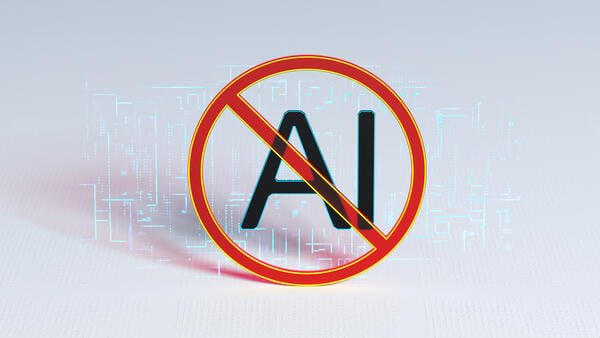
While there is no single line of defense that will stay the encroachment of AI, my conversations with faculty have led me to believe that a critical part of the solution is creating a new kind of space on campuses—one free of AI.
Imagine a space where students could pursue head-on the hard work of learning, free from the temptations of AI shortcuts. To make this vision a reality, I propose the creation of human intelligence labs, spaces designed to foster the sustained cognitive engagement that has always distinguished advanced studies. Whether co-located in a central location on campus or housed within academic departments, human intelligence labs would be staffed spaces configured to permit the use of technologies that support student learning, while restricting access to those that undermine it. Most critically, these spaces would enable faculty to block access to AI, compelling students to practice the reading, writing and problem-solving skills fundamental to their disciplines.
Reinventing the physical campus—reimagining where and how learning takes place across campus spaces—is a formidable task that will take time and resources. If residential colleges are to continue to deliver on the promise of providing a transformative learning environment, however, we must think creatively beyond current systems and structures.
As a Spanish professor, I posit the language lab as a jumping-off point for what we could create. If you studied a modern language in college, you likely frequented a computer lab to complete assigned doses of listening and speaking practice. Language labs disappeared as students gained direct access to multimedia resources on their own devices. In its time, though, the language lab served as an important auxiliary learning space where students engaged in productive struggle in the target language. College campuses currently boast a variety of related spaces, such as writing and tutoring centers, which support student learning outside of class. Our challenge is to evolve those spaces and build upon their successes to create new spaces that respond to the principal challenge of the day—AI’s encroachment.
Consider the possibilities. Students in disciplines ranging from history to sociology could visit human intelligence labs to write research papers only using the technologies that their professors deemed appropriate for the task. They would articulate and clarify ideas, build arguments, and craft transitions—cognitively demanding tasks that students might be tempted to offload to AI. Students would visit human intelligence labs to complete many of the mundane tasks of higher education that you and I completed in our dorm rooms, in the library or in a campus coffee shop; our current technology environment, however, requires us to build a robust infrastructure that protects these building blocks of the learning process.
Critically, these labs would allow faculty to continue to assign research and analytical papers, work products many currently avoid because of their susceptibility to unauthorized use of AI. Human intelligence labs would be the on-campus gyms for the mind recently described by Cal Newport.
Human intelligence labs could also encourage deep engagement with reading, an endeavor that has bedeviled faculty as both a media environment that favors video and the availability of AI summaries threaten to render sustained, deep reading obsolete. Faculty could experiment with varied approaches to strengthening students’ reading muscles. A low-tech approach might consist of assigning students to log hours in a lab that looks like a traditional reading room, outfitted with comfortable chairs and tables, while leaving devices in lockers in the hallway. A high-tech approach might feature a computer lab where students read assigned texts on computers equipped with social annotation software such as Perusall or Hypothes.is, but which block access to generative AI. (Yes, faculty find that students use AI to complete required annotations of course readings.)
Math students could benefit from this same low-tech environment, completing problem sets without struggling against the lure of all-knowing chatbots. If students were assigned specific times to attend, as they are with chemistry labs, they could engage in peer-to-peer learning or the lab sessions could be attended by teaching assistants or tutors.
For human intelligence labs to be effective, they would need to employ trained staff to monitor compliance with established norms, such as leaving devices in lockers. This might be the most controversial aspect of the model, reawakening the debates over surveilling our students (through proctoring software) that erupted during the turn to emergency remote instruction during the pandemic. Faculty do not want to build relationships with students on a foundation of suspicion and distrust.
There is evidence, however, that college students want us to protect them from aggressively invasive technologies, including AI. When we do not create these spaces for them, they create them for themselves. For example, earlier this academic year, a group of students at St. John’s College in Santa Fe organized a six-day “tech fast,” locking away their phones and other devices in a classmate’s suitcase. Students expressed the desire to feel more connected to one another and less addicted to gaming apps and the numbing effects of scrolling. Human intelligence labs would respond to students’ hunger for a reprieve from tech’s grip.
While featuring supervision, human intelligence labs would be fundamentally distinct from testing centers. Whether run by college campuses or by third parties such as Prometric, testing centers focus on summative assessment, measuring the extent to which test-takers have mastered knowledge and skills. Their mission is generating a secure site for reliable testing; surveillance is at the center of what they do. The mission of human intelligence labs would be quite different: to serve as a warm, welcoming space that supports students in practicing human intelligence.
Certainly, AI should be welcomed into appropriate spaces on college campuses. I met recently with a faculty member from the Center for Entrepreneurship who allows her students unfettered access to AI on most assignments because AI is, in her words, the entrepreneur’s best friend. Employers in the entrepreneurial space want to hire college graduates who are sophisticated users of cutting-edge AI tools. If anything, this professor was concerned that her students’ use of AI was too basic for the job market’s current demands. She assigns weekly “AI challenges” to her students to stretch them to use the tools in new ways. This professor may have little use for human intelligence labs. For faculty in many other disciplines, a space free of AI would be a godsend, allowing them to focus on teaching their discipline rather than spend all their time trying to outrun AI.
Institutions implementing human intelligence labs will doubtless face many challenges. To create flexible, AI-free environments is to engage in complex space, technology and accessibility planning. Institutions will need to transform existing spaces or build new ones. Faculty will need to discuss and agree upon the norms for those spaces, including levels of supervision. Staff will need to be hired. Departments will need to work out details related to this transition. Most students access textbooks as ebooks, so we will need to find workarounds (one idea: Stock a lab frequented by calculus students with hard copies of the textbook). All this will take time, innovation and money. Indeed, higher education’s investment of resources will need to match—in creativity and intentionality, if not in raw numbers—Big Tech’s almost unfathomable investment in AI, projected to total $700 billion in 2026 alone.
The arrival of the latest large language models on our campuses has felt, to many, like a monstrous kudzu vine, hell-bent on covering all surfaces, wrapping itself around our most valuable teaching tools (the research paper, the creative project, the humble reading assignment) and strangling them until they are lifeless. Faculty cannot tackle this intruder by simply teaching differently. We cannot expect students to restrain themselves from using these alluring tools. A thoughtful, multipronged institutional response is needed to preserve the value of the residential college, and to protect the teaching tools and strategies that serve our students well as learners. The creation of human intelligence labs would be a meaningful step in that direction.
You may be interested

Meghan Markle’s summer blouse has a £28 lookalike shoppers are loving | Royal | News
new admin - Jul 28, 2026[ad_1] Whether you love her or loathe her, there’s one thing few people can argue with - Meghan Markle has…

How Will New Student Visa Rules Impact Athletics?
new admin - Jul 28, 2026[ad_1] Only about 4 percent of all NCAA athletes are international students. Photo illustration by Justin Morrison/Inside Higher Ed | Mario…

Ohio governor calls Trump’s plan to deport Haitians “a mistake”
new admin - Jul 28, 2026Ohio governor calls Trump's plan to deport Haitians "a mistake" - CBS News Watch CBS News Camilo Montoya-Galvez sits down…