

Why are so many U.S. CEOs in China with Trump, and what do they want?

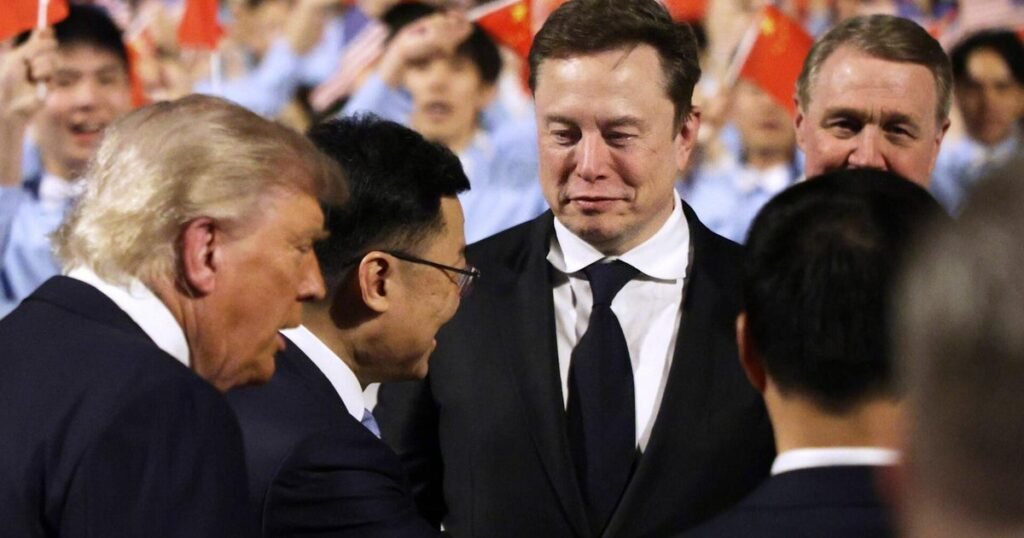
Chinese President Xi Jinping told U.S. CEOs traveling with President Trump to China that it will open further to American business, a key goal for corporate leaders eager to expand their presence in the world’s second-largest economy.
Xi spoke with the delegation of chief executives, which includes Apple CEO Tim Cook, Tesla CEO Elon Musk and Nvidia CEO Jensen Huang, according to a statement on Thursday from the Chinese Foreign Ministry. The executives — whose combined net worth approaches $1 trillion — lead companies with major interests in China, despite years of trade disputes between the world’s two largest economies.
China’s pledge to welcome more foreign business comes after years of escalating trade tensions with the U.S., including the Trump administration’s move last year to raise tariffs on Chinese imports to as much as 125% after Mr. Trump said China “was taking us for a ride.”
Yet U.S. companies continue to see China’s expanding middle class and massive consumer base as critical growth markets, even as it has become harder to wring profits from financially struggling consumers in the U.S. and other developed economies.
The White House said that several American business leaders participated in a portion of a broader meeting between U.S. and Chinese officials.
“The two sides discussed ways to enhance economic cooperation between countries, including expanding market access for American businesses into China and increasing Chinese investment,” a White House official said in a readout of the meeting.
The CEOs accompanying Mr. Trump include:
- Cristiano Amon, CEO of Qualcomm
- Tim Cook, CEO of Apple
- Lawrence Culp Jr., CEO of GE Aerospace
- Larry Fink, CEO of BlackRock
- Jane Fraser, CEO of Citigroup
- Jensen Huang, CEO of Nvidia
- Ryan McInerney, CEO of Visa
- Sanjay Mehrotra, CEO of Micron Technology
- Michael Miebach, CEO of Mastercard
- Elon Musk, CEO of Tesla and SpaceX
- Kelly Ortberg, CEO of Boeing
- Stephen Schwarzman, CEO of Blackstone
- Brian Sikes, CEO of Cargill
- David Solomon, CEO of Goldman Sachs
- Jacob Thaysen, CEO of Illumina
Conciliatory measures
Based on the CEOs attending the talks, China could take several steps to ease economic tensions with the U.S., according to analysts with Eurasia Group, a political risk consultancy.
“We continue to expect the two sides to announce increased trade and tariff adjustments in non-sensitive sectors, including Chinese purchases of U.S. agricultural products (including beef), Boeing aircraft and energy,” they said in a report.
China could also ease restrictions on foreign financial services firms, lower antitrust barriers or, for Tesla, give the electric car maker the green light to roll out fully autonomous driving, according to Eurasia Group.
The trip is already paying dividends for some of the CEOs accompanying Mr. Trump, including Boeing CEO Kelly Ortberg. On Thursday, the president told Fox News host Sean Hannity that China had agreed to buy 200 Boeing 737 Max jets, up from an earlier deal for 50 aircraft.
Mr. Trump said that Xi has also agreed to buy more soybeans, a boon for U.S. farmers who have been hurt by China’s retaliatory decision a year ago to halt purchases of the key agricultural export.
Historical precedent
There is ample historical precedent for business leaders accompanying U.S. presidents on high-stakes overseas trips or trade missions.
During President Obama’s 2015 visit to India, for example, dozens of U.S. CEOs attended a summit to expand bilateral trade and investment. In 2000, President Bill Clinton brought leading U.S. executives to India, including representatives from General Motors, IBM, and Microsoft.
When Mr. Trump visited China in 2017, he was joined by the leaders of major U.S. banks, energy companies and technology firms.
“It’s not unusual for CEOs to travel with the president, and I think it speaks to the fact that the Chinese-U.S. relationship is highly dependent on the countries’ business relationship,” Moody’s Analytics chief economist Mark Zandi told CBS News. “We are the two largest economies on the planet, and how we interact with each other largely determines how our economies and the global economy are going to perform.”
The presence of top executives alone could help “open up the lines of communication” between U.S. companies and Chinese officials and business leaders, he added.
“I don’t think there is a very high bar here for success,” Zandi said. “They just have to come away thinking they now have a channel to communicate quickly and they can trust each other.”
Chips and AI
For the U.S. CEOs accompanying Mr. Trump, the broader goals include bolstering sales to Chinese consumers and businesses, as well as ensuring their companies are positioned to win key manufacturing and trade agreements.
Apple, for instance, is the largest smartphone brand in China, although it faces intense competition from local rivals such as Huawei and Xiaomi. The Cupertino, California-based company also relies on Chinese partners such as Foxconn, the world’s largest contract electronics manufacturer, to produce the bulk of its products, which are shipped across the globe.
Semiconductor giant Nvidia is seeking broader access to China’s AI market as U.S. export controls threaten sales of its advanced chips, Wedbush Securities analyst Dan Ives said in a report. Such access comes as Chinese firms are racing to develop domestic alternatives.
“What is at stake is not just one trip or one headline but the direction of AI supply chains, the shape of future export controls and the degree to which US chip leadership remains monetizable in China,” Ives said.
Financial products
A number of major U.S. financial companies are also represented on the trade trip, including BlackRock CEO Larry Fink and Citigroup CEO Jane Fraser.
BlackRock is seeking broader access to China’s fast-growing wealth and retirement markets while navigating increasing political scrutiny in both Washington and Beijing. Citigroup, meanwhile, wants broader access to China’s financial markets, partly to help its clients engage in cross-border transactions.
“We have had huge interest and a large number of investors and companies coming to China to understand what’s happening here, as well as the Chinese companies and investors that are looking much more externally now,” Fraser told Bloomberg News last year.
Also among the executives in China with U.S. officials is Jacob Thaysen, the only biotech industry representative on the trip. Thaysen told Bloomberg last year that export restrictions have hurt Illumina’s sales of DNA-sequencing technology in China.
“We want to be a part of China,” Thaysen said, according to the news service.
You may be interested

Kindergarten vaccine exemptions hit record 4.2%, CDC says
new admin - Aug 21, 2026The CDC says the number of children exempted from vaccine requirements was up to 4.2%, an estimated 155,000 kids across…

The Freedom 250 Continues The History Of DC Races Celebrating America’s Birthday
new admin - Aug 21, 2026[ad_1] NEWYou can now listen to Fox News articles! The Freedom 250 isn't the first race hosted in Washington, D.C.…
Tupac Jurors See Keffe D’s First Public Interview About Killing
new admin - Aug 21, 2026[ad_1] Jurors watched portions of a BET documentary Friday in which Duane “Keffe D” Davis recounted the 1996 shooting that…