

When Nontraditional Students Become the Norm

Adult learners, working students, student parents, transfer students and first-generation students are often grouped under the broad umbrella of “nontraditional” students. While their experiences differ, they also highlight the various ways higher education is, or isn’t, designed around the realities of students’ lives.
Many of these students are navigating similar pressures: balancing college with work and family responsibilities, managing financial challenges and figuring out systems that weren’t necessarily built with them in mind. And as these experiences become increasingly common across higher education, they raise a bigger question: If so-called nontraditional students reflect the reality of today’s college population, does it still make sense to call them nontraditional?
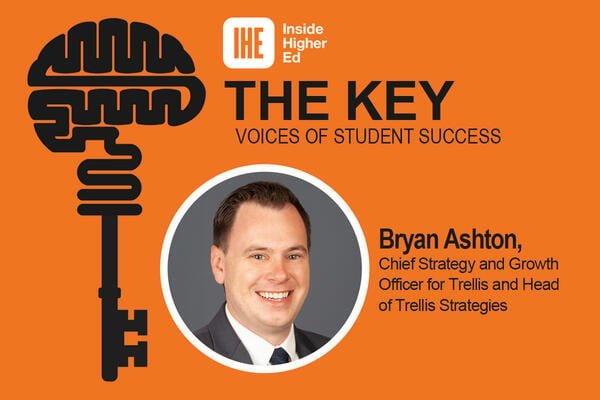
Bryan Ashton, chief strategy and growth officer at Trellis and head of Trellis Strategies, a nonprofit organization that works with colleges and universities across the country, joined Inside Higher Ed student success reporter Joshua Bay on Voices of Student Success for the final episode of our series on nontraditional students.
Follow us on Apple Podcasts and Spotify
Here are five key takeaways from Ashton on what today’s students need and how colleges can better design around their lives.
- “Nontraditional” students have become the norm.
Ashton noted that as more people pursue postsecondary education later in life, the characteristics once associated with “nontraditional” students have become increasingly common across the broader student population.
“Even the traditional students are having characteristics of what we would traditionally call nontraditional,” Ashton said, noting that Trellis Strategies uses the term “modern learners” to encompass both traditional-age students and adult learners balancing education with work, family responsibilities and other demands.
“That kind of perspective on how we serve learners is probably more fitting for where students are today than trying to think about this arbitrary cutoff of a 25-year-old or somebody who’s transferred in, but rather that our systems need to evolve to meet the needs of all learners, and that those needs look different than they did 10 to 15 years ago for many of our students,” Ashton said.
- College is only one part of students’ lives.
Drawing on the Trellis Strategies 2025 Student Financial Wellness Survey, Ashton highlighted that one in five students identify as a parent or caregiver and 34 percent consider themselves workers who go to school rather than students who work.
“When we start to think about these different personas that students have, that really informs how they engage with postsecondary education and training,” Ashton said, adding that students are increasingly engaging with their education in a “nonlinear” fashion, meaning attending consecutive semesters may not always align with how they navigate college.
“When you start to think about the trade-offs of ‘Do I go to class or do I take care of a child who’s sick and can’t go into a childcare setting?’ Those other primary personas always will weed out the academic experience,” he said.
Ashton also noted that employment can create a push-and-pull for students who need to work to afford college and their broader living expenses, even when their jobs make it more difficult to fit classes into their schedules.
“We know that [students] need to work to be able to close those gaps, but oftentimes employment and class schedules can come into conflict,” Ashton said.
“Something that we lose a lot in conversation is this isn’t just students that are engaging with one employer; they’re engaging with sometimes two employers or multiple gig employers,” he added. “As they try to navigate these employment schedules with academic schedules, it becomes a semester-by-semester puzzle that they have to put together to be able to attend class.”
- Financial instability can become an academic problem.
Ashton said higher education leaders thinking about student engagement and persistence also need to consider how financial stability affects whether students are able to remain enrolled and ultimately complete their education.
“It’s impossible to separate those two conversations,” Ashton said. “When I ask learners why they left an institution, finances, both direct and indirect costs, are always some of the leading causes of why students say that they don’t persist.”
He noted that the Pell Grant, a need-based federal subsidy for undergraduate students, covers only a fraction of the total cost of attendance, but the growing financial pressure students face isn’t driven solely by tuition and other direct college costs.
“What has increased exponentially is the cost of living,” Ashton said. “And it’s unfortunate because this isn’t something that institutions have a ton of control over, but it’s a super real reality for the students that they’re enrolling.”
Ashton also pointed to Trellis survey data showing that about 52 percent of students worry about having enough money to cover their monthly expenses, and 21 percent said they ran out of money eight or more times in a single year. Those recurring financial gaps, he said, have contributed to students turning to products such as credit cards and buy-now-pay-later services to cover expenses.
“We see both the macro, which is that unmet need is really driving unsustainable financial gaps that students can’t cover to stay enrolled and the micro, which is that there’s month-to-month stress and anxiety that’s coming with not being able to meet basic needs,” Ashton said. “That creates this perfect storm for student financial stress and then has a persistent impact after that.”
- Rethinking institutional design can reduce student barriers.
Ashton noted that higher education has historically expected students to center their lives around their education, pointing to the rigidity of structures such as the academic calendar that institutions can struggle to adapt around students’ changing needs.
“We’re really in a position where, as these other personas—a worker who goes to school, a student parent—become more and more the primary persona, we have an obligation to figure out how we can fit education into people’s lives,” Ashton said.
While some challenges, such as rising housing costs, lie largely outside an institution’s control, colleges have more control over other barriers, Ashton said. Offering online or hybrid courses, for example, could reduce the transportation burden for students as gas prices rise.
“There’s a redesign component around what do institutions control that is super important,” Ashton said. “We’ve asked students to navigate a really complex system, and we haven’t necessarily thought about, ‘How do we make that user experience easier?’”
One of the most underappreciated interventions available to colleges, Ashton said, is the course schedule.
“We sort of refer to it as the highway through which everything else is scaffolded on,” Ashton said. “I really can’t do a great job of helping students to manage employment with academics if they don’t have predictability when their scheduled courses are going to be.”
“Those are where we’re really thinking about ‘How do we take those points and make that kind of more holistic systemwide change, while still allowing for certain student populations to get those targeted interventions that help to create and serve some of the unique circumstances that they’re facing?’” he added.
- Colleges need to design for the students they actually serve.
Ashton said part of the challenge of redesigning higher education around today’s students is determining what comes first: changing how institutions define student success or altering the structures attached to that definition.
“A lot of what we’ve built the environment around is how we define student success … [but] the future of education and training is much more nonlinear, with people starting and stopping,” Ashton said. “It’s a lot more about credit mobility, learning mobility and how we take experiences from one institution to another.”
For Ashton, the biggest takeaway is the need for institutions to flip their perspective: Instead of asking students to fit their lives into an institution’s model, colleges should ask how they can make that model fit into students’ lives.
“If we can begin to ask that question as we’re looking at institutional policies or as we’re looking at the experience that students are having on campus, that can become a really good test to say, ‘Are we evolving to meet the needs of modern learners?’” Ashton said.
Get more content like this directly to your inbox. Subscribe here.
You may be interested

Wisconsin police find dozens of partially clothed men in frat house basement in alleged hazing incident
new admin - Sep 25, 2026Two 20-year-olds were arrested after police were called to the scene of an alleged hazing incident where over two dozen…
Insta360 conquered 360 cameras — now it’s eyeing glasses
new admin - Sep 25, 2026It’s right there in the name: “Insta360” makes 360-degree cameras, ones that film every angle simultaneously so you can shoot…

Lidl banned from selling major dupe in supermarkets
new admin - Sep 25, 2026Lidl has been ordered to stop selling one brand's dupes after a major copyright ruling. Source link