



Colleges Are Losing Young Men. What Brings Them Back?

Women have outnumbered men on college campuses for decades, but the divide extends beyond who enrolls. Young men are also less likely than young women to earn a degree of any kind, raising questions about why some men are opting out of higher education and what colleges can do to better engage and support them.
The gap comes as colleges are confronting broader questions about the value of a degree, the rising cost of attendance and whether traditional higher education is meeting the needs of today’s students. For institutions seeking to enroll and retain more men, the challenge is not only understanding what is keeping them from college but identifying what changes could make higher education a more attractive and successful path.
Former U.S. education secretary Betsy DeVos was among those who addressed such challenges Thursday at the Symposium on Young American Men in Washington, D.C., which brought together lawmakers, researchers, journalists and organizational leaders to discuss policies shaping outcomes for young men in education, work, family life and mental health.
Pointing to the decline in men pursuing higher education, DeVos said “there’s no simple answer” for the trend. She highlighted questions about the economic returns on some college degrees as well as men’s disproportionate interest in apprenticeships and other career pathways that do not require a degree, adding that she’s “not sure that a lot of the degrees that have been granted in higher ed institutions in the last couple of decades are all that valuable for a lot of young people.”
The symposium coincided with the release of new survey research from Cygnal examining how young men view their lives and the challenges they face. Of the 800 U.S. men aged 18 to 30 who responded, about 55 percent said they felt their life was on track, compared with 40 percent who said it was off track. Nearly two-thirds, 63 percent, said they wanted the federal government to do more to address problems facing young men, with inflation and housing among their top concerns.
Devos zeroed in on the role higher ed could play, arguing that colleges need to reconsider what they offer young people and how they demonstrate its value.
“Higher ed has a lot of self-analysis to do on what their value proposition is today,” DeVos said. “We would benefit from thinking more broadly about what higher education actually is and how it could look.”

Former U.S. education secretary Betsy DeVos speaks at the Symposium on Young American Men.
Joshua Bay/Inside Higher Ed
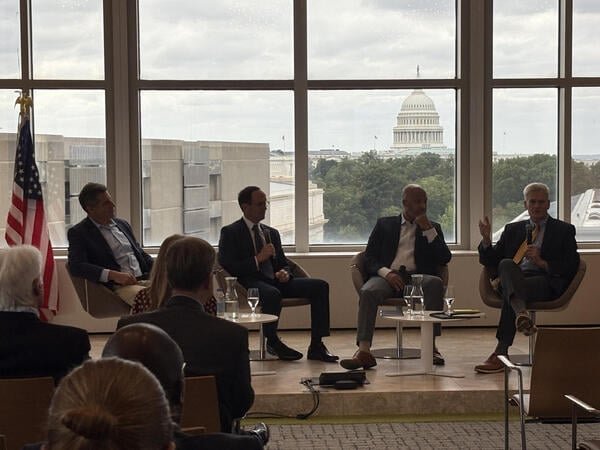
The diploma divide: The challenges facing young men specifically in higher education were the focus of a subsequent panel featuring Sen. Bill Cassidy; Judson Horras, president and chief executive officer of the North American Interfraternity Conference; and Curtis Valentine, founding president of the Male Educator Network and Policy Institute.
The panelists explored what is driving young men away from college, pointing to a split of roughly 60 to 40 in enrollment between women and men. They discussed demographic shifts, questions about the value proposition of a college degree and whether institutions are creating environments where young men feel welcome and supported.
Cassidy, who chairs the Senate Health, Education, Labor and Pensions Committee, outlined three areas for higher education leaders to consider: identifying whether college or a technical education is the right path for each individual student, recognizing gender disparities in college-going and paying greater attention to the persistence and retention of young men once they enroll.
While college may not be the best path for every young man, Cassidy said, that should not keep policymakers and higher education leaders from confronting the gender gap among those who do pursue a degree. He also highlighted a potential role for the federal government in addressing those disparities, pointing to the bipartisan College Transparency Act, which he and Sen. Elizabeth Warren are working on to modernize postsecondary data reporting.
“Does federal policy play a role in trying to address those issues? Absolutely,” Cassidy said.
Valentine emphasized the need for more male mentors in young men’s lives, arguing that such relationships can help ensure they feel not only like they belong but also that they matter.
“There’s something about hearing from a male educator that college is possible, that you’re needed,” Valentine said. “You’re seeing instances where just having a male mentor and educator tell you, ‘You’d be great. You have so much more potential than you think you have’ … [helps] them see their potential.”
Horras noted the importance of community for young men, pointing to fraternities as one avenue for providing a sense of belonging while fostering both agency and accountability.
“That’s where they’re finding the most personal growth,” Horras said. “As we track them, the students joining fraternities or all-male societies are the most likely to stay in school and to follow through to graduation because they’re finding a place where they belong, where they’re welcome and where they can challenge their ideas.”
Echoing DeVos’s comments earlier in the day, the panelists also touched on the growth of apprenticeships and earn-while-you-learn models and their appeal among young men. Valentine pointed to the growth of dual enrollment programs, while Horras argued that colleges should embrace learning opportunities beyond the classroom.
As artificial intelligence reshapes education and work, Horras said, it will be increasingly important for young men to develop not only hands-on skills but also discernment and critical thinking skills.
“With AI, it’s going to be less about what you’re learning in the classroom and more about thinking critically and influencing others to build something,” Horras said. “You’re going to see opportunities grow outside of the classroom far more than they ever have in a classroom, and colleges should embrace that.”
The mentorship gap: The panelists also discussed rising loneliness among college students and its disproportionate impact on young men. Horras said that isolation can affect men across socioeconomic backgrounds, particularly first-generation students, who may have fewer organic mentoring relationships within academic networks than their continuing-generation peers.
Asked what tangible policy changes could help address some of the challenges facing young men, Horras called for greater incentives for adult men to mentor boys in middle and high school. Valentine went a step further, suggesting free college tuition for men interested in pursuing careers in teaching or coaching.
“There’s something about having someone in your life who believes in you more than you believe in yourself at a time that you don’t even fully understand,” Valentine said.
Get more content like this directly to your inbox. Subscribe here.
You may be interested

Microsoft thinks its new Copilot ‘super app’ will be as influential as Office
new admin - Sep 25, 2026After teasing its new Copilot “super app” last month, Microsoft is officially unveiling it today. The redesigned Copilot app bundles…

Vet warns all dog owners to do one task after this weekend's full moon
new admin - Sep 25, 2026As the nights draw in, dog owners are being urged to do an important task before taking their pet for…
Sen. Duckworth slams Trump’s “foolhardy plan” to make triumphal arch a military complex
new admin - Sep 25, 2026Democratic Sen. Tammy Duckworth of Illinois is demanding the Pentagon and Federal Aviation Administration reject President Trump's call to convert…