



What is postpartum psychosis? – CBS News


Ten years ago, Meghan Cliffel was a working mother in New York City. In December 2015, she was back at work, eight months after giving birth to her second girl: “I had taken on a lot of work stress, and not quite feeling like myself, but outwardly, I was functioning well,” she said. “And it wasn’t until Friday, December 4th of 2015, when things just dramatically changed for me.”
On that day, Cliffel says she began to believe she was being “surveilled.” “And from that moment on, I am just lost in a totally deluded, terrifying reality, where I believe the entire city is out to get me,” she said.
Family Photo 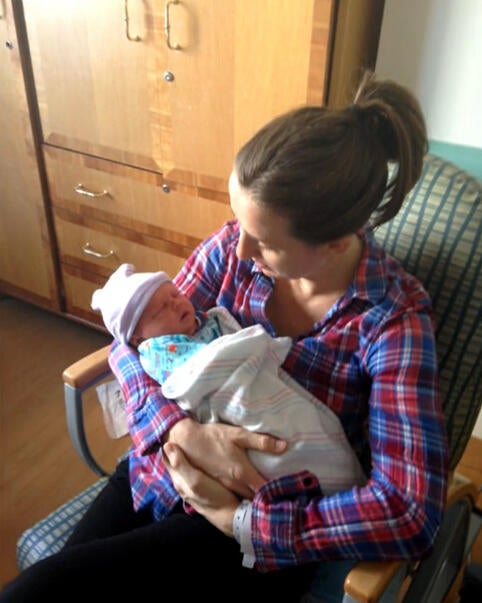
Then, she started to hallucinate. “The TV starts to change, and it’s the face of a male relative of mine, and then he says, ‘If she thinks she’s getting out of this alive, she’s got another thing coming,'” Cliffel said.
As her husband, Colin, remembers, the next morning Meghan’s crisis engulfed the whole family: “I felt like I was interacting with a wholly different person,” he said. “Her behavior in those, like, acute 12 hours in particular in our apartment was unlike anything I’d ever seen before. … It just became this sort of epic battle where, you know, she is trying to quote/unquote rescue our girls (who are happily in our bedroom playing), and I literally have to have my back up against our bedroom door to try to keep Meghan out. And then, just like that she turns around and is trying to get to our apartment door, ’cause she’s threatening to go to the roof. And eventually, you know, I’d say she punches like Mike Tyson, and came out swinging and, you know, clocked me twice.”
Colin called 911, and Meghan spent the next two weeks in Bellevue Hospital, where she was prescribed Lithium. It wasn’t until two months later that she learned the diagnosis: postpartum psychosis, a severe mental illness.
Dr. Veerle Bergink, a psychiatrist and director for women’s health at Mr. Sinai’s School for Medicine, has been studying postpartum psychosis for 20 years. She says it should not be misunderstood as postpartum depression. Bergink calls postpartum psychosis a “psychiatric emergency,” with symptoms that can be extreme: “Mania, racing thoughts, psychosis, losing reality, or depression with psychotic features, being so low that you think everything is your fault, or a mixture of these. And these symptoms occur within a few months after delivery.”
Asked how common are cases where a mother with postpartum psychosis harms herself or her baby, Bergink replied, “Unfortunately, suicide is a major cause of mortality. Infanticide is extremely rare.”
Postpartum psychosis was at the center of the trial of Lindsay Clancy, which has riveted the country. Neither the defense nor the prosecution disputed that Clancy had killed her three children in January 2023.
Greg Derr/The Patriot Ledger/Pool 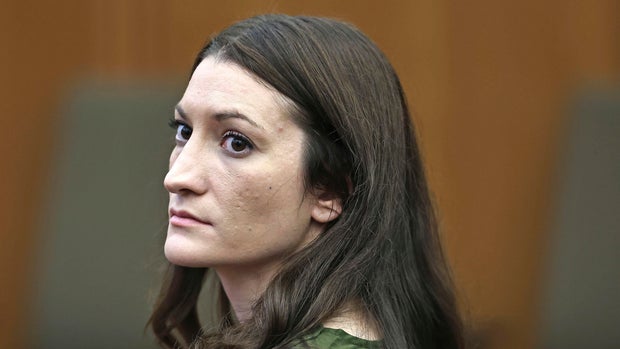
During the trial, prosecutor Jennifer Sprague argued, “The issue is whether, at the time [Clancy] killed Cora, Dawson and Callan, she knew the difference between right and wrong, and whether she could conform her behavior to the requirements of the law.”
But Clancy’s lawyer, Kevin Reddington, argued that her undiagnosed psychosis rendered her legally insane: “This is a woman who was suffering from psychosis at the time that she went down to that basement. She had no motive. She loved her children.”
After deliberating for seven days, the jury could not reach a verdict, resulting in a mistrial.
The condition at the center of the trial is considered rare, afflicting an estimated 1 to 2 women per 1,000 births a year in the U.S., potentially affecting up to 9,000 mothers annually, according to the Cleveland Clinic.
Bergink said, “It has been known for thousands of years. It has been described, you know, by the ancient Greek, in all cultures, in all times.”
Yet, Bergink says there are currently fewer than 10 research groups in the U.S. studying the illness. “We don’t know how to prevent it yet, because there is no research, there is no funding,” she said. “But then, if you make the diagnosis, we can treat it. Ninety-eight percent in our studies really got better within weeks.”
Postpartum psychosis has no single known cause. Symptoms can shift dramatically over days or hours, and mothers may intermittently appear functional – which can confuse their family and clinicians.
Dr. Jennifer Payne, a reproductive psychiatrist and vice chair of research at the University of Virginia School of Medicine, said, “Postpartum psychosis is a much rarer presentation, and many psychiatrists have never seen a case.”
Payne hopes the tragic case of Lindsay Clancy will educate the public and the legal system about postpartum psychosis. She notes there has been some change in the nearly 25 years since Andrea Yates was tried for the murder of her five children while suffering from psychosis.
However, Payne said, “I don’t think the legal system has progressed to handle postpartum psychosis cases well. I think that there continues to be an amazing amount of stigma surrounding maternal mental health and psychiatric diagnosis.”
Payne said she would like to see, “when it is clear that a patient has had postpartum psychosis and acted on delusions as part of that illness, that that particular case should not progress to a murder trial, and should instead be relegated to a mental health treatment journey.”
Three years after her recovery, Meghan Cliffel and husband Colin decided to have a third child. “The risk of recurrence was one-in-three unmedicated,” Meghan said. “I actually didn’t want to take medication, ’cause I felt like I’d done so much work on myself and our life. My husband was, ‘Hard no.’ So, I took Lithium prophylactically immediately after birth in the hospital until a year after. And then, honestly, it turned out more beautifully than after my first two. I had, like, so much more joy the third time around.”
Their son is now six years old. And with all the attention surrounding the trial of Lindsay Clancy, Cliffel felt she needed to share her story. “It’s a real illness,” she said. “There’s no shame. And you can get better. It is a beast and it’s hard to heal from, and it warrants time and attention. But take that time, because this is a very real, devastating illness.”
If you or someone you know is in emotional distress or a suicidal crisis, you can reach the 988 Suicide & Crisis Lifeline by calling or texting 988. You can also chat with the 988 Suicide & Crisis Lifeline here.
For more information about mental health care resources and support, The National Alliance on Mental Illness (NAMI) HelpLine can be reached Monday through Friday, 10 a.m.–10 p.m. ET, at 1-800-950-NAMI (6264) or email info@nami.org.
For more info:
Story produced by Kay Lim and Reid Orvedahl. Editor: Jason Schimdt.
You may be interested

Preparing for 9/11 trials inside Guantanamo | 60 Minutes Archive
new admin - Sep 06, 2026In 2013, Lesley Stahl got unprecedented access to the Guantanamo Bay, Cuba, facility where accused 9/11 terrorists were set to…

Nature: Newfoundland – CBS News
new admin - Sep 06, 2026Nature: Newfoundland - CBS News Watch CBS News We leave you this Sunday morning on the coast of Newfoundland. Videographer:…

Luke Combs Collab, New Album ‘Cinco,’ AI
new admin - Sep 06, 2026[ad_1] When Luke Combs joined the Wilder Blue for a cover of Steve Young’s “Seven Bridges Road” in 2023, it…