


What Are We Missing About Student Mental Health?

Colleges have devoted growing attention and resources to student well-being in recent years, but supporting mental health goes far beyond what happens inside a counseling center.
Students’ well-being can be shaped by nearly every part of the college experience—from the expectations they bring with them to campus and the academic, financial and social pressures they encounter to how they navigate setbacks, uncertainty and the transition into adulthood.
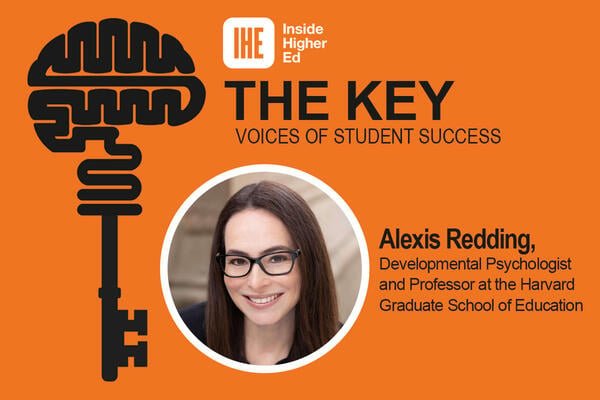
Alexis Redding, a developmental psychologist and professor at the Harvard Graduate School of Education, joined Inside Higher Ed student success reporter Joshua Bay on Voices of Student Success to talk about what colleges may still misunderstand about student mental health, how the broader college experience impacts students’ well-being, where normal stress and struggle fit into the conversation, and what it would look like for institutions to build a culture of care that supports students throughout college and beyond.
Follow us on Apple Podcasts and Spotify
Here are five key takeaways from Redding on what it takes to support student well-being across the college experience.
- Student mental health is shaped by the entire college experience.
Redding said higher education often thinks too narrowly about student mental health by focusing primarily on the years students are enrolled in college. Instead, she said, institutions should consider the experiences that affect students’ well-being before they arrive on campus and as they prepare to leave.
That includes the pressures students experience during the college admissions process as well as the expectations they bring with them about what college should look like academically, socially and personally.
Redding noted that in her book Mental Health in College, she also explores for students “the transition into the workforce or into graduate school and making those decisions, because it is yet another moment of transition that really feeds into what happens during the college years.”
She added that the pressure to have a successful or even transformative college experience can affect students’ mental health when reality doesn’t match those expectations.
“The story of college that we tell culturally on Instagram, in movies, in our retelling is that college will be the best four years of your life,” Redding said. “For a lot of people, college is not four years. It is longer or shorter than that. But more importantly, you’ll have great moments in college, but you will also have challenging moments because you are in transition.”
“What’s really important for us to do is to start to tell a much more honest story about college,” she added. “Every student has their own version of feeling lonely and unsettled, and almost no student shares it with each other. They all think that they are struggling alone [and] that they are uniquely doing something wrong.”
- Not every struggle is a mental health crisis.
Redding said it’s important to distinguish between students who are in need of clinical care and should be referred to a counseling center and those who are experiencing more common struggles associated with college and emerging adulthood.
“The vast majority of students are struggling in more typical ways,” Redding said. “Developmental issues of being in a moment of transition, doing something hard for the first time, being disconnected from home or navigating multiple responsibilities at once.”
She said it’s important for higher education leaders to be able to discern between the two so “we don’t overreact to the student who’s having a typical bad day, and we don’t underreact to the student who has a clinical concern.”
Redding emphasized that the instinct to refer students to clinical care comes from a good place, but she said treating every expression of struggle as a mental health crisis can prevent students from receiving the kind of support they were actually seeking.
“We are so worried about missing somebody who has a clinical need, and that is the right instinct,” Redding said. “The issue with leading with that instinct is that we tend to overreact when a student is having the typical bad day.”
Redding noted that when students approach faculty about a bad grade, issues with financial aid, struggles with a roommate or difficulties with their commute, immediately referring them to the counseling center because they say they’re struggling can “[shut] down the lines of communication with the caring campus adult who they sought out to have a conversation with and [escalate] it.”
- There is no single student mental health experience.
Redding noted that today’s college students include community college students, adult learners, veterans, student parents, first-generation students and many others whose lives may look very different from the traditional image of an 18-year-old living on campus. Those differences, she said, should shape how institutions approach student well-being rather than designing around a one-size-fits-all student experience.
“When we design programs and policies and practices thinking that everybody is in residence, is attending full-time, we set up friction points in the campus or in the institution that don’t need to exist,” Redding said.
She said institutions can identify those friction points in a range of ways, from creating focus groups with students to putting themselves in the position of the different students they serve and examining how easy—or difficult—it is to access the resources they need.
If a commuter student is “trying to get help at the dean of students’ office, trying to go hang out in the queer students’ office and build community there, or trying to get counseling when it is offline when they arrive on campus, that sends a particular signal that ‘they don’t understand my experience here.’”
“Beginning to think through all of those ways of experiencing campus can empower you to fix that,” Redding said. “To not put things behind a paywall that a prospective student might actually need to know about, like the hours of the childcare center or how much it costs.”
- Awareness alone won’t solve the student mental health challenge.
With World Mental Health Day coming up on Oct. 10, Redding noted that colleges increasingly use moments like it to raise awareness and encourage students to seek help. But she said the next phase of this work should include not only addressing clinical concerns but also helping students understand and navigate common experiences such as loneliness, disconnection and the emotional ups and downs of college.
“What I would love to make sure we’re doing simultaneously with moving forward on all of the powerful work we have done to destigmatize the conversation around mental health is to continue to uplift this conversation about the typical bad days and what students should expect,” Redding said.
In conversations with higher education leaders, Redding often points to the W curve, a model illustrating the typical pattern of emotional highs and lows students may experience as they adjust to college. Understanding when those dips tend to occur, she said, can help institutions think more intentionally about when students may need additional connection and support.
“We know that so many colleges and universities put all of their programming, especially for first-year students, during orientation week, and the enthusiasm and excitement of building community and the programming starts to drop off,” Redding said. “Having these midpoints of the semester and reupping that kind of enthusiasm and programming at the beginning of the second semester actually meets where students are on the W curve at the moments where they have these profound dips.”
- Supporting student well-being takes the whole institution.
Redding said building a culture of care requires institutions to consider how students experience support not only through formal mental health services but also in their classrooms, advising relationships and everyday interactions on campus.
One example she has seen is faculty creating “warm” policies in their syllabi that signal to students that they care about them as people. That can include explaining how to request an extension or ask for help and sharing information about resources such as food pantries and other basic needs supports.
“We tend to underestimate how important it is for students to have those moments to ask a really basic question,” Redding said. “Let them ask the really basic question, because it’s almost always a preamble to the much harder question that’s two questions down the line.
“Creating the spaces where they can do that and they can see that you really care, that you are doing this work because you want them to succeed, makes a big difference,” she added.
For Redding, creating that kind of environment also requires thinking more broadly about what student success ultimately means. Rather than focus only on whether students persist and earn a degree, she said colleges should give students opportunities to explore who they are and what they want from their lives beyond graduation.
“We want to be preparing our students for a life that is meaningful to them, and that means that we have to carve out the space while they are with us for them to do genuine exploration and to make big decisions with scaffolding,” Redding said. “A college experience that, to me, is successful is one where every student can ask and answer those questions for themselves, and we can create the space where that happens.”
Get more content like this directly to your inbox. Subscribe here.
You may be interested

Major earthquake shakes Panama
new admin - Oct 09, 2026IE 11 is not supported. For an optimal experience visit our site on another browser.New video shows moments before ICE-involved…

Judge strikes down DOJ’s policy of reviewing state voter rolls, saying it would “run roughshod over longstanding laws”
new admin - Oct 09, 2026A federal judge has struck down the Trump administration's plan to check state voter rolls against federal immigration databases, a…

Ella Langley Cancels Tulsa Show Due to ‘Serious Security Threat’
new admin - Oct 09, 2026[ad_1] Ella Langley canceled her show in Tulsa, Oklahoma, on Friday night due to a “serious security threat” to fans,…