



The Hidden Curriculum First-Gen Students Face

Being the first in your family to attend college can mean entering an unfamiliar system without the same knowledge or networks some of your peers have—from knowing where to turn for help to navigating financial aid, academics and the unwritten rules of campus life.
But first-generation students also bring their own experiences, strengths and support systems with them. So what do colleges still misunderstand about first-gen students—and what actually helps them feel like they belong and ultimately allow them to earn a degree?
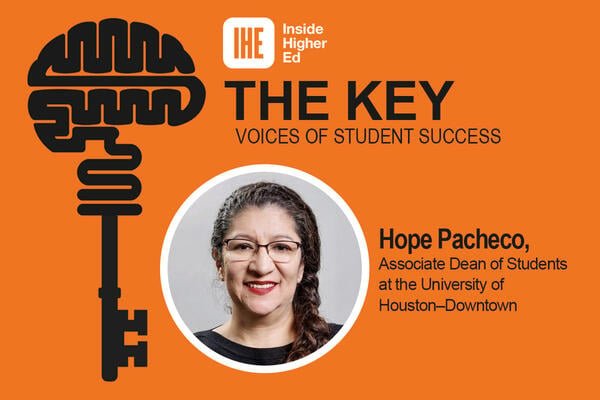
Hope Pacheco, associate dean of students and executive director of the Gator Resource Center at the University of Houston–Downtown, joined Inside Higher Ed student success reporter Joshua Bay on Voices of Student Success to unpack what first-generation students experience when they arrive on campus, whom they turn to when they need help and what colleges can do to make sure they don’t have to figure it all out on their own.
Follow us on Apple Podcasts and Spotify
Here are five key takeaways on what colleges can do to better understand and support first-generation students.
- First-gen students navigate a hidden curriculum.
For first-generation students, Pacheco said, navigating college can mean learning how a complicated set of deadlines, requirements and decisions fit together, often while they’re already expected to be making consequential choices about their education.
“There are a lot of things that I think that the academic calendar drives for students, especially first-gen students who are trying to figure out: Is this the right major for me? Is my financial aid award right? How much time do I have to drop a class or add a class?” Pacheco said.
“There’s information that’s shared through orientation and advising, and even precollege through their college counseling advisors,” she added. “The academic calendar can really drive some of the tensions that some of our first-gen students might feel about having to make decisions in the moment.”
- Being first-gen shouldn’t be regarded as a deficit.
Pacheco said institutions often lump first-generation students together, but they aren’t a monolith.
“What I feel like we’re missing is the nuances of our traditional-age students, adult learners and older students who are coming back to complete a degree, and they can all be first-gen students as well,” Pacheco said. “[There are] nuances of what a first-generation college student experience is going to look [like] … across the age and the time that they’re coming to us.”
“What a first-gen traditional-age student might need is going to look different from [what] a parenting student working full-time or one who might be coming to us as a transfer student from community college [might need],” she added.
At the same time, Pacheco said, colleges shouldn’t define first-generation students only by the knowledge or experiences they may lack. Many are already advocates for their families and arrive on campus with skills they’ve developed while navigating other parts of their lives.
“The advocacy skills that [first-gen] students bring is important,” she said. “Even as we talk about students maybe not having the college knowledge, they’re coming to us with financial skills, they’re coming to us with skills that they’re having to not only blaze a trail to be the first, but also be a role model to their own family.”
- Supporting first-gen students means supporting their families, too.
Pacheco said institutions often have an array of supports for students, but first-gen students still often lean on their families and communities, regardless of whether those people have firsthand college experience.
“We want to be there for students, but at the end of the day, it’s more than likely that they’re going to their family,” Pacheco said. “It’s important when we are talking to families that they know that there is support at the university, and provide that information to families as early as possible.”
Giving families that information helps them understand that they don’t need firsthand experience with higher education to play an important role in helping their students navigate college, Pacheco said.
“This is your student, this is our student, this is our journey together,” Pacheco said. “Regardless of what type of education level they have or not, they are the experts of their students.”
- Students need to establish trusting relationships before they will ask for help.
Pacheco said building trust with first-gen students starts with making it clear that they belong on campus—and then demonstrating that message through how institutions support them.
“What colleges can do is very simple: Say it out loud, say you belong here, put it on everything, write it everywhere,” Pacheco said. “We are institutionalizing ‘You belong here.’ We are walking the walk. We’re demonstrating that we value you and your experience. We value the nuanced experience of all of our students [and] see you as an individual.”
In practice, that means designing programming and supports around the first-gen experience, adjusting hours so students can utilize them when they need them most and, at its core, ensuring first-gen students are able to build meaningful relationships and connections with the campus community.
“We shouldn’t assume that the student is going to trust us,” Pacheco said. “We have to actively build the relationship. Building is on us as faculty and staff to do the work, to do the lift. And if that means changing our hours, if that means doing the program three times instead of one, if that means moving it online, we do that.”
- A sense of belonging can determine whether students stay.
Pacheco said she often asks first-gen students at her university what might prevent them from successfully completing the semester. Often, those conversations revolve around college affordability, financial aid, working while enrolled, or managing mental health challenges alongside their coursework.
“Students are coming in and they want to be able to get as much as they can in the shortest amount of time and work—they’re looking at a very straight path,” Pacheco said. “I try to encourage students to think about a winding road.”
“So maybe it’s affordability, maybe it’s basic needs, maybe there’s a crisis that’s happening with family or with themselves,” she added. “We want to be able to get them through a successful semester, but how can we do that and still preserve the student? Because at the end of the day, they’re human. They may have multiple priorities and time may not be on their side.”
Ultimately, Pacheco said, an institution that successfully cultivates an inclusive and welcoming environment for first-gen students ensures they know they won’t have to navigate those challenges alone.
“I want a student to feel like even if I don’t know, I can go to anybody and they can point me in a direction, and if I’m unsure, they’re going to walk with me,” Pacheco said.
“Walking with someone—literally—is what I think every first-gen student needs,” she added. “And can you walk with the people that they’re bringing with them? It might be their family, it might be their chosen family, it might be their community, their friends. Walking through all of the things to come, and eventually walking across that graduation stage.”
Get more content like this directly to your inbox. Subscribe here.
You may be interested

Spain’s spy agency warned of Ceuta border breach before crisis, declassified files show
new admin - Sep 10, 2026Madrid — Spain's national intelligence agency issued multiple warnings before the Ceuta border crisis about a potential mass crossing of…

Harry Styles Shares 2027 Stadium Tour Dates
new admin - Sep 10, 2026[ad_1] After three years away from the stage, Harry Styles can’t get enough of being together, together again. The Grammy…

Fire on cargo ship docked in Chinese port kills 20 and some people are missing, state media say
new admin - Sep 10, 2026Beijing — At least 20 people were killed and five were missing after a cargo ship caught fire while docked…