



The 3 incredible purposes that Stonehenge may have served – not just for worship | Books | Entertainment

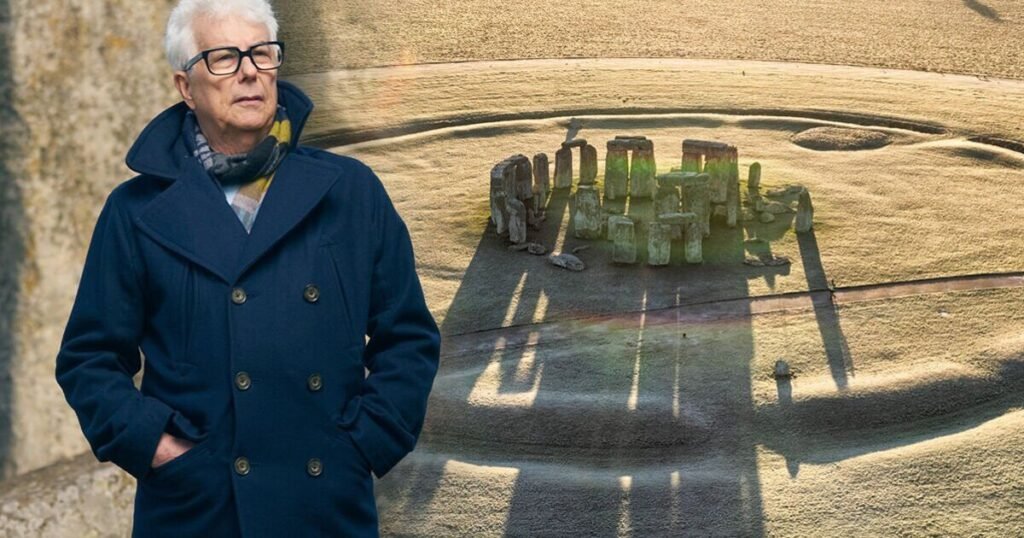

Stonehenge is the inspiration for author Ken Follett’s new book Circle of Days (Image: Gareth Iwan Jones / Getty)
History has always inspired me, particularly historic buildings and monuments. My new book, Circle of Days, is a novel about the building of the greatest and most mysterious monument in the world – Stonehenge. What could be a more fitting and intriguing setting for a historical novel than that?
I was attracted to this story because Stonehenge is such a mystery. Why was it built? It cannot have been easy to do. The wheel – which would have made the task much easier – had not yet been invented, nor were animals used to transport heavy loads. So those giant stones had to have been moved by a large group of people, working together. But why? What drove them to do it? What did they hope to achieve? I’ve imagined some of the answers to these questions.
I think Stonehenge may have had three functions. The monument is oriented to the rising sun and the setting sun, so it seems likely that the people who built it worshipped the sun. Secondly, wherever hundreds of people gather, a market usually appears. There was no money in the Stone Age, yet people still traded at Stonehenge. We know this because archaeologists have found pottery, tools and special stones that came from faraway places there.
Stone Age people may have used flints as currency, because they were one of the most useful and valuable things you could possess – they were the only cutting tool before the invention of metal. Sharpening a flint is called knapping. It’s a difficult and skilled job, and I was fortunate to have the archaeologist Phil Harding show me how it was done.

Sunset at the prehistoric monument of Stonehenge on the Salisbury Plain in Wiltshire (Image: Getty Images)
As part of my research, I also visited the site of a Stone Age flint mine in Norfolk, today known as Grime’s Graves. Miners dug down through layers of chalk, using the antlers of red deer as pickaxes. They had to excavate many tonnes of chalk to get at the top quality, jet black flint that lay beneath. The seam of flint had to be smashed up into manageable lumps, then carried in baskets up the climbing pole to the surface. Flint mining, like coal mining, was hard, dangerous work. One of my characters is a flint miner – but dreams of another life.
The third function of Stonehenge – and the one that inspired me to call the novel Circle of Days – may have been as a calendar. Stone Age people knew when it was Midsummer Day and Midwinter Day but they hadn’t yet invented writing – so how did they know the days of the year? One theory is that Stonehenge was their calendar. The 30 upright stones may have represented the days in a month.
When the builders of Stonehenge were looking for stones for their fabulous monument, they went to what is now called West Woods in Wiltshire. I visited the site with the archaeologist Dr Katy Whitaker, who explained to me how we now know that the stones used in the monument came from this location.
She told me about experiments conducted in recent years that tested the chemical composition of the upright sarsen stones at Stonehenge and compared them with sarsen stones from several locations across central and south-eastern England.
The results showed that almost all the stones used in the construction of Stonehenge were taken from West Woods – even stones from just a mile away were not a match.

Circle Of Days by Ken Follett is out now (Image: Quercus)
However, it is not so much the stones themselves that interest me – though they too are fascinating – but rather the people who put them there.
The original Stonehenge was probably made of wood, but around the year 2500 BCE it was transformed into the extraordinary stone monument whose ruins we see today. The task of building it must have seemed impossible: no-one had done anything like it before. There were other stone circles already in existence but nothing as elaborate as Stonehenge with its 75 matched stones.
The construction would have involved hundreds of people over many years. Stone Age people were ingenious, and I’ve imagined a character called Seft who has to solve unprecedented practical problems, from lifting a giant stone upright to placing a massive crossbar or lintel over the tops of two uprights.
The people building the monument must have had a charismatic leader: someone who organised and motivated them, inspiring them to achieve this task that seemed impossible. A young priestess, Joia, fulfils that role in my book.
The characters don’t know whether it’s possible… until they do it.
In Circle of Days, Stonehenge has enemies. Some characters think the monument is a waste of time and effort. The farmers in the river valleys compete with the cattle herders for control of the Great Plain and there are elusive hunter-gatherers living in the woods. Rivalry sometimes turns to violence, even war.
History has always fascinated me and I’m grateful that I get to explore the parts that interest me the most and share them with readers.
However, it is people and human achievement that have always been at the heart of my writing. Circle of Days is no exception. It is a story not just of human accomplishment but of the trials and the triumphs of the ordinary people – people more like me and you than you might think – who made history.
You may be interested

Biddeford, Maine, mayor on ICE shooting, community's response
new admin - Jul 16, 2026Liam LaFountain, mayor of Biddeford, Maine, joins "The Daily Report" to discuss his town's response to Monday's incident where an…

Lydia Millen’s sold-out Fairfax & Favor has finally been restocked
new admin - Jul 16, 2026Lydia Millen’s sell-out Fairfax & Favor handbags are finally back after huge demand (Image: Fairfax and Favor) This article contains…

‘Flattering’ M&S denim midi dress under £40
new admin - Jul 16, 2026[ad_1] When shopping for new wardrobe staples, many buyers are on the look out for pieces that are versatile enough…