


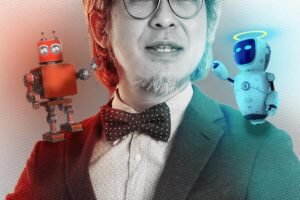


The 2027 Tipping Point: Humanoid Robots on Campus


The AI revolution has taken the world by storm. We saw the emergence of generative artificial intelligence when OpenAI launched GPT 3.5 in 2022. Rapid development has resulted, due to particularly frenetic competition among the field of American tech companies. Generative AI has been a transactional version in which chatbots and other configurations respond to prompts submitted by human users.
More recently, agentic AI has been the latest trend in development, enabling autonomous agents to carry out tasks. These agents can operate and control other complex computer programs and even function in swarms of agents communicating among themselves in organized teams to take on multifaceted tasks, simultaneously engaging multiple tools and approaches.
The fiercely competitive, highly funded leading corporations in this field have driven activity to a level at which no one seems to be able to keep up. As described in the prior edition of this column two weeks ago, “The Singularity, Black October and Other Lessons for Higher Education,” we are facing the difficult transition to the state in which AI is recursively improving itself, creating ever more powerful versions on its own every month or two.
Attempts by governments around the world, and even the manufacturers themselves, are moving forward in attempting to effectively monitor and control the development of new models of AI. But there are so many hundreds of players in the field around the world that it seems unlikely that a single regulation can control all the developments among private, public, governmental, commercial and special purpose entities worldwide. In this context of rampant, uncontrolled growth, there is yet another version of AI application that has been taking off this final quarter of 2026 and will reach our field of higher education next year.
That development is autonomous, humanoid robots that combine bipedal mobility, artificial intelligence and physical manipulation abilities to perform tasks without continuous human remote control. Certainly, we have seen robotic developments increase in number, speed and sophistication in recent years. As with the rest of the field, this technology is rising on an exponential graph, with each new version building upon the inherent advances of the prior version. One of the leading corporations in this field, Siemens, has prepared an array of blog posts, ebooks, reports and publications on the topic of building humanoid robots from design to operation.
In September of this year, in the MDPI research journal Applied Sciences, authors Sebastián Matus, Sandra Cano and Carina González offered “Recent Research Trends on Social Robots in Higher Education: A Systematic Review.” They introduce an extensive review of research in the emerging field of robots in higher education, which provides a strong background for individuals and committees charged with examining humanoid robots in higher education:
“Artificial intelligence (AI) is rapidly transforming higher education by reshaping how students learn, instructors teach, and educational institutions deliver academic services. Recent advances in large language models, multimodal AI systems, learning analytics, and intelligent educational technologies have expanded opportunities for personalized learning, adaptive feedback, automated assessment, and collaborative knowledge construction. As AI systems become increasingly integrated into university environments, attention has shifted from their technical capabilities toward understanding how they can effectively support meaningful teaching and learning processes while preserving the social and human dimensions of education.
“Social robots have emerged as one of the most distinctive forms of intelligent educational technology because they combine artificial intelligence with physical embodiment, enabling interactions that extend beyond those offered by conventional digital systems. Unlike virtual agents or large language model-based chatbots, social robots occupy the same physical space as learners and communicate through speech, gaze, facial expressions, gestures, body movements, and other verbal and non-verbal behaviors. These capabilities allow them to establish richer social interactions, promote social presence, and support collaborative activities in ways that are difficult to achieve through screen-based technologies alone. Consequently, social robots have attracted increasing attention as educational partners capable of supporting not only cognitive processes but also motivational, social, and affective dimensions of learning.”
The authors go on to describe human-robot interaction (HRI) as “an interdisciplinary field that investigates the design, implementation, and evaluation of interactions between humans and robotic systems. Emerging from early developments in robotics, artificial intelligence, psychology, cognitive science, and human-computer interaction, HRI seeks to understand how robots can communicate, collaborate, and coexist effectively with people in a wide range of application domains, including healthcare, industry, public services, and education.”
Just as with all human communication, characteristics of the HRI can include nonverbal communication through such actions as facial expressions, hand and arm gesturing, and voice inflections. Emotional communication can include empathetic expressions, urgency can be reinforced by volume and word choices, and vocabulary choices can vary by the age of the human as well as whether the language being used is the first language of the human. Multilingual communication is also possible.
Of course, on a university campus, such robots can perform important out-of-the-classroom work including greeting visitors, library research assistance, overnight security, emergency responses, grounds maintenance, counseling services and much more. The costs of robots vary widely based on features and capabilities. Robozaps provides a good overview of humanoid robot pricing in 2026 as well as many of the considerations in selecting and piloting a robot project.
LabourBooking.com, the B2B marketplace connecting licensed labor agencies with overseas partners, has drafted recommendations on establishing pilot HRI programs, designed for companies, but generally applicable to higher education as well:
- Companies do not need to predict every technical breakthrough to make better robotics decisions. They should begin with the operating problem and use evidence from their own processes. Before committing capital, employers should compare automation with recruitment, retention, training and job redesign; see Automation vs Recruitment for a practical decision framework. Choose a specific task. Record current throughput, labour time, quality, injury exposure, downtime and exception rates before selecting a robot.
- Calculate total cost of ownership. Include integration, site changes, safety equipment, software, training, maintenance, energy, downtime and end-of-contract or replacement costs.
- Run a representative pilot. Test normal work and difficult cases over enough operating time to reveal jams, edge cases, maintenance needs and human intervention.
- Plan integration and cyber security early. Confirm that the robot can exchange the necessary data with existing systems, that access is controlled and that failure will not disrupt the whole operation.
- Involve the workforce. Define who supervises the system, who responds to faults, what training is required and how the new process changes responsibilities.
- Set exit criteria. Agree in advance what performance, reliability, safety and cost thresholds must be met before a pilot becomes a full deployment.
This field is growing at that exponential rate mentioned earlier. The time for formal planning and consideration is now. Are you the right person to lead the exploration of HRI on your campus? Now is the time to examine the potential and establish a pilot program to inform the entire institution on this topic.
You may be interested

Trump pushed for Huang's reinstatement as Nvidia CEO over economic concerns, officials say
new admin - Nov 25, 2026Jensen Huang was reinstated as CEO of Nvidia on Monday after resigning over an affair with an alleged Chinese spy.…

Tehran denounces U.S. use of AI to plan and carry out deadly attacks on Iran
new admin - Nov 25, 20265m ago Iran criticizes U.S. for using artificial intelligence for deadly attacks Iran has denounced the U.S. military's use…

Meghan Markle’s father indicted by federal grand jury on child pornography charges
new admin - Nov 25, 2026A federal grand jury has indicted the estranged father of Meghan, the Duchess of Sussex, on child pornography charges, authorities…