



Teen’s headache reveals alarming health risk for family: “Saving people’s lives”

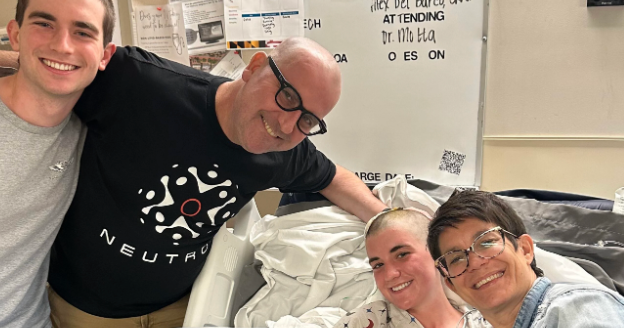
Caroline McCaffrey usually ran in the morning, but on Father’s Day 2025, she was feeling tired and decided to exercise in the evening instead. She invited her mother Kim to bike alongside her.
Just a few minutes into the run, Caroline, then 18, was struck by a “really bad headache.” She had experienced and received treatment for migraines before, but this was a new sensation.
“It felt like I got punched in the face,” Caroline said. Within minutes, she was vomiting. She couldn’t walk, so Kim called her husband to come pick them up. When the symptoms didn’t immediately recede, Kim started to panic.
“I literally Googled, as she was throwing up, the signs of (ruptured) brain aneurysms. My husband was like, ‘Do you think this is what it is?’ And I was like, ‘I don’t know. This isn’t normal,'” Kim recalled.
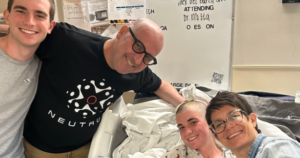
The McCaffrey family 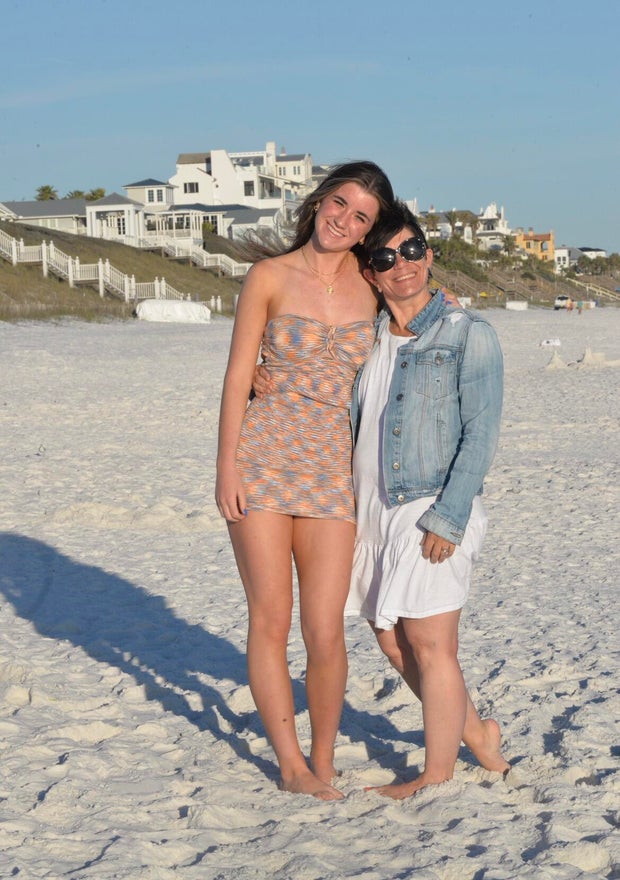
At an area hospital, Kim quickly raised her concerns, but Caroline’s physician was skeptical.
“I was like, ‘I’m pretty sure she’s having a brain aneurysm or a ruptured brain aneurysm,’ and he’s like, ‘I don’t think we should go there yet,'” Kim recalled. Caroline was given another dose of migraine medication, but it had no effect.
A few hours later, a second doctor ordered a CT scan. That test found bleeding in Caroline’s brain. Caroline said she was relieved to be on the path to treatment.
“I think I was in so much pain that I couldn’t really even be scared at that point,” Caroline said.
Treating a deadly diagnosis
Caroline was transferred to the University of Maryland Medical Center. The next day, she woke up in the intensive care unit with a bald spot. Her parents filled her in: Tests had shown two brain aneurysms. One had ruptured and caused an aneurysmal subarachnoid hemorrhage, which led to her symptoms, said neurointerventionist Dr. Gunjan Parikh.
The condition typically affects people in their mid-50s. It’s a dangerous diagnosis, Parikh said: About 1 in 4 patients with aneurysmal subarachnoid hemorrhages die before making it to the hospital. Another 13% of patients die at the hospital. But Caroline had been lucky: Neurosurgeon Dr. Jacob Cherian had treated the ruptured aneurysm and repaired the damaged brain tissue. Despite the delays in care, she had been treated “really quickly,” Kim said.
The McCaffrey family 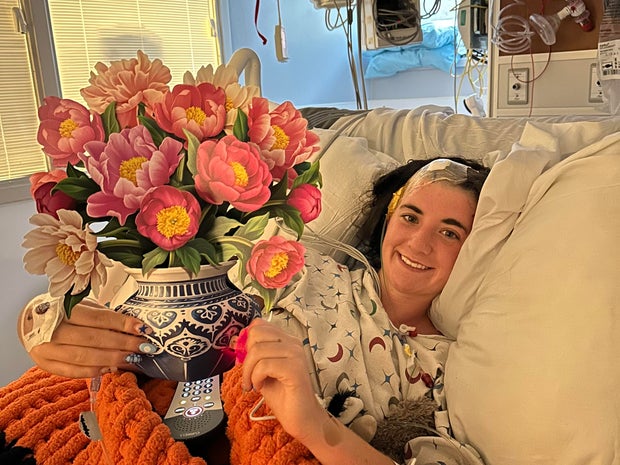
Caroline said she was “really shocked” by the news. It took her a few days to “comprehend what happened.”
“Once I did that, I was ready to get things going, get treatment going,” Caroline said. “Once I processed it, I kind of just wanted to get things on the road.”
It would be a long road. The drain was still removing fluid from her brain. She needed regular ultrasounds and monitoring to ensure that she wasn’t having any strokes or seizures, as well as occupational and physical therapy. Then she underwent another surgery to remove the second aneurysm. It was over three weeks before she was finally released from the hospital.
The McCaffrey family 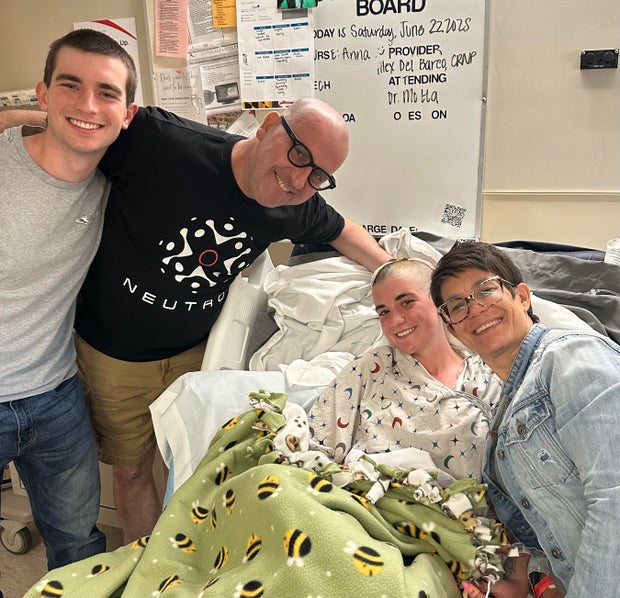
Finding a family connection
In the meantime, Caroline’s parents were trying to figure out how their 18-year-old daughter could have had such a dangerous condition. While poring over the family’s medical history with Caroline’s care team, they realized Caroline’s paternal great-grandmother had an aneurysm in the 1960s.
That suggested a genetic cause for Caroline’s condition. The McCaffreys were encouraged to undergo testing for other potential aneurysms. Usually, aneurysms occur in about 1 in 50 people, Cherian said, but having a first-degree relative with one brings those odds to more like 1 in 5.
“Caroline’s very young, at 18, to have something like this. So that was already a clue that maybe there could be something in the family,” Cherian said.
Kim was the first family member to be tested. A CT scan found two small aneurysms, which Cherian surgically removed in November 2025.
The McCaffrey family 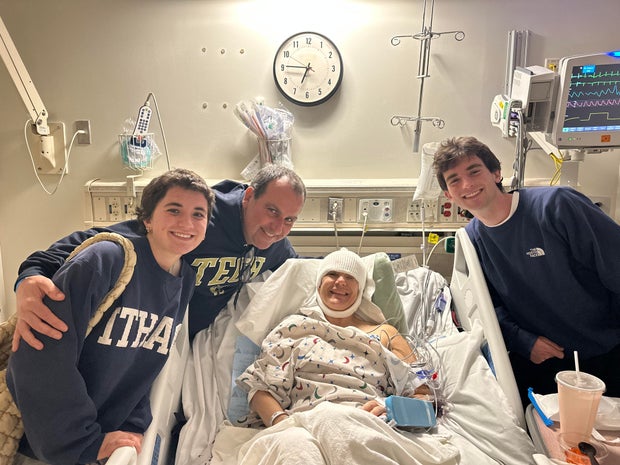
Kim’s husband and son did not have an aneurysm, but her sister-in-law had two. Other family members are continuing to undergo testing, Kim said.
It’s not clear why the family is prone to aneurysms on both sides, but Parikh said there is likely a genetic component. Cherian said that neurologists aren’t sure why aneurysms form, but they can run in families.
“Caroline was like, ‘Okay, I’m tired of saving people’s lives,'” Kim joked.
“Now I have a reason”
Both McCaffreys are now fully recovered from their aneurysm experiences, though they will undergo regular monitoring for the rest of their lives. Caroline, now 20, is at Bucknell University for her junior year and is back to running competitively.
She is also taking part in a National Institutes of Health study. The study has enrolled thousands of patients to look at the impact of aneurysms and strokes on the brain over the course of years. Because Caroline is young and had a hemorrhage typically seen in older patients, the data she can offer is unique, Parikh said.
University of Maryland Medical Center 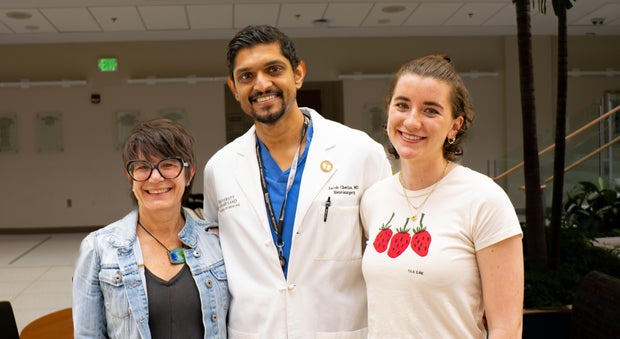
“It really gives scientists a real-time way to observe what the human brain’s maximum potential for self-repair is. It allows us to, in a way, reverse engineer for everybody else,” Parikh said. “You’re searching for the biological blueprint, and the ultimate goal of this research is to figure out how to use medications or pharmacology or physiologically trigger those exact same youthful healing pathways in a 60- or 70-year-old patient.”
Caroline also participated in a study that is using bloodwork to try to find biomarkers that could point to a person’s aneurysm risk. She has also worked with multiple charitable organizations and is interested in possibly forming her own foundation dedicated to helping young aneurysm survivors. After graduating college, she wants to explore becoming a nurse anesthetist — another goal inspired by her experience.
“I really fell in love with the nursing staff at the University of Maryland. They became like my friends,” Caroline said. “So now I’m pre-nursing. I feel like that’s right up my alley, and now I have a reason behind why I want to do that.”
You may be interested

Smithsonian’s National Museum of African American History celebrates 10th anniversary
new admin - Sep 26, 2026The Smithsonian's National Museum of African American History and Culture is marking a major milestone this week - celebrating its…

The story behind the first CIA officers in Afghanistan after 9/11 and the Russian chopper that flew them in
new admin - Sep 26, 2026Twenty-five years ago, a Soviet-designed helicopter crossed the mountains of Afghanistan carrying the first CIA officers sent into the country…

Pokémon card scalpers have turned collecting into an online blood sport
new admin - Sep 26, 2026Earlier this month, Pokémon card content creator Natalie Roush posted a video to her YouTube and Instagram pages that enraged…