



Takeaways from Alito’s CBS News interview: His future on the Supreme Court, opinion in Dobbs and rise in heated political rhetoric

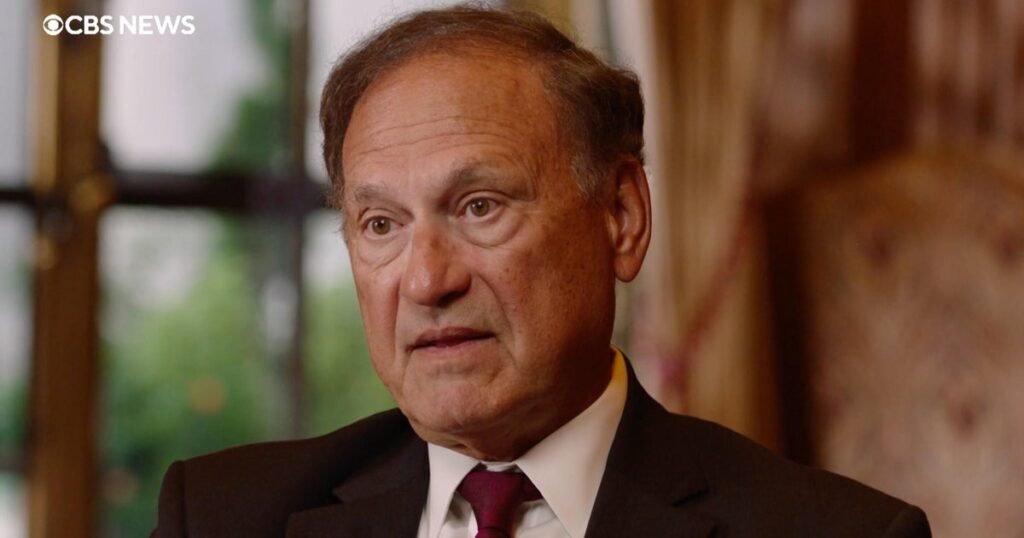
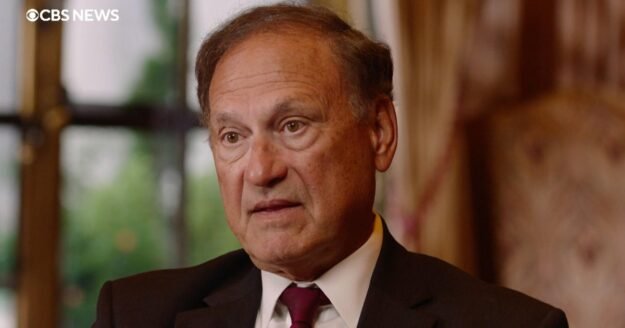
Washington — Justice Samuel Alito sat down with CBS News chief legal correspondent Jan Crawford for discussions touching on a host of issues, including his future on the Supreme Court, his majority opinion in the case that overturned Roe v. Wade and the charged rhetoric of political leaders from both parties.
The rare interview came ahead of the release of Alito’s first book, “So Ordered: An Originalist’s View of the Constitution, the Court and Our Country,” a collection of speeches that will be released Tuesday.
The Supreme Court began its new term Monday, and will hear cases on President Trump’s immigration agenda, voting rules in Arizona and the constitutionality of state laws banning AR-15s and other semiautomatic rifles, among other disputes.
The high court could also decide to take up other legal battles involving Mr. Trump’s policies, including his ban on transgender people in the military and attempt to effectively shut down asylum at the U.S.-Mexico border.
Alito, 76, marked his 20th year on the Supreme Court in January and has emerged as the leader of the court’s conservative wing. He may perhaps best be known today as the author of the landmark 2022 decision in the case Dobbs v. Jackson Women’s Health Organization, in which the court ruled 5-4 to overturn Roe v. Wade, the 1973 case that established the federal right to an abortion. In the Supreme Court’s last term, Alito wrote the majority opinion that struck down Louisiana’s congressional map and weakened Section 2 of the Voting Rights Act.
Alito’s future on the court
During the Supreme Court’s last term, there was much speculation about Alito’s future as a justice and whether he would step down and allow Mr. Trump to nominate a successor while Republicans still control the Senate.
Alito was appointed to the high court by President George W. Bush, a Republican, and it is not unusual for justices to retire during the presidential administration of the same party as the one in office when they were named to the Supreme Court.
Alito told Crawford that he had considered retiring but ultimately opted to remain on the high court.
“I thought about it,” he said. “It’s something I think that somebody at my age has to think about every term. But I thought that I could still make a valuable contribution, which is why I became a justice and a judge in the first place. So that was basically it.”
Pressed on the potential risks of remaining on the Supreme Court — namely, the possibility of a Democratic president filling his seat — Alito rejected the idea that presidential politics should play a role in that decision, saying it is too difficult to say what the political landscape will be.
“It’s too hard to predict how, for anybody, and particularly when you reach a certain age, what your situation will be a year from now, two years from now, and so forth,” he said. “And it’s too hard to predict what the political situation will be and what any president might do with respect to a replacement.”
The late Justice Ruth Bader Ginsburg, who anchored the court’s liberal wing, resisted calls to retire during President Barack Obama’s administration and remained on the court until her death in 2020. Mr. Trump, then in his first term, appointed Justice Amy Coney Barrett to fill the vacancy, expanding the Supreme Court’s conservative majority to 6-3.
Barrett would go on to join Alito in the majority in the 5-4 decision that ended the constitutional right to abortion.
Changes in rhetoric from political leaders
In recent terms, as the Supreme Court has waded into thorny issues like abortion, affirmative action, guns, presidential immunity and regulatory power, political leaders on both sides of the aisle have ratcheted up their criticisms of the high court and begun denouncing individual justices.
In 2020, as the Supreme Court convened to hear a case involving a Louisiana law that required doctors providing abortions to have admitting privileges at nearby hospitals, Senate Minority Leader Chuck Schumer delivered a message to Justices Brett Kavanaugh and Neil Gorsuch during a rally outside the court: “I want to tell you, Gorsuch, I want to tell you Kavanaugh, you have released the whirlwind and you will pay the price. You won’t know what hit you if you go forward with these awful decisions.”
The comment prompted rare public pushback from Chief Justice John Roberts.
Alito said the language from politicians on both sides of the aisle can be “quite damaging.”
“There’s been a great change in what presidents have said about the court when they are unhappy about our decisions,” he told Crawford. “Traditionally, what presidents would say is, ‘The Supreme Court, it’s made its decision. I disagree with it, but we have to abide by it.’ And that was it. That’s what presidents said. That’s what members of the Cabinet said. That has changed.”
Mr. Trump has chastised the conservative justices who have ruled against him in cases involving some of his signature second-term policies, including his tariffs on nearly every U.S. trading partner and his attempt to restrict birthright citizenship. Last month, in a case on its emergency docket, the Supreme Court blocked new U.S. Postal Service rules for mail ballots while legal proceedings continue. In each of those cases, Alito dissented.
The president called Barrett and Gorsuch, who voted to strike down his sweeping tariffs, “fools and lapdogs for the RINO and the radical left Democrats.” RINOs is short for “Republicans in name only.”
After the mail-ballot decision, Mr. Trump said of the three justices he appointed, Gorsuch, Kavanaugh and Barrett, “these are not the people I interviewed to serve on the United States Supreme Court, they are merely a shell of their original selves.”
Alito said criticism of the court has been “a bipartisan effort.”
Pressed on Mr. Trump’s language, specifically, the justice said, “He has his own way of saying things. But the criticism of the court — I mean, I wanna be even-handed on this. The criticism of the court by President Biden and justices, by President Biden and his administration, was very harsh. And President Trump has been very harsh.”
Mr. Trump, however, has praised Alito and Justice Clarence Thomas as “legends,” and called Alito specifically “one of the greatest of all time.”
But Alito resisted any suggestion that the justices are motivated by politics.
“Well, we are not part of any political movement, and we are not attempting to further any political agenda,” Alito said of the president’s comments. “We are trying to interpret the Constitution as best we can and apply it in the cases that come before us.”
Fallout from the Dobbs decision
Before the Supreme Court issued its decision in Dobbs, a draft of the opinion leaked and was published by Politico. The leak was unprecedented, and soon after, protesters descended on the homes of the conservative justices who voted to roll back Roe, including Alito’s.
An armed California man was arrested outside of Kavanaugh’s Maryland home in June 2022 and found with a gun, ammunition, a knife and various tools, as well as hiking boots with padding on the soles, according to court records. Prosecutors later revealed that Nicholas Roske wanted to kill three Supreme Court justices to “single-handedly and irrevocably to alter an entire branch of the United States government through violence.”
Roske pleaded guilty to attempting to assassinate Kavanaugh and was sentenced to eight years in prison.
Now, the justices travel with security details and have law enforcement outside their homes. Barrett has spoken about being given a bulletproof vest to wear. In its latest budget request to Congress, the Supreme Court asked for an additional $14.6 million to expand security for the justices provided by the Supreme Court Police.
“It’s part of the job that you’re gonna displease people by making decisions on controversial matters because one side or the other is gonna really dislike you because of the decisions,” Alito said. “The physical threats and the harassment represent something new in our society and something that’s quite disturbing. And I think it’s a danger. It’s a danger for the courts. And it’s a danger for others in public life.”
The Supreme Court Police is anticipating a 38% rise in threats for 2026, Justice Elena Kagan told lawmakers in July.
Asked about whether there was a case that required courage from Alito, he pointed to the decision reversing Roe and said he has lost friends over that ruling.
“The leading example is Dobbs,” he said. “I think that required courage by all of the justices in the majority. Of course, it actually involved — we didn’t know it at the time. We didn’t know it when we produced the draft that was leaked, but it required courage to go ahead with that because of the implications. That was an example. There are others. I mean, there are cases that have resulted in the loss of old friendships. And that’s something that you have to live with.”
The future of the right to same-sex marriage
When the Supreme Court released its decision on abortion, which left the issue to the states, Thomas authored a concurring opinion that called for the court to reconsider some of its precedents, including Obergefell v. Hodges. In that landmark decision, the Supreme Court said the Constitution protects the right to same-sex marriage.
No other justice joined Thomas’s opinion, but it led to concerns that the 2015 decision was at risk of being reversed.
While Alito dissented in Obergefell, he wrote in Dobbs that “nothing in this opinion should be understood to cast doubt on precedents that do not concern abortion.”
Alito indicated to Crawford that Obergefell remains on firm legal footing.
“One of the important factors we take into account in deciding whether we should reexamine a past decision is the degree to which there has been reliance on the decision,” he said. “Obviously a great deal had changed in the country as a result of Obergefell. There was a lot of reliance in various ways on the decision in Obergefell.”
Still, Roe v. Wade had been decided in 1973, and overturning that decision has had significant impacts on women’s access to abortion. In the years since Dobbs was decided, 13 states have imposed near-total bans on abortion and another seven restrict the procedure either at or before 18 weeks of pregnancy.
But Alito said there are distinctions between Obergefell and Roe.
“After Obergefell, people of the same sex got married and entered into contracts … it was much more concrete,” he said. “Whereas with Roe, the argument was made that it had an effect on people’s ideas, women’s ideas about the kind of society that they were going to live in, that this would have an effect on the society. It was much more abstract than what would’ve been involved had we been asked to overrule Obergefell.”
Recognition by the public
Unlike Congress, there are no cameras in the Supreme Court’s courtroom, and when justices do appear at public events, they are often speaking to audiences of other lawyers, law students or judges.
Alito said he rarely gets recognized in public, but joked that may change.
“I’m sure after this is on television, I’ll be recognized more frequently,” he said. “I was recognized much more frequently after my confirmation hearings. And there were some, a few, interesting episodes with people who recognized me.”
Alito recalled one encounter with a man he met while stopping to get coffee on a drive from Washington, D.C., to New Jersey.
“This fellow came up to me in a rest stop and he said, ‘I know you. I know you but I can’t quite get the name. And don’t tell me. I’m thinking. I know you,'” Alito recalled. “And this went on for a little bit. And finally he couldn’t figure out why he thought he knew me. And I said, ‘What do you do?’ And he said, ‘I’m a funeral director in Delaware.’ So I thought, ‘Well, I must remind him of one of the corpses that he’s worked on.'”
Watch more of the interview Monday on “CBS Mornings” and “CBS Evening News.” Jan Crawford is one of the nation’s leading experts on the Supreme Court. She has interviewed multiple justices during her 30-year career, and her book “Supreme Conflict: The Inside Story of the Struggle for Control of the United States Supreme Court” was a New York Times bestseller.
You may be interested
Country Disco, Drag Shows, and Ella Langley
new admin - Oct 05, 2026[ad_1] Miranda Lambert has won just about every country-music award in existence, but her barometer for success is rather simple:…

PepsiCo recalls 122,000 cases of Gatorade due to undeclared dyes
new admin - Oct 05, 2026PepsiCo has recalled roughly 122,000 cases of Gatorade sold across the U.S. because the product contains undeclared dyes, the Food…

An open-source tool lets you delete 12GB of Apple Intelligence data on macOS
new admin - Oct 05, 2026You have to find about a dozen settings, and several of them are under Screen Time. Even when everything is…