



Students Who Fail Dual Enrollment Still Enroll in College

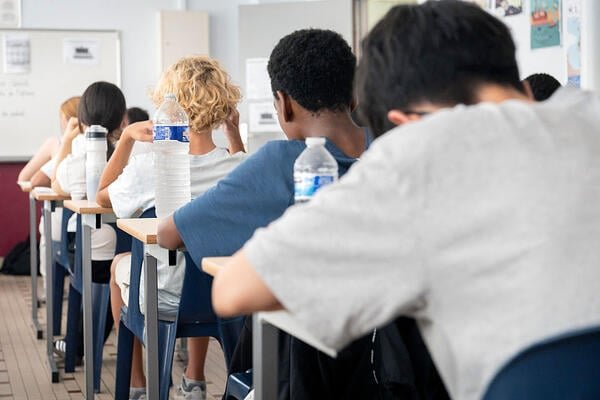
The study found that the majority of students who failed dual-enrollment courses were Hispanic, and they were more likely to be socioeconomically disadvantaged, lower achieving and male.
Jean-François Fort/Hans Lucas/AFP via Getty Images
States have increasingly expanded students’ access to dual enrollment—the practice of allowing high school students to simultaneously enroll in college courses for college credit—to give them a head start and ease the transition to postsecondary education. But what happens to the high schoolers who fail their college-level classes?
According to a new study published by the Annenberg Institute at Brown University, students from socioeconomically disadvantaged backgrounds are more likely than their better-off peers to fail dual-enrollment classes, regardless of their prior academic achievement or preparation. And students who fail a dual-enrollment course are considerably less likely to attend college, the study noted. At the same time, it found that even those who attempt a dual-enrollment course and fail are more likely to enroll in college than those who never participate in dual enrollment.
To conduct the study, researchers examined administrative data on about 1.74 million public high school students in California who entered ninth grade from 2015–16 through 2018–19. They analyzed how the likelihood of failure varies based on students’ prior academic achievement, whether it differs by socioeconomic status and how such failure impacts college-going decisions.
For Jenna Howard Terrell, co–principal investigator of the study and senior research associate at WestEd, a nonprofit research group aimed at improving education, the findings counter the commonly held belief that failing a dual-enrollment course dissuades students from attending college. She often hears from policy practitioners who believe that a student’s failing grade on their transcript will discourage them from enrolling, leading to a “very catastrophic outcome,” she said.
The research suggests otherwise.
“They’re gaining something … from just taking a college course, and maybe the exposure of being in a class with different students with higher rigor is giving them something that we can’t see in the data,” Terrell said.
Key findings: Students who took dual-enrollment courses and passed tended to be better prepared academically and less socioeconomically disadvantaged, the research found. Those students were more likely to be Asian or white and less likely to be Hispanic or Black.
The findings also show that the majority of students who failed a dual-enrollment course were Hispanic and more likely to be socioeconomically disadvantaged, lower achieving and male.
Dual-enrollment courses generally have high pass rates, according to the study, given that many programs restrict enrollment to students who are deemed academically prepared. But California has made efforts to expand dual enrollment in high schools to close equity gaps in education.
About 16.8 percent of California students enrolled in dual enrollment failed at least one course, according to the data.
John Fink, senior research associate and program lead at the Community College Research Center at Columbia University’s Teachers College, said even if one or two students fail a dual-enrollment course, it’s like a “five-alarm fire” for high school principals, counselors and teachers who focus on ensuring that students succeed.
He pointed out that some academically high-achieving students are still failing courses, which makes him question practitioners’ reliance on standardized tests to indicate students’ perceived success in dual enrollment.
Fink said dual-enrollment programs should be designed with enough support to ensure student success, even for those who may seem academically strong—which the study also suggests.
“Part of the implication is how much do we really read into these standardized tests in high school in terms of determining readiness?” Fink said. “We need to think less about ‘Is a student ready for dual-enrollment courses?’ We need to think more, ‘Is our dual-enrollment program ready to serve all students? Do we have the systems and processes in place to identify struggling students and provide them with the supports they need to be successful in their course?’”
Building support systems: The study emphasized that disadvantaged students often lack support structures in dual enrollment, necessitating that systems be put in place to allow all academically capable students to succeed. More states have changed their criteria for allowing participation in dual-enrollment courses from tests to grades, leading to more students enrolling. But course pass rates haven’t increased.
Joanna Rometsch Mathias, co–principal investigator for the study and senior research associate at WestEd, said both high schools and community colleges need to invest in staff to coordinate dual-enrollment programs and boost student support.
She cited a case study published by WestEd in which she and a team examined how Oakland Unified School District’s partnership with Peralta Community College District has achieved high course pass rates, despite the high share of students who are first generation, lower income and people of color.
Mathias said Oakland has a “point person,” or a staff member in every dual-enrollment classroom, who works with students and helps bridge communication gaps between college instructors and school-based staff. She said the person also helps students understand classroom practices, like reminding them to take out their notebooks and put their phones away.
“Unfortunately, because that’s expensive, a lot of school districts kind of shy away from investing in people. They are really constrained on their resources, and salaries are a huge part of school district spending. But it really is people and relationships,” Mathias said.
Fink said states need to adequately fund dual-enrollment programs to ensure they are free for at least low-income students and give colleges enough money to increase support infrastructure.
CCRC found in an October 2025 review that a majority of states fund dual-enrollment students at colleges at a relatively low rate compared to funding for regular college students.
“There’s a lot of opportunity to sort of step up, not just the investments in expanding access and growing dual enrollment, but ensuring that students are successful and on a pathway, having the full benefit of dual enrollment, which is sort of broadening access to college, but also promoting completion in a field aligned to students’ interests and that can benefit the local community,” Fink said.
Get more content like this directly to your inbox. Subscribe here.
You may be interested

M&S beauty bag slashed to £12 with Estee Lauder's 'magic' anti-wrinkle eye cream
new admin - Aug 25, 2026[ad_1] The Marks and Spencer Skincare Gift Bag is filled with six mini-sized skincare products from popular brands, including Estée…

Girl, 8, dies from brain-eating amoeba infection in Louisiana, family says
new admin - Aug 25, 2026An 8-year-old girl in Louisiana has died after being infected by an extremely rare brain-eating amoeba that is found…

8/24: The Takeout with Major Garrett
new admin - Aug 25, 20268/24: The Takeout with Major Garrett - CBS News Watch CBS News Trump administration unveils new sanctions against Iran; Supreme…