



Stockton Pulls Genocide Reference After Donor Complains

Stockton University officials removed language from a departmental website that referred to the mass casualties in Gaza as a genocide following a complaint from a donor.
Stockton leaders have defended the move, arguing that the language was scrubbed amid a broader review of university web pages. But the removal came abruptly on a Sunday, with no notice, and was not part of a scheduled review, said Raz Segal, director of Stockton’s Holocaust and genocide studies program.
“This is clearly the university caving to crude donor interference,” Segal told Inside Higher Ed.
Now faculty are crying foul, raising questions about donor influence and academic freedom at the public university in New Jersey.
The text in question came under the “message from the director” section of the program’s website, in which Segal noted “unprecedented challenges” in the field of Holocaust and genocide studies. It listed contemporary examples of bloodshed and displacement in Myanmar, Gaza, Ukraine and Sudan.
“Israel’s ongoing genocide in Gaza since October 2023 has killed, according to official figures, more than 70,000 Palestinians, including over 20,000 children, leaving almost the entire population of 2.3 million people forcibly displaced,” Segal wrote in the now-removed text.
That line seemed to draw the ire of Stockton donor John F. Scarpa, who earned a fortune in telecommunications and has made significant donations to colleges and conservative causes.
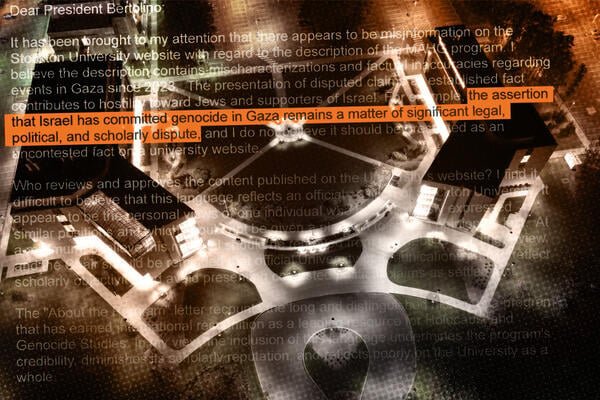
In a letter to Stockton President Joe Bertolino, which Scarpa also sent to The Press of Atlantic City, the donor wrote on July 31 that he had been informed of “misinformation” on the university website, pointing specifically to what he called “mischaracterizations and factual inaccuracies” on Gaza.
“The presentation of disputed claims as established fact contributes to hostility toward Jews and supporters of Israel. For example, the assertion that Israel has committed genocide in Gaza remains a matter of significant legal, political, and scholarly dispute, and I do not believe it should be presented as an uncontested fact on a university website,” Scarpa wrote to Bertolino.
He also questioned who reviewed and approved the content on the university’s website, describing the genocide language as “the personal views of one individual who has previously expressed similar positions and which should not be given a platform to spread opinion as fact.”
Stockton officials deleted the text two days later. Other materials, including posts on current events and the program’s mission statement, were also deleted from the site.
They cast the change as part of an ongoing effort to review and revise “the layout and content of graduate program webpages” and noted statements were removed from other university websites as well.
The university declined to make Bertolino available for an interview. But in a message to the community Thursday, the president and board chair José Lozano acknowledged the incident had raised “serious concerns” on campus about academic freedom, shared governance and communication around the decision.
“We may not all agree about what belongs on an official University webpage,” they wrote. “But we can say this plainly: the process used in this instance should have included more consultation and better communication with the academic units involved.”
They vowed to launch a review of the policies and practices around creating webpage content, as well as “look at ways to better highlight faculty scholarship, expertise and public engagement.”
Fact vs. Opinion
Officials have also downplayed concerns about donor influence driving campus decisions.
“Donors do not have decision-making authority over Stockton’s academic or institutional decisions,” a Stockton spokesperson wrote in an emailed statement. “Like faculty, students, alumni and other members of the University community, donors may express their views. Decisions remain with University leadership and Stockton’s established governance processes.”
Segal, a genocide scholar, rejects Scarpa’s claim that his statement is a personal opinion. He points to a vote by the International Association of Genocide Scholars last year in which the group declared that “Israel’s policies and actions in Gaza meet the legal definition of genocide” detailed in the United Nations Convention for the Prevention and Punishment of the Crime of Genocide.
(Israel has rejected allegations that it is committing genocide in Gaza.)
Segal dismissed the notion of widespread debate on whether Israel is perpetrating genocide, arguing that the statement on Stockton’s website reflected “broad consensus” among fellow experts.
Amid the controversy, Segal noted that leading scholars in the field of Holocaust studies have thrown their support behind him, evidenced by multiple emails they sent to the university on his behalf. American Federation of Teachers New Jersey officials have also thrown their support behind Segal.
“Our public universities must remain an environment for open and free discourse among our students and faculty,” said AFT New Jersey President Jennifer S. Higgins. “Allowing donors to dictate what speech or debate is allowable on campus is inappropriate, counterproductive and deeply un-American.”
Segal—who is Jewish, Israeli and has grandparents who survived the Holocaust—argued that Scarpa is weaponizing the discourse about antisemitism “in the service of genocide denial” and engaging in antisemitic behavior by attacking Segal as unsupportive of the Jewish community.
(Scarpa did not respond to a request for comment from Inside Higher Ed sent via LinkedIn.)
For Segal, the fight over the website language comes with a sense of déjà vu. In 2024, he was offered a role as director of the University of Minnesota’s Center for Holocaust and Genocide Studies—only to have the institution suddenly reverse course and revoke the job offer. Last month Segal won a $250,000 settlement from UM.
Donor pressures were also at play in Minnesota.
Public records obtained by the Center for Constitutional Rights turned up several emails from UM donors taking issue with Segal’s writings, in which he argued that Israel is committing genocide. One donor also alleged that Segal “uses all sorts of tropes that are offensive to Jews.” To Segal, the parallels between the situations at the two universities are obvious.
“It’s really playing this game of good Jew–bad Jew, which is exactly what went on in Minnesota,” Segal said. “Good Jews are Zionists, good Jews support Israel, and if you don’t then you’re a bad Jew. And playing the good Jew–bad Jew game, as we know, is very real antisemitism.”
You may be interested

Cambridge to Review Hiring Processes After Arday Scandal
new admin - Aug 14, 2026[ad_1] Cambridge confirmed that the inquiry will continue despite Arday’s resignation. Education Images/Universal Images Group via Getty Images The University of…

Drivers call £23 accessory a 'must' for south-facing driveways and hot weather
new admin - Aug 14, 2026Easy to attach and perfect for the heatwave, shoppers say cars are 'so much cooler in this unusual hot weather'…

UAE accuses Iran of attacks in Strait of Hormuz as Vance says cheap oil and gas are “goal number one”
new admin - Aug 14, 202631m ago UAE says Iran attacked two vessels in Strait of Hormuz The United Arab Emirates on Friday blamed…