



States Wrestle With Data and Program Tweaks to Access Workforce Pell

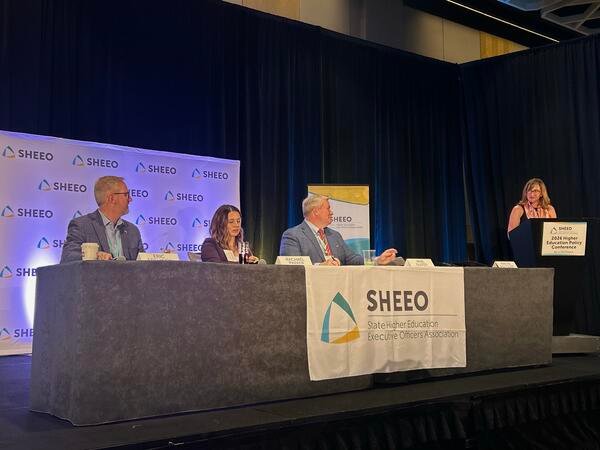
CHICAGO—States and institutions are trying to capitalize on the federal government’s increased focus on nondegree, workforce-targeted credentials but, for many, their data collection systems and current short-term programs don’t meet the federal criteria for funding.
That was an overall message coming out of this year’s State Higher Education Executive Officers Association (SHEEO) Higher Ed Policy Conference. The event, which ran from Monday through Thursday, featured six scheduled panels with “Workforce Pell” in the title, including two at the same time. There were also panels on merging higher ed and workforce agencies and other sessions focused on how to better connect what have traditionally been separate workforce and higher ed functions and expand access to workforce training.
“Workforce Pell is clearly the canary in the coal mine,” said JB Holston, executive director of the Colorado Department of Higher Education, during the workforce-higher ed agency merger panel. He said that, regardless of one’s politics, Workforce Pell represents the path moving forward, and states need to have “interlocking data systems.”
Bennett Boggs, commissioner of the Missouri Department of Higher Education and Workforce Development, got laughs when he said during the same panel: “I don’t think we need to talk more about Workforce Pell.” But he said “the fact that we had the Workforce Development Board in our agency made some things a lot more efficient.” Missouri recently integrated what was the Department of Higher Education and the Division of Workforce Development into a new Department of Higher Education and Workforce Development.
Workforce Pell—passed by Congress as part of President Trump’s signature One Big Beautiful Bill Act—went into effect July 1. It allows low-income students to spend the traditional Pell grant on pursuing nondegree credentials. The Congressional Budget Office has estimated that Congress will invest more than $1 billion in the program over the next decade and that, by 2034, about 100,000 new students each year will receive Workforce Pell grants of about $2,200 each.
But programs must meet multiple criteria to qualify for Workforce Pell, including producing completion and job-placement rates of at least 70 percent—outcomes that states must find a way to measure. So far, the Education Department has approved one program, Iowa Central Community College’s training for emergency medical technicians.
Shannon Gilkey, Rhode Island’s postsecondary education commissioner, advised states to take “a hard look at your data infrastructure, how your state’s funding is being used and how close it is to making state decisions, and then quadruple it as a priority.”
Arkansas, which took steps to improve its collection of noncredit data before Workforce Pell took effect, was well-represented on conference panels. The state already had a Workforce Challenge scholarship and other programs necessitating data collection improvements, said Tina Moore, assistant commissioner for workforce and strategic alignment at the Arkansas Division of Higher Education.
“On the noncredit side, often that data was being collected on an Excel document, on a Google form, if not a sheet of paper,” Moore said during a panel titled “Noncredit Data: The Workforce Pell Imperative and Beyond.”
Arkansas has improved its data collection annually over the last few years, Moore said. “We did tweak it slightly for Workforce Pell, but we had put in all of these elements for our own internal purposes and state purposes that, when Workforce Pell came to the stage, we didn’t have to add that much at all.”
Despite having “great data,” Arkansas then ran into another problem facing states: meeting the Workforce Pell criteria for programs. They must run between eight and 14 weeks and between 150 and 599 instruction hours.
“We did not have programs that meet the parameters very well at all,” Moore said. She said a “large portion” of the nearly 1,300 Arkansas Workforce Challenge programs would meet the hour criteria, but “when it goes to applying instructional weeks to that, they do not.” To those states that submitted commercial driver’s license and certified nursing assistant programs to the federal government, Moore said, “We need to talk, because in Arkansas, the CDL and CNA programs are not fitting that criteria, so I’d love to figure out how that’s working for you.”
In another panel, Mike Duffey, chancellor of the Ohio Department of Higher Education, mentioned CDL, nursing and firefighter programs as among the first that may qualify for Workforce Pell in his state. He noted it may be a boon to public service professions.
“You can see the clustering of some of these professions, and I think that’s a really positive thing,” Duffey said.
You may be interested

Back-to-School Shopping 2026: Biggest Expenses Facing Families
new admin - Aug 07, 2026[ad_1] IE 11 is not supported. For an optimal experience visit our site on another browser.Now PlayingBack-to-School Shopping: What Will…
Will a Data Center Bring Risk or Reward to Fisk?
new admin - Aug 07, 2026[ad_1] When Agenia Clark took the helm of Fisk University in late 2023, she made it her mission to secure…

Warren presses U.S. companies to share billions in tariff refunds with customers
new admin - Aug 07, 2026Sen. Elizabeth Warren is pressing companies entitled to refunds for illegal U.S. tariffs to return the money they are recouping…