



Star Search is Netflix’s biggest live bet yet

Two hours before one of the most important live events in Netflix’s history, LA’s sprawling CBS Radford Studio Center is abuzz with the strangest combination of things. As I walk through one cavernous soundstage on a Tuesday afternoon, I hear multiple people warming up their voices to sing. I pass a man carefully waving a hair dryer in front of a piano. Outside, a man and a woman, both in scant black leather, walk past with a wave. I’m told they’re aerialists. Somewhere in this enormous rehearsal space, there’s also a 74-year-old budding standup comedian, an 11-year-old gospel singer, and a dancing border collie.
Such is the wondrous, bizarre versatility of Star Search, which on this January evening will start a five-week run of live shows streamed to Netflix’s 300 million-plus subscribers. It’s a reboot of one of TV’s most successful talent shows, though your average Stranger Things fan has likely never heard of it. It also represents one of Netflix’s biggest programming bets ever. The company has spent years building the technical infrastructure to stream all over the world, while also quietly testing show formats and interactive features to see how it might tweak a competition show to make sense in a world overrun by social media.
The company has done huge one-off events, like a boxing match between Jake Paul and Mike Tyson; it has done live shows, like Everybody’s Live with John Mulaney. It has hit shows and blockbuster movies, and the ability to turn a decade-old show nobody’s ever heard of into a No. 1 hit. It has wrestling and even some of the NFL. But Netflix has never really tried to do the hardest thing in TV: get its audience to show up, night after night and week after week, to build a simple talent show into an undeniable star-making machine.
When shows like this work, they become cultural events in their own right. Think of American Idol, The Voice, whatever Got Talent you like — all are among the most popular and long-lasting franchises you’ll find anywhere. “There are those formats that are undeniable,” Brandon Riegg, Netflix’s head of unscripted programming, tells me. He sees American Idol as the genre’s true gold standard. “We’ll never see another Idol, in terms of the gap between Idol and the second-place show,” he says, “but we can certainly try to say, ‘What’s the next iteration?’”
The next iteration is about to take place in the next soundstage I enter, which I do cautiously, so as not to run into the enormous pallet filled with every imaginable size and shape of cactus. The Star Search studio is enormous, with bright screens along one wall and a lit-up star at least twice my height casting a golden glow around the room. There are three stages in the room, plus an elevated platform in the center from which the show’s celebrity judges will watch the night’s proceedings. The only hints as to what’s coming tonight: a single chair on one stage, and a tall platform on another that is perfectly suited for falling off to your death in front of millions of people.
With about 90 minutes to air, 450 select audience members are finally allowed to leave the parking garage they’ve been waiting in, and begin to file into the studio. Most don’t know quite what to expect, other than some good celebrity sightings and maybe a chance to be on Netflix themselves. Meanwhile, the team at Netflix is about to find out whether their platform can mint a superstar.

A few minutes after the evening’s audience takes their seats, the event’s emcee, Chuck Dukas, explains how the show works. Most of the audience seems as confused as I am by his explanation, so allow me to try my own: Star Search is America’s Got Talent in content and Jeopardy! in structure. The show features eight categories, from dance to stand-up to music to magic, four of which are shown in a given episode. Each category has a champion, crowned the best of the previous episode, and a challenger, there to knock the champion off the throne. Both contestants do their thing, the judges each give them a score between one and four, and whoever receives the highest average score advances to the next episode to take on a new challenger. Win enough times, and you’re guaranteed a spot in the season finale, where a single grand champion will win $500,000.
Most of the format is borrowed from the original Star Search, which first aired in 1983. It was originally created by Al Masini, a legendary producer who also had a hand in shows from Entertainment Tonight to Baywatch. Masini’s idea was to do an amateur talent show, with carefully chosen acts, presented as glitzily as possible. “We gave them the best lighting available, we gave them the best audio… we put them in a Tiffany setting,” producer Bob Banner said in an interview with the Television Academy years later. “If they didn’t perform well, there’s nothing we could do about it, but we gave them every advantage.”
The show ran until 1995 (not including a reboot nobody really remembers), with Ed McMahon as genial host, and featured an astonishing number of now-household names. Britney Spears, Christina Aguilera, Justin Timberlake, Usher, and Beyoncé all sang on the show as young kids; Adam Sandler, Dave Chappelle, and Rosie O’Donnell all competed as comedians; Sharon Stone competed as a “spokesmodel,” a category that mercifully no longer exists, in the show’s very first episode.
There is something about the Star Search structure that feels distinctly modern, even four decades after its debut. You can watch a lot of old episodes and clips on YouTube, and it is remarkable just how fast the show moved in those early days. There’s no long windup to each contestant, no heartstring-pulling backstory documentary; there is just a singer and then another singer. An actor and another actor. McMahon slings his arm around the contestant, they get a score, and we’re off to the next one.
Ultimately, that format meant that Star Search had nothing else to offer you but performances. Nearly everyone I spoke to said that casting Star Search was the hardest and most important part of the development process, and that while a show like The Voice or American Idol can survive on the strength of its format and cast alone, Star Search lives and dies a performance at a time. “We’re not booking bad acts to get jokes out of it, you know?” says David Friedman, the show’s co-showrunner. “We’re saying, basically, ‘Look, there’s two acts here, we’re looking for a star. Is there one out here that’s a star?’”
This turns out to have two distinct advantages for Netflix. The first is a more universal appeal: While senses of humor and cultural references may differ across age groups, borders, and demographics, good singing is good singing to pretty much everyone. “And if you don’t like singing,” Friedman says, “wait five minutes. We’ll have a magician for you.”
The second, and maybe more important, is that Star Search functions eerily like a TikTok feed. Look, a dancer! Ooh, magic! Here’s three minutes of stand-up! Time for a cover of your favorite *NSYNC song! Jesse Collins, one of the show’s executive producers, embraces the comparison. “In a way, social media has prepared the world for this,” he says. “You’ll go on TikTok and you’ll fall in love with somebody that does tricks or is a comedian or is a singer or like someone like an IShowSpeed.”
The opportunity for Netflix, Collins says, is to do it bigger and better. To take people out of their parking garages, bedrooms, and passenger seats, and put them back in the “Tiffany setting.” Many of the acts on the show’s first season already have large social followings, some in the millions, which seems to stretch the definition of an amateur talent show. But there may be something still uniquely star-making about Netflix.
Jeff Gaspin, Netflix’s vice president of unscripted series, says he was convinced of all this as soon as he saw the pitch for the show. A group led by the actress Taraji P. Henson had been developing a reboot for a while, and Gaspin immediately thought it might work for Netflix. But he offered a wrinkle: What if the audience could vote? In the original show, the in-studio audience was occasionally called upon to break the judges’ tie scores, but Gaspin thought maybe the audience should operate as effectively a fourth judge, voting in real time from their couches. And he wanted them to be able to vote with their remotes, right on screen, during the broadcast.
Netflix’s product team spent months building a voting system into its apps for mobile devices (where you can vote if you want to), and onto every TV platform and streaming box you can think of. They ran tests with audiences and tested voting in somewhat innocuous places, like a live cooking show hosted by celebrity chef Dave Chang, in which the audience got to rate sandwiches. It all worked, and early testers used it and loved it. So on Star Search, viewers get a pop-up at the end of every performance asking them to rate it from one to five stars, and the average score makes up a quarter of the contestant’s overall rating. Ironically, the only people who don’t get to vote are those of us in the studio audience. We’re under very strict instructions not to use our phones.

Going into the evening, I expected the live voting tools to be on everyone’s minds. If not that, then certainly the uniquely global audience potentially tuning in. But the cast and crew actually seemed more worried about another very Netflix-y thing: This edition of Star Search has no commercial breaks. Commercials, see, are a godsend to the cast and crew. “That’s the time you spend two and a half minutes going, Okay, where are we going next?” Friedman says. “And saying, Oh, the tape’s not ready? Here’s what we’re going to do.” Breaks also give a show its shape, and without them, “there’s no natural ebb and flow anymore,” he says. “It’s just going to have to go.”
Ahead of the first show, Friedman has been chatting with Anthony Anderson, the Black-ish star who is Star Search’s new host. “I’m in his ear, and I’m like, ‘Look, you’re on live TV with no commercials. If something is not working for you, own it,’” Friedman says. “We have passed the point in which you have to hide stuff — viewers like to be brought in on the ride.” Part of making live TV, multiple people told me, is being able to embrace the chaos.
On this Tuesday evening, at least, there is surprisingly little chaos. With about an hour to spare before the 6PM live start, emcee Chuck announces that we’re going to pretape the magic portion of the competition, for reasons no one ever explains. (This eventually causes some conspiracy theories, as viewers of the “live” show notice some clues that they’re seeing old footage.) Both competitors’ tricks go off without a hitch, everyone goes backstage, and Anderson comes back out to practice his intro to the show. Then he’s banished with three and a half minutes to air, and all that’s left to do is wait.
Precisely at the top of the hour, Netflix’s iconic “tudum” sound thunders through the room, Anderson walks out, and the live show commences. Anderson explains to the camera how the show works, has the audience vote on his suit to practice, and kicks off the proceedings. The rest of the show is a blur of singers (Friedman told me just ahead of air that two young kids would be going first, and that yes, he knows it’s kind of cheating to use adorable children to make people like your show), dancers, magicians, and musical groups.
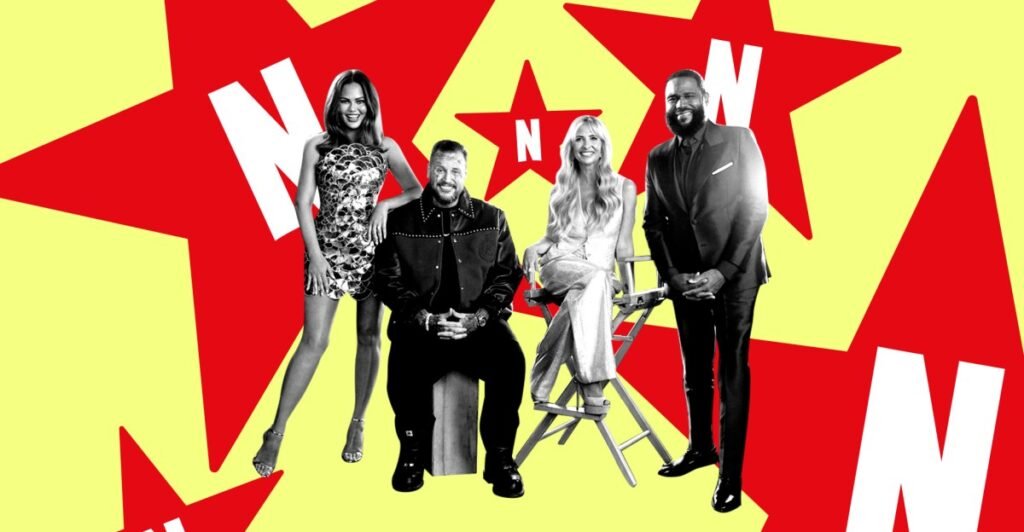
There were, of course, plenty of things to work on. The three celebrity judges — Sarah Michelle Gellar, Jelly Roll, and Chrissy Teigen — were all far too nice to the contestants, even when they gave them bad scores. They also all talked way too much. The sound mixing, particularly on the groups, didn’t always actually mix. At one point, Anderson was visibly confused by the teleprompter, which was instructing him to look in three different places for three different scoring numbers. There were some solid performances, but no obvious stars, and a couple of genuine stinkers. Mostly, the whole thing took too long. This supposedly 60-minute show lasted 90. Still, the voting worked, the stream stayed live, and the whole room seemed to exhale as the confetti fell and the lights turned off.
This was just the first night. There were seven more to do in the next four weeks, plus a grand finale episode on February 17th. Judging from the early reactions, Star Search wasn’t quite a cultural phenomenon yet, but Friedman says he knows even Netflix can’t create a hit all at once. “We do this for five weeks and hopefully it builds, and hopefully the excitement builds, and we get to the end and there’ll be one champion — and hopefully you discover the next somebody.” Everybody studiously avoids jinxing the next season, because Netflix is famous for canceling and forgetting about projects it deems not to be working. But it’s clear the company hopes this was the first night of many in this studio.
Just as we’re all filing out, heading back into a mild LA evening, Dukas the emcee booms back out over the audience telling everyone to take their seats. “Okay!” he says. “We’re going to do the show again in Spanish, and then we’ll get you out of here.”
You may be interested
Tehran producer Dana Eden found dead in Athens hotel room while filming new season | Ents & Arts News
new admin - Feb 16, 2026The executive producer of hit TV spy thriller Tehran has been found dead in an Athens hotel, police have said.Dana…

Samsung ad confirms rumors of a useful S26 ‘privacy display’
new admin - Feb 16, 2026Samsung has released a new advertisement for its upcoming Galaxy S26 launch that all-but confirms rumors of a new display…

Morrisons makes major update to save you £20 in February
new admin - Feb 16, 2026Shoppers at Morrisons holding a Blue Light Card can look forward to a 10% discount in-store when they spend £40…