


Rethinking Support for First-Gen Sophomores

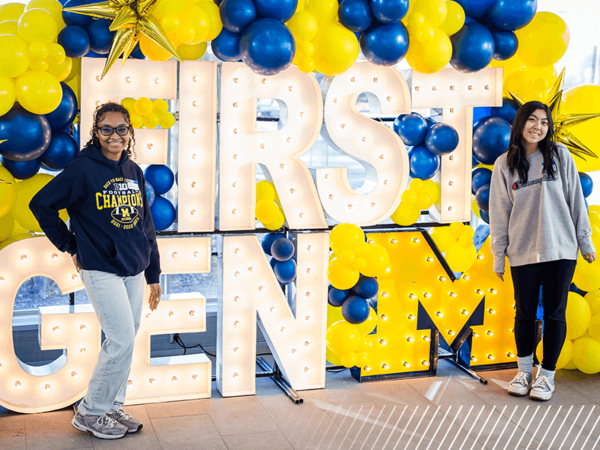
First-generation students can face a range of challenges in college, from financial barriers and feelings of isolation to navigating complex university systems without the guidance of family members who have done so before. Colleges often address those barriers through dedicated programs that provide first-year students with cohort-based courses, mentoring and other supports.
But that support can drop off after the first year, even as students begin making consequential decisions about their majors, careers and how they spend their time outside the classroom. The University of Michigan is betting that adding supports sophomore year can improve outcomes for first-gen students.
The university’s College of Literature, Science, and the Arts is launching LSA First Fellows, a cohort-based program designed to connect first-generation sophomores with resources, mentors and opportunities on campus. The program will officially begin in January, with applications opening this fall to all domestic first-generation sophomores in the college.
First Fellows will provide students with a one-credit course, team-based mentoring and community events, as well as $4,000 to pursue an experiential learning opportunity during the summer after their sophomore year. The funding, supported by philanthropy, will be available to every participant regardless of financial need.
LSA Dean Rosario Ceballo said the idea for First Fellows grew out of conversations with first-generation students who described a gap in support after their first year.
“When you get to college in the first year, you’re often in a residence hall, you’ve got peer mentors and advisers, all of the university clubs want you to join, everybody comes to your classes and everybody is excited,” Ceballo said.
“But when I was doing focus groups and talking to a lot of first-gen students, one of the things that they said to me at the time was ‘There’s all this support and attention in the first year,’” she added. “‘Then in sophomore year, you’re like, where did it all go?’”
How it works: First-generation students make up about 18 percent of LSA’s undergraduate population, and the college enrolls about 62 percent of all first-generation undergraduates at the University of Michigan. First Fellows is designed to bring several forms of academic, financial and social support together for first-generation sophomores.
John Vasquez, assistant vice provost for student success at the university, who will lead the program, said First Fellows builds on LSA’s existing efforts for first-generation students. Those include the Kessler Scholars Program and the Comprehensive Studies Program, which, along with First Fellows, are part of LSA First-Gen Pathways, the college’s coordinated effort to support first-generation students.
“What we’re trying to do is really create a cohesive system so that students don’t have to go look for the opportunities. They understand the opportunities are there, and we help them take advantage of them when it works for them,” Vasquez said. “That’s a big part, at least for me, why I’m excited and why we’re doing this. First Fellows is just the first piece of that broader ecosystem that we’re developing.”
The First Fellows program includes:
- A one-credit course. Students will learn about selecting majors and minors, finding research and internship opportunities, building financial literacy, navigating campus resources, and preparing for summer experiences and life after college.
- Team-based mentoring. Each student will be connected with a small network of faculty, staff and peers who can help them navigate the university, build relationships and identify opportunities on and off campus.
- Community-building. Fellows will participate in events with other first-generation students and have opportunities to connect with alumni and mentors.
- Summer funding. Every fellow will receive $4,000 for an experiential learning opportunity during the summer after their sophomore year. The donor-funded award can be used for research assistantships, internships, community-engaged learning, creative projects or study abroad.
Making access meaningful: Ceballo said the thinking behind First Fellows recalls the work of sociologist Vincent Tinto, who believes that access without adequate support does not necessarily create opportunity. That can be particularly relevant at a large, decentralized institution like the University of Michigan, Ceballo said, where navigating the campus can present challenges for first-generation students across backgrounds.
“It cuts across race and ethnicity, socioeconomic status, geographic location,” Ceballo said. “We have some first-gen students that come from very wealthy families. We have some first-gen students that come from rural conservative homes in Michigan. This is a very heterogeneous group of students, and one of the commonalities that they share is difficulty navigating the complexity and the size of an institution like the University of Michigan.”
“What really struck home for me is that if students don’t feel comfortable accessing those resources, if students don’t have someone who can help them go to an office, if students don’t have meaningful connections with people who can help make those resources actually feel accessible, then all the resources that we have aren’t really doing anyone any good,” she added. “It’s our responsibility to make sure that we provide them with the resources so that they can succeed, and part of that is making sure that there are people who can support them and make sure that they can access and are aware of those resources.”
Vasquez said the summer funding, in particular, is intended to remove some of the financial barriers that can prevent first-generation students from pursuing experiential learning opportunities. While first-generation students come from a range of socioeconomic backgrounds, he noted that students with fewer financial resources may not be able to afford an unpaid or lower-paying internship—or the costs associated with temporarily relocating for one.
“We have students who come from rural areas that want to do an internship, say, in New York or L.A. or in a big city, but it’s really expensive for them and they’ve never been there and don’t know how to navigate that process,” Vasquez said. “For them to make that investment, it’s really hard because they don’t know if it’ll work.”
The funding is not about “giving anybody an edge,” Vasquez said, but “actually allowing folks to do the things we know they can do.”
He said the timing is also intentional: Giving students an opportunity to explore an academic or career interest after sophomore year can help inform the choices they make during their final two years of college.
“Our goal is really to help students narrow down in this time frame, so that when they come back their junior year, they’re able to say, ‘Yes, I’m going to declare in bioscience, economics, history, and I’ve got a project or I’ve had some practical experience that tells me this is something I really want to do,’” Vasquez said. “It helps them figure out what they’re going to do for the next two years so they’re not behind trying to figure it out.”
Measuring success: Vasquez, who was a first-generation student at the University of Michigan himself, said First Fellows is intended to be part of a more connected support system for first-generation students.
“This is the first step in a broader initiative around first-gen [students],” Vasquez said. “Students don’t experience our program in a vacuum. They experience it as part of the college, as part of the university.”
Once the program begins early next year, Ceballo said the college will track measures including retention and graduation, participation in experiential learning, and students’ sense of belonging to assess whether First Fellows is making a difference. The college will also look at whether the program helps students make earlier, more informed curricular choices and allows them to explore their academic interests.
“Scaling that for thousands of students—that’s hard, but it’s so important,” Ceballo said. “That’s what I’m hoping that we will be able to show that we can do.”
Get more content like this directly to your inbox. Subscribe here.
You may be interested

These Republicans will not be attending the midterm convention where Trump will speak
new admin - Sep 09, 2026These Republicans will not be attending the midterm convention where Trump will speak - CBS News Watch CBS News The…

Roman's 60s mod-inspired 'lovely' £19 dress with pockets is perfect for autumn
new admin - Sep 09, 2026[ad_1] The Paisley Print Pocket Shift Stretch Dress from Roman is a versatile piece that can be worn to the…
Europe's richest country has a larger economy than UK, Portugal and Greece combined
new admin - Sep 09, 2026This country generates trillions every year. Source link