




Oil surges 15%, hitting markets as storage shortages force production cuts

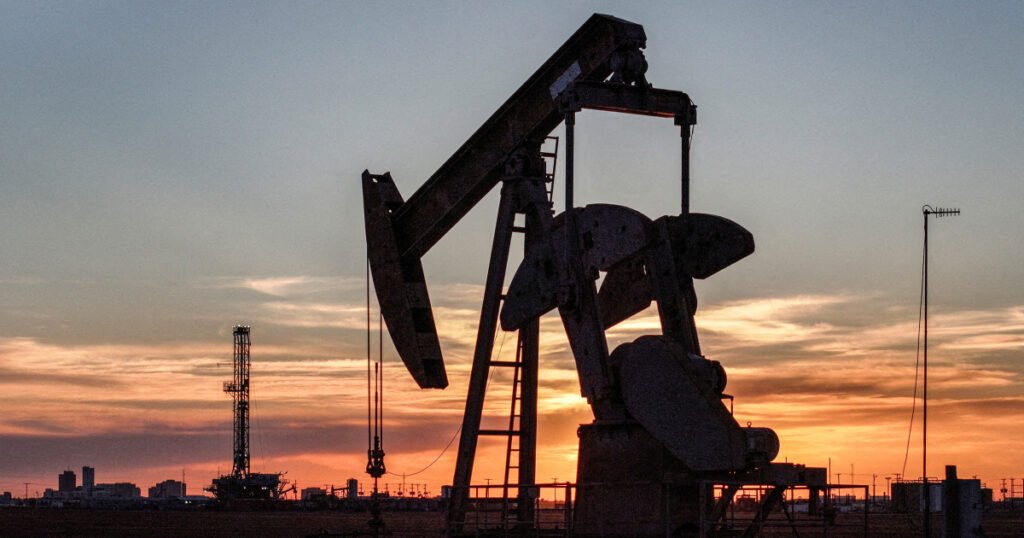
The price of oil surged more than 15% Monday, as the effects of the Iran war hit markets worldwide and stoke fresh worries about inflation.
U.S. crude oil rose 15% to more than $103 per barrel and international Brent crude oil rose 13% to more than $104 per barrel.
The price of U.S. crude oil has now risen more than 60% over the last month and more than 45% over the course of the last five days.
“The psychological level of $100 oil may just be a short-term price target on its way to higher levels as the conflict drags on, oil production is throttled back as oil storage fills up because tankers are unable to load,” oil industry expert Andy Lipow said on Sunday.
As of Monday morning, the average price of U.S. retail gasoline nationwide hit $3.46/gallon, continuing its sharp march higher. Since the war began, the average price per gallon has risen more than 50 cents, according to price-tracking service GasBuddy.
That staggering pace of increases hit stocks. S&P 500 futures dropped 1%, Nasdaq 100 futures slid 1.2% and Dow futures slid about 600 points.
In Japan, the broad Nikkei 225 recorded its worst day since April 2025’s tariff-induced selloff, tumbling 5.2%. The index also entered correction territory, which is when a stock or index falls 10% or more from its most recent record high.
South Korea’s Kospi index also tumbled 6%, and for one point was halted for 20 minutes on heavy selling. In Europe, the Stoxx 600 index slid 1.6% as markets in Germany, France, Italy, the U.K. and Spain dropped more than 1%.
Bonds also sold-off around the world. As a result, the 10-year U.S. government bond yield hit 4.17% and the 30-year bond yield hit 4.78%.
Natural gas prices jumped as well, with futures traded in New York rising about 5% and futures traded in Europe soaring nearly 20%.
G-7 finance ministers will hold a video conference on Monday at 8:30 a.m. ET, according to France’s finance ministry, which currently holds the rotating G-7 presidency. The ministers, which will include U.S. Treasury Secretary Scott Bessent, will discuss a potential joint release of oil reserves in a bid to ease skyrocketing prices, according to the Financial Times.

NBC News was not able to immediately verify the report.
Multiple countries have trimmed oil output since the war started, including Kuwait, the UAE and reportedly Saudi Arabia. Aramco, Saudi Arabia’s state-run oil company, did not return requests for comment.
Those production cuts come as the Strait of Hormuz, through which more than 20% of the world’s daily oil demand flows, remains essentially closed to tankers. Ships near the Strait, off Iran’s southern coast, have reported receiving threats over radio transmissions. The U.K.’s maritime trade agency has also reported multiple attacks on or near ships in the region.
Storage has also started to reach its capacity in the region.
“With export bottlenecks unresolved and storage continuing to tighten, a further acceleration in regional supply cuts appears increasingly likely in the coming days,” commodities analysts at JPMorgan Chase wrote on Friday.
“By next Friday, we estimate that more than 4 [million barrels per day] of production will need to be curtailed.” Already, they said, about 2 million barrels per day have been cut.
So far, no country has fully shut down oil production, but analysts warn that could be next.
“If producers beyond Iraq and Kuwait are forced to curtail output, the ability to restore pre‑crisis supply quickly would become increasingly constrained,” said analysts at Societé Generale in a note to clients on Monday morning. “Time is therefore critical: the longer disruptions persist, the greater the likelihood that what initially appear to be temporary outages evolve into more durable supply losses.”
“The UAE is likely the next producer at risk of shutting in output, potentially within the next five to seven days,” they wrote. “Qatar is also vulnerable.”
All four of those countries rank among the top five oil producing countries in OPEC. Iran also makes the top five, but given U.S. sanctions, most of its oil ends up in China.
Later this week, U.S. Treasury Secretary Scott Bessent and China Vice Premier He Lifeng are planning to meet, according to multiple reports.
You may be interested
Trump visits Wisconsin as job growth reported in May
new admin - Jun 06, 2026The Bureau of Labor Statistics released the May jobs report on Friday, with numbers that were significantly higher than experts'…

Women praise trainers ‘as comfortable now as day I first put them on’
new admin - Jun 06, 2026[ad_1] Amazon has a number one bestselling pair of trainers up for grabs - and shoppers are calling them comfortable,…

Intracranial Atherosclerotic Disease (ICAD) | National Institute of Neurological Disorders and Stroke
new admin - Jun 06, 2026What is intracranial atherosclerotic disease?Intracranial atherosclerotic disease (ICAD) is one of the main causes of stroke. ICAD happens when the arteries…