


New England Accreditor Weighs In on College Closures

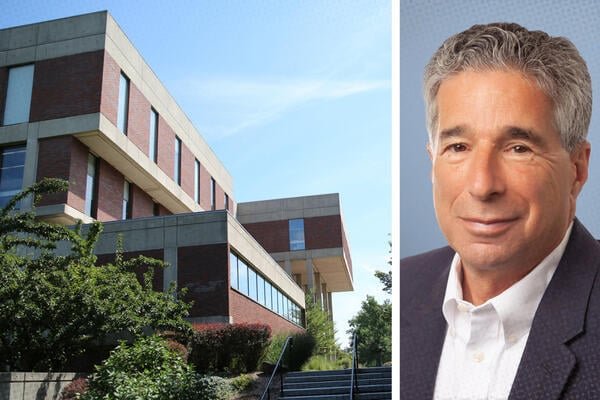
When Hampshire College and Anna Maria College said this month that they would shut down, it didn’t surprise Larry Schall, president of the New England Commission of Higher Education.
NECHE had issued public warnings about the stability of both institutions and sent private notifications to leadership at both colleges when they first showed signs of not meeting the accreditor’s financial standards. Dozens of small colleges like Anna Maria and Hampshire have closed across New England in the past two decades, and Schall expects more to follow. Yet at the same time, he believes concerns about the state of small colleges are largely overblown.
As president of Oglethorpe University in Atlanta from 2005 to 2020, Schall faced scrutiny from his accreditor over finances. But by the time Schall left, Oglethorpe had significantly increased enrollment and was operating with a budget surplus. Now at the helm of an accreditor that has seen multiple institutions close in recent years, Schall emphasizes the importance of recognizing and addressing financial challenges while colleges still have the runway to do so.
Schall spoke with Inside Higher Ed for a wide-ranging discussion of both the accreditation landscape broadly and the state of small colleges. This interview has been edited for length and clarity.
Q: I remember you once said that when you were a college president you had a dim view of accreditors. Now here you are leading NECHE. How did you go from critic to accreditor?
A: I had decided to step down for my presidency after 15 years without really knowing what I wanted to do. I was pretty sure I was going to end up staying in Atlanta, and then I got a call from a colleague of mine who was the CEO of a big university up here [about the NECHE job].
I said that would be about the last place I would think I would work. And he said, “Do me a favor, just call them, and I think you’ll find that the New England Commission is a different place.” And when I got hired in 2020, that’s how I started my interview. They asked what interested me, and I said I’ve spent 30 years not finding much value in my interactions with accreditors, and I think the New England Commission has a history of being different.
Q: Now that you are on the other side of that dynamic, what do you think critics get wrong?
A: People speak about accreditation the same way they speak about higher education, as a monolith. Higher education is not one thing, it’s many things, and we talk about accreditation like it is one thing, and it’s many things. There are lots of different accrediting agencies … and I think each of us have different ways of doing business. My commitment has been to try to make every interaction that we had with an institution feel like it’s valuable to them, as opposed to going through a process that they have to go through, which, generally, was my experience.
Q: What do you think critics get right? What do you think accreditors, broadly, could do better?
A: I think some criticism of accreditation is based on historical experience or a historical view. We continue to hear, even from officials in the Department of Education, “Why are we counting books in the library?” We haven’t counted books in the library for decades. I think it is true that at one point in our history, our focus was a lot on inputs. Over time, our focus has moved and is moving. I think some of the criticisms, that we are looking at things that don’t matter in terms of outcomes and student success, were true at some point, but we’re evolving. We’re not exactly where we need to be yet, but I think it goes a long way. There’s a criticism that accreditation is expensive. We’ve done analysis, and our cost to institutions per student per year is around $3 or $4, so we’ve become more efficient. One criticism is that we’re not responsive, that we hold up innovation. That may have been true at some point, but I don’t think it’s true anymore.
Q: I’m sure you’re closely following the Accreditation, Innovation and Modernization Committee talks at the federal level. What do you make of the Education Department’s proposals to overhaul accreditation?
A: There are parts of the proposals that we support, and then there are certainly other parts of the proposals that we don’t think are appropriate and have made that clear. And it’ll be interesting to see whether consensus is reached here. If that is possible really depends on what language the department comes back with after the first week [of negotiated rule making]. Time will tell. These are probably the most significant changes to accreditation that we’ve seen in many, many years. I think there’s an intent to remove some of the bureaucracy that gets imposed on us, which I think is a good thing. On the other hand, there’s a number of rules and regulations there, which are going to not only burden us, but our institutions.
Q: Two of your institutions—Anna Maria College and Hampshire College—announced closures recently. What do these closures say about the state of the sector, especially in the region?
A: For us, these closures are both tragic because they’ve been two very important institutions around for a long time. But also we work very closely with institutions, and their decision to close was not entirely surprising. But I do think that people read maybe too much into closures. We have over 200 institutions in New England—public and private, very highly selective, open admission, two-year and four-year. And we have seen closures in New England for decades. If you go back 26 years ago, there were almost 70 institutions in 2000 that are no longer on our roster. New England has seen its share of closures, mergers, consolidations—both on the public and private side—and I think that will continue. The demographics of New England haven’t been positive for decades, and they’re not going to be positive for the next couple of decades, so that puts pressure on all of our institutions. And I think COVID-19 accelerated the trend.
We’ve seen this trend of closures and mergers and acquisitions consolidations for decades, and it has accelerated of late, and I don’t see that slowing down. On the other hand, the vast majority of our schools are healthy and will survive and continue to produce terrific graduates.
Q: What makes you think it’s not slowing down? What other pressures are institutions facing?
A: I’d also say that there are policies being put into place that have increased the pressure on institutions. We have a number of institutions that had significant portions of international students, and they’ve lost some or even most of them, depending on the institution. We also have changes with regard to financial aid, to Pell Grants, which, I think, will result in fewer people being able to access both undergraduate and graduate programs. And you have the new rules that were in the Big Beautiful Bill that pose these, I think, very rigid and in some cases inappropriate requirements of programs to ensure that their graduates within four years of graduating show return on investment. And that’s not a problem for certain disciplines—pharmacy, medicine, things like that—but we have a lot of schools that are offering really important programs in the arts and education where showing return on investment so quickly is going to be difficult. So I think that’s another thing that’s putting pressure on schools.
Q: You say you believe the demise of small colleges is overstated. Why is that?
A: Generally, the schools you see close are small colleges. I think people draw the assumption that small colleges as a group are in trouble and are going to close. Every one of these cases is a different matter; the reasons that Hampshire didn’t make it are different from the reasons that Anna Maria didn’t make it. But New England has dozens and dozens of healthy small colleges that aren’t going anywhere. I think the strength of American higher education has always been in the diversity of its institutions, the diversity of its missions. We are losing some of that. That’s not a good thing. But I don’t think that the small college as an institution is going away.
Q: How does NECHE identify colleges that may be at risk of closure?
A: We have a very sophisticated financial model. We screen every one of our institutions, both public and private, on an annual basis for financial health. Our model looks at 12 different metrics. If an institution falls outside a healthy range of four of the 12, they are screened into another process where they’re required to send a report … explaining it. Then the institution appears in front of a committee … that consists of about a dozen highly skilled financial experts. Then I would go meet with the institution’s president, the chair of the board, to make it clear where we think the issues are. I think it’s the most sophisticated analysis and tool that exists in terms of determining financial health. We’re rarely surprised when we see an institution in trouble, because we’ve been working with them for years.
Q: How do you help struggling institutions find their footing again, if you can?
A: We can issue a notice of concern, which is a private communication to the president and chair of the board that indicates we feel that while they still meet the standard, they’re at risk of not meeting the standard. That prompts a meeting between the board chair, the president and then often the finance committee of the board so that they’re clear that they’ve got a significant issue that they’ve got to address, so that it’s not possible for an institution to bury their head in the sand. We then have something called a notation, which is a step up from a notice. We still think the institution is in danger of not meeting a standard, but at this point, we think the public needs to know. Then, finally, we have show cause, where we require an institution to come in to show cause why we should not put them on probation or have their accreditation withdrawn.
Q: Broadly speaking, what has changed since you took the job in 2020?
A: The administration has changed. So our relationship to the Department of Education has changed. It’s always the case when a new administration comes in, you have to adjust to a new set of values and rules and regulations. The last year and a half has probably been the most significant change we’ve seen, so that’s a big deal. COVID happened. In those years when the federal government was providing funds to institutions, a lot of our institutions looked fairly healthy in 2021 and ’22, but we knew once those federal funds disappeared, that we would see an acceleration of pressure. And then every 10 years, we take a hard look at our standards. We have new standards going into effect July 1, we’re going from nine standards to five standards, and we’re going from almost 200, what we call numbered paragraphs that are the sort of details under those standards, to 60, trying to give institutions the ability to be more innovative, for us to be more flexible in terms of how we determine quality.
Also, we’re not accrediting but recognizing quality providers of [noncredit] credentials. We now recognize eight institutions. It’s a recognition by us that a degree is not the only valuable path.
You may be interested

Kylie Minogue Netflix Doc Shows Why We Can’t Get Her Out of Our Heads
new admin - Jun 05, 2026[ad_1] The world has caught Kylie fever all over again. The new Netflix documentary Kylie is more than just a…

Dodgers’ Max Muncy, Diamondbacks’ Ildemaro Vargas leave after collision
new admin - Jun 05, 2026[ad_1] NEWYou can now listen to Fox News articles! Two MLB players left a divisional matchup on Thursday night after…

New York lawmakers pass one-year ban on new data centers
new admin - Jun 05, 2026The New York State legislature passed a one-year moratorium on new large data centers, the first statewide ban of its…